It’s a magical world, Hobbes, ol' buddy…
…let’s go exploring!
Concept
American comics have followed a distinct trajectory shaped closely by U.S. history. As the country’s political and economic landscape shifted—as attention moved from one issue to another, and values developed and were reassessed—so too did the comic medium: its heroes, themes, and visual language all evolved. The 20th century, rich with events, can broadly be divided into periods, where each decade marks a new phase in the comic’s development, characterized by the traits specific to that time.
In the early 20th century, comics existed exclusively in the form of newspaper comic strips and served as light entertainment alongside news articles. The nature of a strip meant it lacked a specific target audience; the entire family could read the newspaper, spanning different generations. Comics were a highly demanded product, and by the 1930s, dedicated comic magazines began to appear. At this point, the audience started to segment and diversify. However, these magazines existed concurrently with newspapers—one did not replace the other. This is why strips remain a subject of particular interest—it intrigues us how they survived competition from full-fledged graphic novels and stories with more complex plots, and what the creators did to achieve that.
Most of all, I was interested in examining a later period when early conventions began to be reinterpreted, characters were endowed with greater psychological depth, and storylines became more inventive. Furthermore, it was important for me to analyze a specific phenomenon viewed through the lens of comics. Therefore, I chose «Calvin and Hobbes» as a unique cultural phenomenon of its time.
«Calvin and Hobbes» is a comic strip about the adventures of a six-year-old boy and his stuffed tiger, Calvin, which centers on the phenomenon of childhood. It ran from 1985 to 1995, after which the author, Bill Watterson, chose not to commercialize his characters, leaving the completed story as a complete work. Nevertheless, «Calvin and Hobbes» still maintains a substantial fanbase and is reprinted in newspapers worldwide, which speaks volumes about its enduring popularity and relevance.
What makes this comic so special? First, the universality of its target audience: at first glance, the comic might seem «childish, ” but because it originated as a newspaper strip, it was intended for the broadest possible audience, and its success proves it achieves this. Second, the wide range of issues it covers—however, what is interesting is that they all converge on one central theme: the experience of childhood. My hypothesis is that it is the image of childhood—thoughtfully constructed both visually and narratively—that allows readers of different ages and cultures to deeply connect with the work. Childhood in Calvin and Hobbes is not an abstract developmental stage, but rather a subtly felt and deeply considered experience by Bill Watterson through the main character, his surroundings, and the situations that can resonate with many people. Next, I want to explore the different aspects of this period shown in the comic and understand the artistic means the author uses to make his work so authentic and relatable to everyone.
The core of the visual material for this study will consist of illustrations and drawings by Bill Watterson. Most of them are black and white because the comic was originally published in newspapers using such limited color palettes. However, the so-called Sunday strips were printed in color, and these will also be included in the analysis. Furthermore, the covers of collections that Watterson drew as standalone illustrations will be incorporated into the work. Thus, the main visual material will be drawn from official book editions («The Essential Calvin and Hobbes, ” „The Complete Calvin and Hobbes, ” etc.) and supplemented with material from online resources. For a deeper and more meaningful analysis, various peer-reviewed articles examining different aspects of „Calvin and Hobbes“ were also reviewed. Scott McCloud’s theory will be applied to analyze the visual techniques used. The study is structured into several sections. Initially, in „Background and Influences, ” the history of the American comic will be briefly outlined to demonstrate the context in which Bill Watterson worked—how he arrived at specific images, and for what audience the comic is visually intended. Next, childhood will be explored through key aspects of the comic: „Childhood Through Imagination, ” to understand precisely how Bill Watterson organizes the space of imagination and the principles by which he constructs transitions between the real and the fantastical; „Childhood in the Adult World”—an analysis of how childhood relates to adulthood; and „Humor”—an investigation into the comic’s effectiveness within its genre, and the multifaceted nature and uniqueness of its comedic element. The study will conclude with a summary of its findings.
Background and Influences
To fully grasp a comic, it is important to understand its target audience. The impression of a «children’s» audience may stem from the stylistic choices, the child as the main protagonist, and his friend—a tiger.
John Lindermayer. New Fun, Vol. 1, p. 31. DC, 1935.
Carl Barks. Walt Disney’s Comics and Stories, No. 126. Cover. Dell Comics, 1950.
Fun on the Run. Beep Beep the Road Runner. Issue 3. Dell Comics, 1967.
In the 1930s, a tradition began forming in American comics to create stories for children set in anthropomorphic animal settings. This is evidenced by the popularity and success of «Walt Disney’s Comics and Stories,» «Looney Tunes,» and the main strips featuring Pelion and Osu from «New Fun.» However, in «Calvin and Hobbes,» Hobbes does not function as a marker for the target audience. On the contrary, based on this background, one can view it as a play with the reader: Hobbes is a living creature only for Calvin, while the adults in the comic clearly regard the boy’s adventures as a game—and the readers do as well. Younger readers will focus on the hero’s fantastic escapades and his tiger in particular, while adults will focus on the humor and other aspects, completely separating Calvin’s reality from his fantasy.
However, the stylistic approach and the child’s portrayal as the main character are largely derived from the tradition of the comic strip.
George Herriman. Krazy Kat. 1936.
Walter Kelly. Pg. 1948.
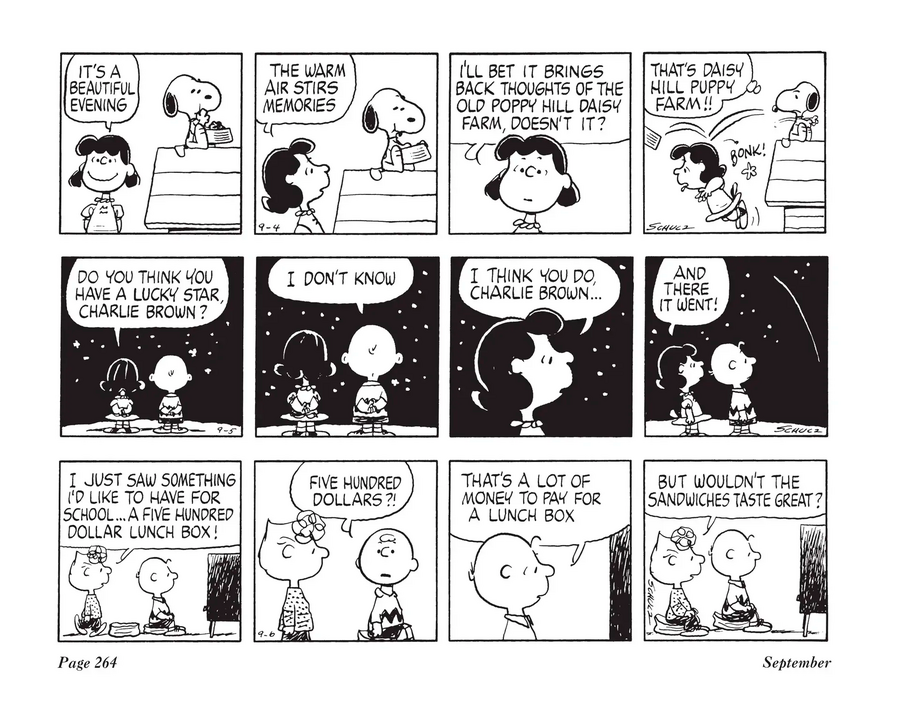
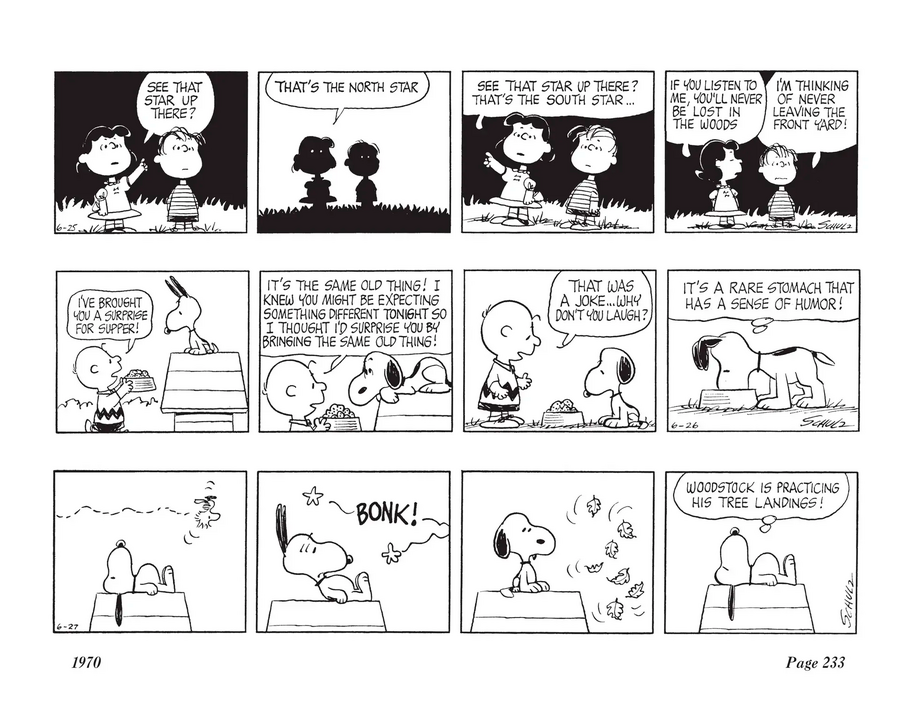
Charles Schulz. Peanuts. 1970.
Charles Schulz. Peanuts. 1971.
The constraints of the newspaper comic strip format significantly limited the authors' scope, causing many different strips to become stylistically similar in their jokes and scenarios. This is particularly evident in the similarity between «Peanuts» and «Calvin and Hobbes"—both in style, in humor type, and in the depiction of philosophical children. However, the strips differ radically in detail, with «Calvin and Hobbes» proving to be more complex and multi-layered in its portrayal of childhood experience.
As has been noted, newspaper comics cannot have a rigidly defined audience: after purchase, the newspaper lands in a «zone of ambiguity» [2], and anyone can read it. The visual style in this context relies on a specific technique that Scott McCloud calls the «iconic sign» [4]. A face, like the human figure as a whole, can be drawn realistically or schematically—and the essence remains the same regardless. Moreover, according to McCloud, it is the simplified, generalized character that most easily becomes a «mask» for the reader to identify with. Therefore, in comics aimed at a broad audience, it is natural to «iconify» the characters and make them as universal as possible. In a comic, the content and essence primarily determine the audience, and in the format of a comic strip, this content must inherently have the potential to resonate with everyone.
Thus, due to the newspaper comic strip format, which targets a broad audience, and the visual style through which readers of any age can experience the situations shown in «Calvin and Hobbes,» it is indeed a universal comic. It will now be particularly significant to examine and analyze the content, including Calvin’s imagination, which plays a key role in the strips' plots. In the next part, I will examine exactly how Bill Watterson visually organizes the space of fantasy.
Childhood Through Imagination
Bill Wolverton. Calvin and Hobbes. 1986.
Bill Waterston. Calvin and Hobbes. 1992.
Bill Waterford. Calvin and Hobbes. 1994.
Calvin’s fantasies are largely built on hyperbole, so the reader clearly perceives when the boy’s imagination «invades» reality. This is conveyed visually through a more dynamic and unconventional composition, play with lettering, and the form of the bubbles. Interestingly, we can observe what is happening through Calvin’s eyes or from an adult’s perspective. For example, in the 1986 strip, we can understand from the context of the situation that the parents, sitting calmly at the table (contrasting with Calvin in the preceding frames), fully realize that everything the son has said is made up, whereas in the 1994 strip, we see Hobbes from the mother’s point of view as a simple plush toy.
Bill Wolverton. Calvin and Hobbes. 1985.
Calvin’s imagination encompasses various aspects. For instance, in the case of Hobbs, it is object-directed. In his article, James Curtis describes this attachment as a «transitional object» [2]—an object closest to the child into which he invests his psychic energy and through which he learns to develop through play and socialize. In Calvin’s case, this is a stuffed tiger toy, which he does not merely imagine as alive but perceives as a fully real being, indistinguishable from other «real» elements of the world.