Introduction
The Qing Dynasty (1644–1912) was the last imperial dynasty of China. Its reign left a significant mark not only on the country’s political history but also on the development of court culture, art, and costume.
The clothing of the imperial court constituted a complex system of visual signifiers. Color, cut, material, embroidery, ornamentation, and headwear indicated a person’s social standing, their affiliation with the imperial family, and their place within the court hierarchy. The costume served not only to emphasize the owner’s beauty and wealth but also as an instrument for displaying power.
A distinctive feature of the Qing era was the fusion of Manchu traditions with Chinese culture. This was reflected in the silhouettes, construction of the garments, decorative motifs, and rules governing their wear.
This study examines the primary types of male and female court costumes, the specific characteristics of their construction, color symbolism, and decorative elements. Special attention is given to three members of the imperial house: Empress Cixi, Empress Lunyü, and the last emperor, Puyi. The preserved photographs allow us to view the court attire at the end of the empire’s existence and trace how the traditional image of the royal family existed on the threshold of a new era.
Navigation
Historical Context: The Qing Dynasty of Manchuria
In 1644, the Manchu armies established power over China, beginning the rule of the Qing Dynasty. This new ruling elite introduced their own sartorial traditions, which were connected to the way of life of nomadic and military peoples of Northeast Asia. Gradually, a distinct court style formed, incorporating elements of both Manchu and Chinese attire.
Unlike the looser silhouettes of some traditional Chinese garments, Manchu clothing was characterized by relatively narrow sleeves, side slits, and fastenings on the front. A distinctive feature was the sleeves with prominent cuffs, resembling the shape of a horse’s hoof. Initially, these features were related to practical riding attire and protecting hands from the cold.
Over time, these details evolved into characteristic elements of court dress. In 1759, during the reign of Emperor Qianlong, the rules of court attire were systematized. These rules dictated the permissible colors, decorative motifs, and silhouettes of garments for different ranks of court officials.
Thus, clothing became one way to consolidate the power of the new imperial dynasty. It combined the Manchu identity of the ruling dynasty with the symbolic system of Chinese imperial culture.
The Silhouette and Construction of Court Attire
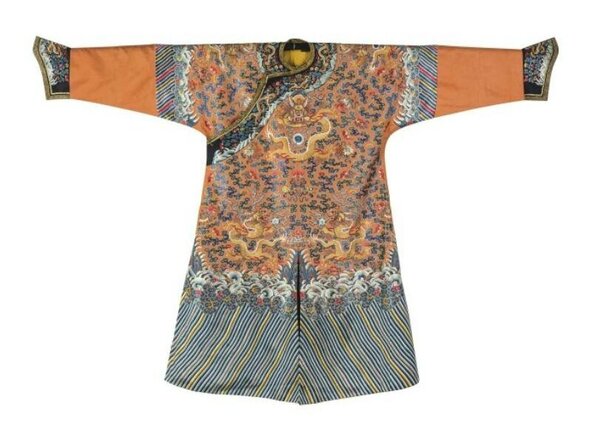
Qing Dynasty court attire was divided into several categories depending on its function and level of formality. The distinctions between these categories were determined not only by appearance but also by strict wearing regulations. One of the most formal types of clothing was the chaofu—ceremonial garments intended for major state rituals, official audiences, and other grand events. It was worn by the Emperor, members of the imperial family, and high-ranking officials.
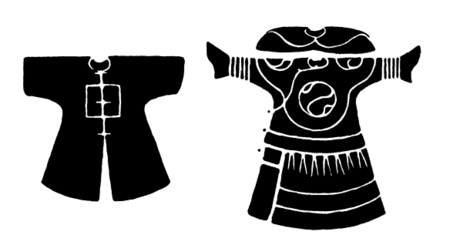
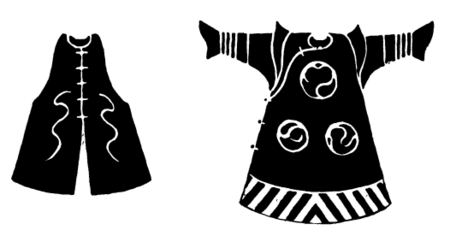
Men’s Chaofu. Sychev L.P., Sychev V.L. Chinese Costume, 1975. Women’s Chaofu. The collar shown at the top of the men’s costume is missing on the right side. Sychev L.P., Sychev V.L. Chinese Costume, 1975.
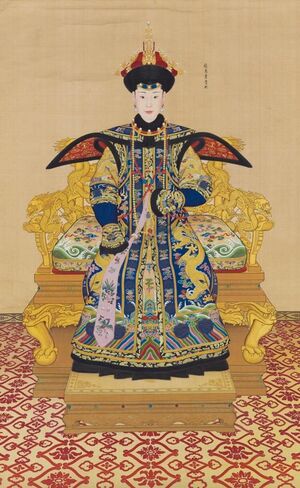
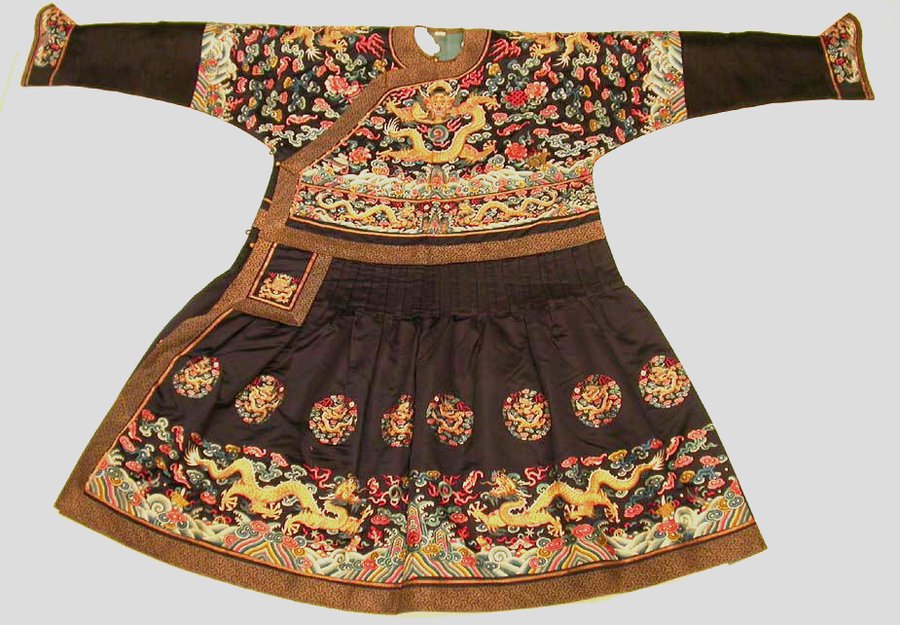
Empress Cixi in the formal robes of the Qing Dynasty. Giuseppe Castiglione. Qing Dynasty male robe (Chaofu). Second half of the 19th century.
Another category was the zhifu—ceremonial attire worn for formal events and court functions. This category included many robes featuring dragon motifs, often referred to as dragon robes.
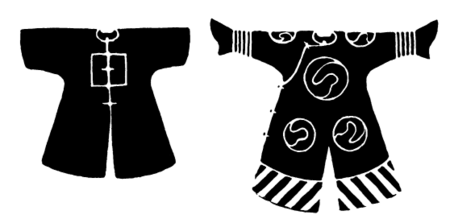
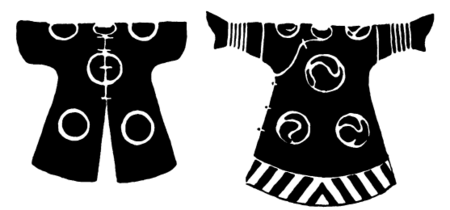
Men’s qipao. Source: Sychev L.P., Sychev V.L. Chinese Costume, 1975. Women’s qipao. Source: Sychev L.P., Sychev V.L. Chinese Costume, 1975.
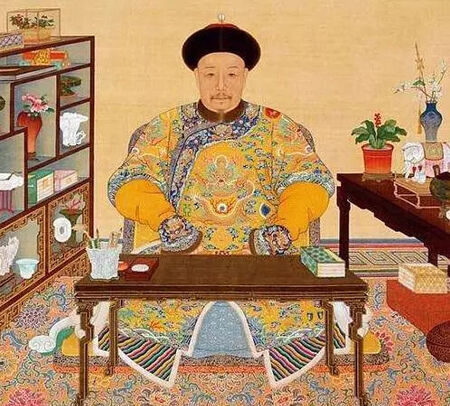
Qing Dynasty, «Emperor Jianzzun of the Qing Dynasty.» Anonymous court artist of the Qing Dynasty. Palace Museum, Beijing. Jifu, mid-19th century.
Chanfu denoted everyday wear. While it could be less formal, it still retained characteristic elements of court attire.
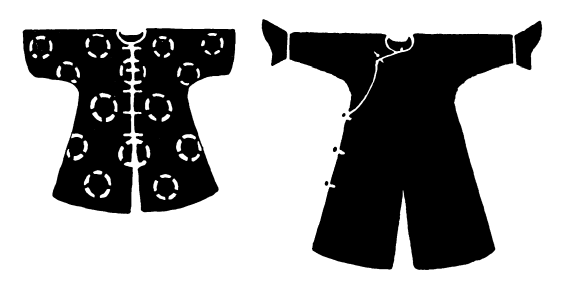
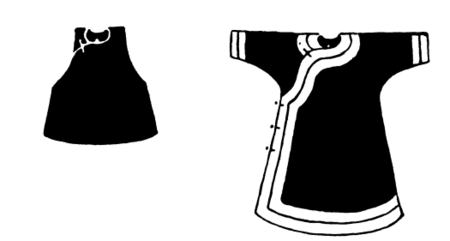
Men’s changfu. L.P. Sychev, V.L. Sychev. Chinese Costume, 1975. Women’s changfu. L.P. Sychev, V.L. Sychev. Chinese Costume, 1975.
Chaofu. National Museum of China: Exhibition of Ancient Chinese Costume Culture.
Among the primary elements of men’s and women’s clothing, one can identify long robes, upper cloaks, skirts, ceremonial headwear, belts, and decorative accessories. Layering and the combination of different fabrics played a crucial role. Women’s formal attire had its own distinct constructional features. For instance, the women’s ceremonial qipao robe was characterized by a distinctive L-shaped seam between the collar and the side closure. Surviving examples of such garments are found far less frequently than men’s, as women participated less often in official court ceremonies.
Qing Dynasty Men’s Formal Robe, 19th Century. Metropolitan Museum of Art.
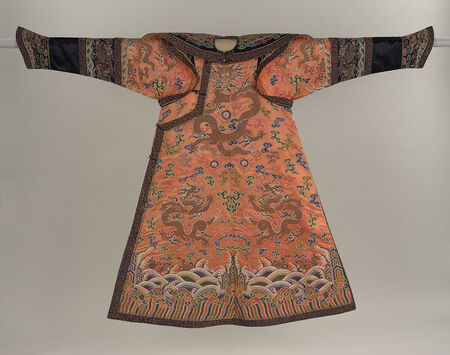
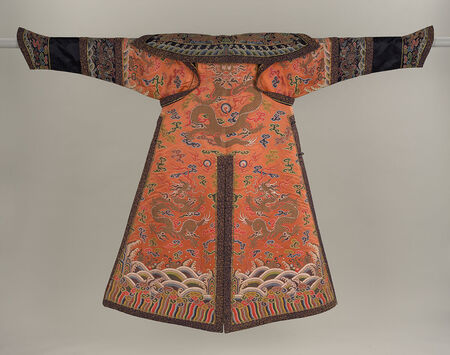
Women’s Chao Pao ceremonial robe, 18th century. Metropolitan Museum of Art.
Color as a Signifier of Status and Power
Color in Qing court attire held significant importance. It not only created a visual impression but also signified a person’s rank within the imperial hierarchy.
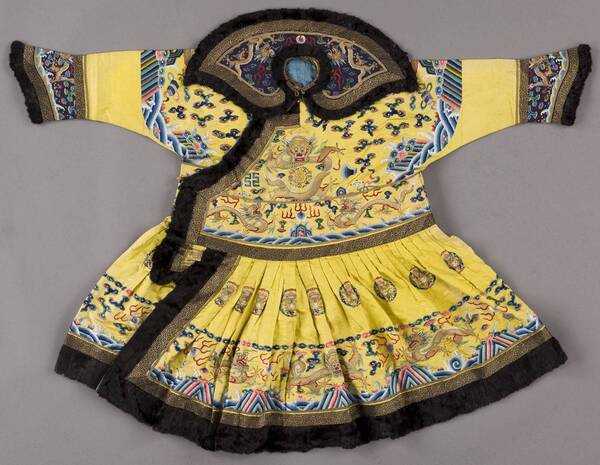
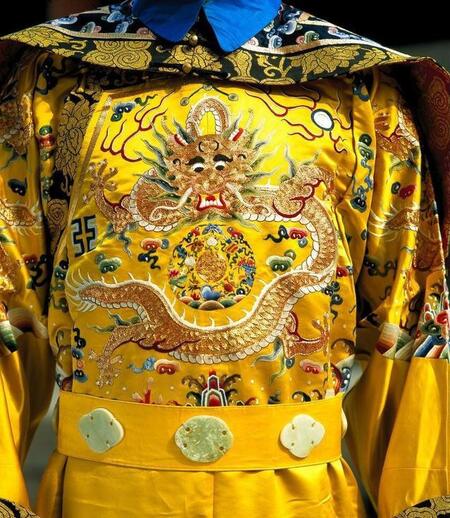
Yellow Imperial Chao-pao of the Qing Dynasty. The Emperor’s golden robe adorned with dragons.
Yellow held a special place. Bright yellow ceremonial robes could be worn by the Emperor, Empress, Dowager Empress, and certain women of high rank within the imperial household. Because there were specific rules governing this, not every yellow attire automatically signified a connection to supreme authority.
A festive imperial gown of the Qing Dynasty. Second half of the 18th century.
Other shades of yellow, including gold and orange-yellow, were also used depending on the owner’s status. Blue and dark blue garments could belong to other members of the imperial family or high-ranking officials.
Color restrictions helped maintain the visual hierarchy of the court. Even with a great diversity of fabrics and decorations, clothing remained part of a strictly organized system.
A Qing Dynasty robe crafted from cashmere, featuring golden patterns of dragons and astral motifs, intended for the Emperor’s appearances at official and ceremonial events. Late 18th — early 19th century.
This example allows us to examine the dark blue color of the fabric, the embroidery, and the placement of decorative elements. Interestingly, the color and the number of dragon claws helped determine the owner’s rank. The color did not function in isolation; rather, it worked in conjunction with other attributes: the style of clothing, the ornament, and the accessories.
Thus, court attire evolved into a visual language of power: even the placement of embroidery and the most minute ornamental details helped underscore an individual’s high status.
Pattern and Symbolism in Imperial Garments
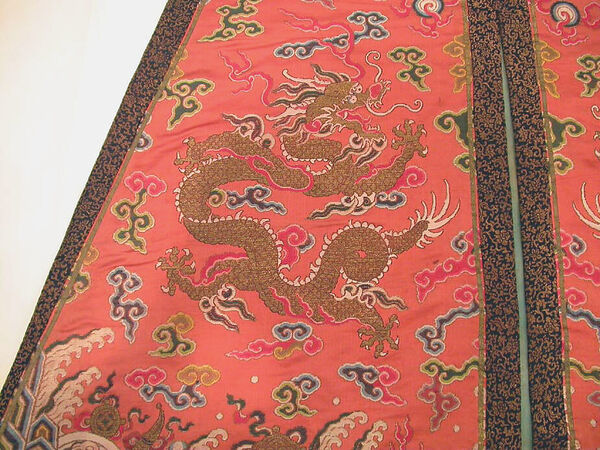
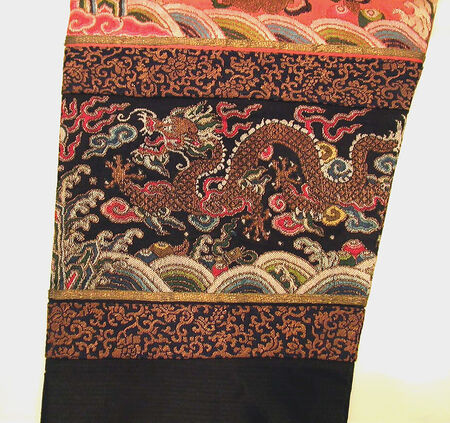
Women’s ceremonial qipao robe, 18th century. The Metropolitan Museum of Art.
Decorative embellishment of court robes was closely tied to conceptions of power, prosperity, and the order of the world. The ornaments were not placed randomly; their composition adhered to established rules and could indicate the owner’s status.