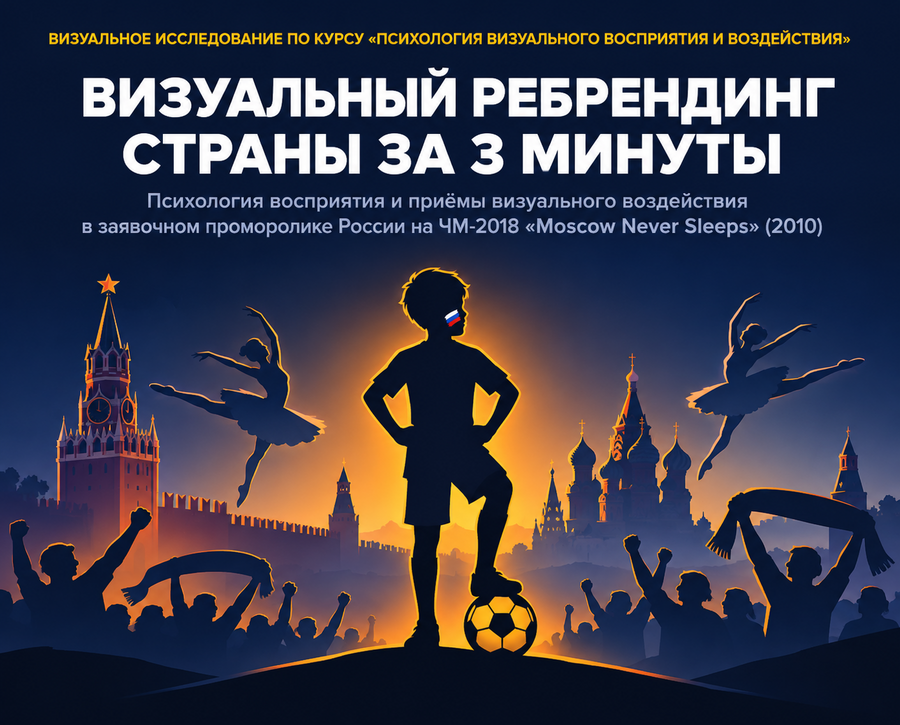
Communication Goal and Context. In December 2010, FIFA’s Executive Committee in Zurich was selecting the host country for the 2018 FIFA World Cup. The creators of Russia’s bid video faced a complex cognitive challenge: in three minutes, they needed to dismantle the ingrained Western stereotypes of Russia as a closed, cold, and gray country with underdeveloped infrastructure, replacing them with the image of a modern, open, and emotionally charged nation.
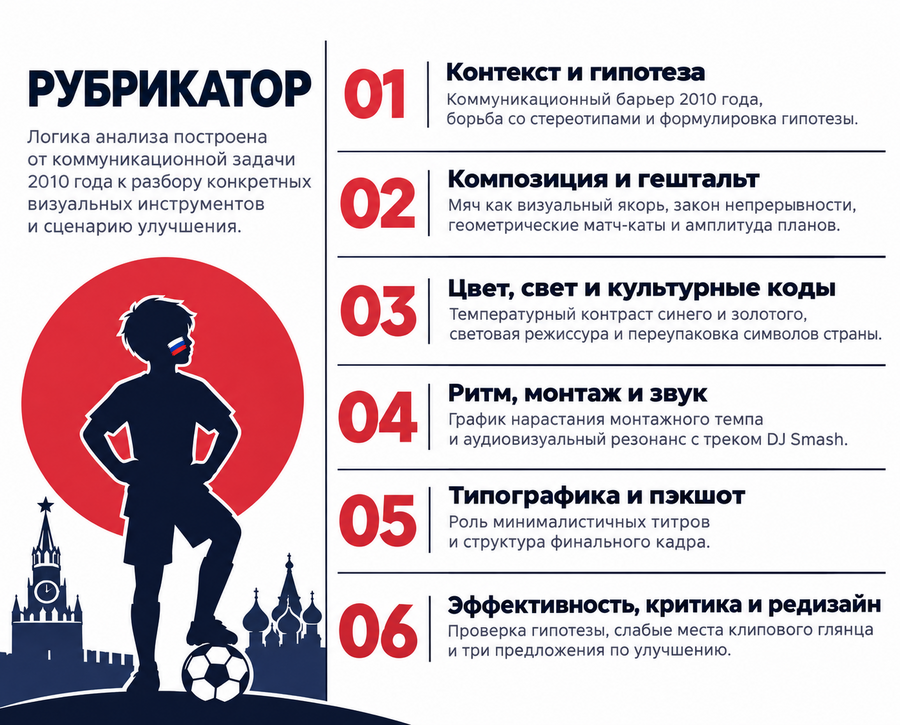
Research Problem. In mass communication, directly refuting stereotypes («it’s not cold here, we have good roads») triggers a defensive reaction and distrust. The video creators abandoned voiceover text and rational argumentation, shifting the entire burden of persuasion to the plane of visual and audiovisual impact.
The viewer does not feel the pressure of propaganda because conclusions are not dictated to them in words—the brain independently «reads» a new reality through direct visual images of energy, warmth, and openness.
As part of this research, we deliberately eschew a chronological recounting of the events shown. The video is examined as an engineering system for managing the viewer’s perception. Each selected still frame is dissected from the perspective of visual psychology: how the entry point of the gaze is structured, how color and light contrast function, and what emotional response the editing splice provokes.
In the early 2010s, FIFA was an extremely conservative, bureaucratized corporation with rigid diplomatic protocol, closed-door meetings, and an academic visual presentation. Against the backdrop of dry official regulations, the Russian film operated on the principle of emotional contrast: instead of presenting graphs of stadium construction or budget figures, it shifted the conversation from the realm of business reports to the realm of the universal human dream—a dream against which bureaucratic skepticism is powerless.
The video opens (00:02) and closes (02:46) in the same location—a warm children’s room where a boy sleeps, hugging a soccer ball. In the psychology of perception, a circular composition functions as a mechanism of psychological safety: the country’s massive bid to host the World Cup is presented not as an official government report, but as a sincere child’s dream. Direct eye contact in the finale (02:46) enhances empathy and solidifies the feeling of openness.
According to the Gestalt law of good continuation, the human eye tends to unify disparate scenes into a single process if a common vector of motion and a stable visual marker are maintained across them. The hero’s bright red T-shirt and the contrasting ball function as a color and geometric cursor: against the backdrop of wooden houses (00:12), yellow desert sands (00:32), or the metal roof of a train (00:42), the viewer’s gaze instantly locates the point of focus in the first fractions of a second after the cut, without fatigue.
In the first half of the video, the camera keeps the protagonist in medium and close-up shots within intimate settings—a children’s room, a bus interior, and a dining car. At the point of dramatic turning (01:44), the protagonist walks down a narrow, dark corridor, after which the edit abruptly throws the viewer into an ultra-wide shot of a radiant stadium bowl (01:46). The sudden shift in light and the instantaneous expansion of perspective create a physiological «breath-taking» effect and convey the scale of the future tournament.
Adaptation to the Organization’s Visual Code.
The color palette of the video (deep blue, golden spotlight, and the red color of the uniform) consciously echoes the official FIFA palette and the World Cup trophy. On a subconscious level, this reduces the feeling of an «unfamiliar» space among the federation’s officials: Russia is perceived as a natural, organic venue for the planet’s premier tournament.Color Score and the Deconstruction of Climate StereotypesThe brain processes color faster than form, directly influencing emotional assessment. The main palette of the video scenes is held in a warm, golden-honey tone: morning light in a room (00:02), steppe sands (00:32), and sunset backlighting on the coast (00:50). The director deliberately excludes winter landscapes, neutralizing the dominant Western stereotype of Russia as an «eternally frozen country.»The only cool blue-cyan block appears in the scene of astronauts training underwater (00:56–01:02), where the blue serves not as an indicator of harsh climate, but as a visual code for high technology and cosmic leadership.
Reception of Unexpected Context: Repackaging Cultural Codes
To capture the attention of the discerning FIFA executive committee, the authors place the soccer ball in deliberately «non-football» environments, creating a gentle cognitive dissonance and humor.Rural Life (00:24): An elderly woman in a traditional headscarf skillfully kicks a ball, dismantling the stereotype of soccer as exclusively a youth sport.Cosmonautics (00:56): A game played in a hydrolaboratory merges the country’s primary technological symbol with sporting excitement.Classical Ballet (01:12): The appearance of a ball on the stage of the Bolshoi Theater during «Swan Lake» connects Russia’s high academic brand with a democratic street game.
Musical Crescendo and the Psychological Role of the Pause Before the Drop
The editing dynamics are dictated by the musical dramaturgy of DJ Smash’s club track «Moscow Never Sleeps» and are structured across four phases:
0:00–0:48 | Exposition: A moderate rhythm of cuts introduces the viewer to the geography and the protagonist.0:48–1:34 | Festival Peak (1:22): As the boy appears on the open-air stage, the frequency of montage cuts sharply increases, matching the driving house beat. The audio-visual syncretism disarms rational skepticism and evokes emotional contagion.1:36–1:40 | Athletic Impulse: Ultra-short cuts from real matches (wrestling, jumps, splashes) heighten the adrenaline level.1:42–2:36 | Suspense Before the Penalty: Before the decisive shot, the clip’s pace abruptly shifts to a tense pause and extreme close-ups of Andrey Arshavin’s gaze (2:06) and the boy’s gaze (2:08). By the law of contrast, this deceleration multiplies the emotional release at the moment of the goal (2:38).