Research Concept
Text and image are traditionally perceived as two independent modes of information delivery. The image usually shows, while the text names, explains, or supplements what is seen. However, this division often becomes arbitrary because the lettering itself can carry semantic weight as distinct elements within the artwork. In such cases, writing ceases to be solely a means of communication; instead, it becomes a line, a texture, a rhythm, a color spot, or a way of organizing space, thereby acquiring its own visual functions. Sometimes, the viewer first perceives the text as a graphic element and only afterward attempts to read it.
In the works of self-taught artists, writing often acquires the qualities of pictorial material. Moreover, inscriptions do not necessarily lose their original meaning; they can simultaneously retain the ability to convey a message while fulfilling a decorative or compositional function.
American Outsider Art presents a particularly fascinating subject for studying this phenomenon. Many artists who worked outside the established academic art system developed individual methods of representation, unguided by conventional ideas about painting, graphics, or typography. Their visual language was shaped by personal experience, religious beliefs, everyday environment, and the need to record their own perceptions of the world around them. Consequently, the use of text in their works often transcends traditional writing and gains an autonomous artistic significance.
Main hypothesis: in American outsider art, text often transcends its communicative function and becomes an independent tool for visual organization.
Analyzing works allows us to identify the artistic techniques by which writing acquires visual qualities, and to trace how the perception of text changes when its exclusively communicative function is lost.The Research Question is to answer: Where is the boundary between writing and image, and can text be perceived as an independent graphic form regardless of the ability to read its content?
Material Selection Principles and Categorization
This study examines the works of American outsider artists, including: Sister Gertrude Morgan, Howard Finster, Mary T. Smith, Chelo González Amézcua, J. B. Murry, and Jesse Howard. Their pieces demonstrate various ways in which text and imagery interact—from religious pronouncements and filling the pictorial surface to decorative lettering, individualized sign systems, and autonomous textual composition.
The research materials are structured chronologically and divided into four thematic blocks:
I. Text as a means of filling space. II. Text as ornament. III. Text as personal language. IV. Text as an independent composition.
I. Text as a Spatial Filler
One of the most striking techniques is the use of text to fill nearly the entire surface of the work. Text can be placed between figures, encircle images, occupy empty spaces on the canvas, or form continuous fields of text.In such compositions, writing becomes a method for creating visual density. Empty space is gradually reduced, and the surface transforms into a single structure composed of words, symbols, and images.
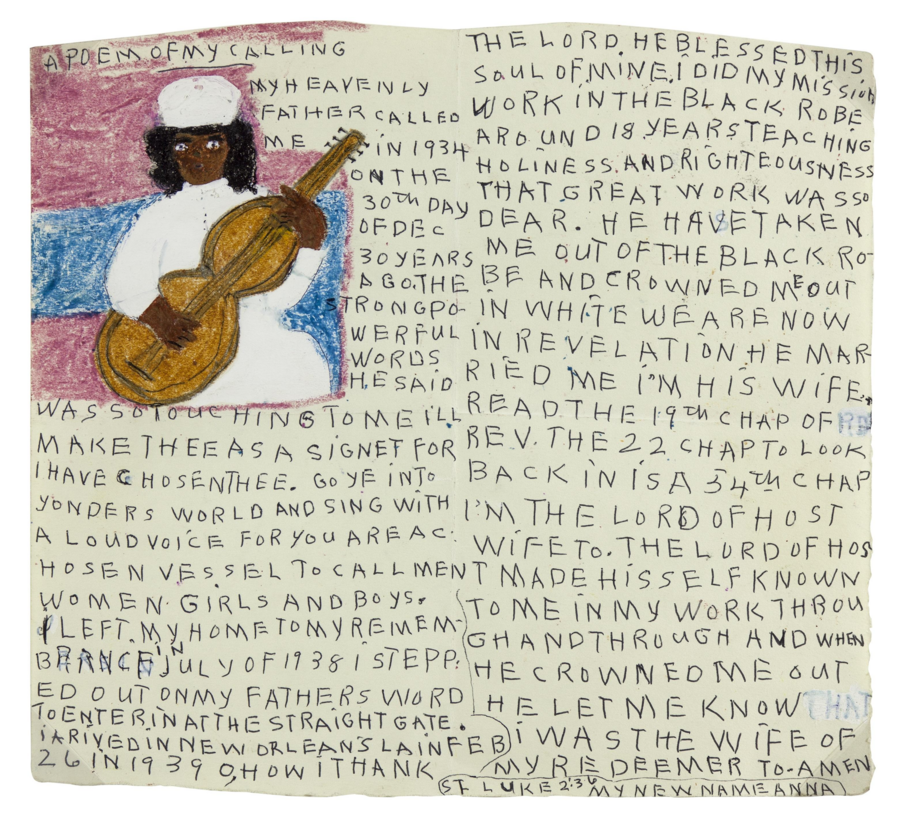
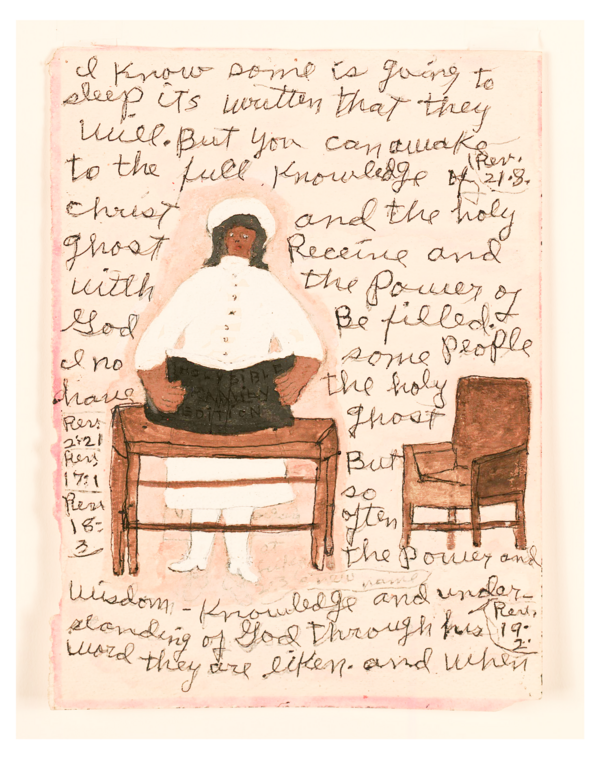
Sister Gertrude Morgan — A POEM OF MY CALLING and self-portrait
The importance lies not only in the content of what is written, but also in the amount of text, its scale, layout, and the style of handwriting. The viewer perceives the work as a whole, noticing the overall density of the surface, and only then begins to decipher individual phrases.
This principle is especially evident in the works of Sister Gertrude Morgan. In A Poem of My Calling, the image and text form a virtually inseparable whole. A small self-portrait of the artist with a musical instrument is located in the upper left corner, while the majority of the remaining surface is covered with handwritten lines.
The distinctive feature of the composition is that the text is not confined to a separate caption for the portrait, but rather forms the main body of the image. The uneven lines, the varying lengths of the phrases, and the large, handwritten letters create their own rhythm—one that is perceived almost as a graphic drawing.
Art critic Elaine Yau examines Morgan’s painting in the context of her religious activities, songs, and oral sermons, noting that the artist’s visual practice is connected to the particularities of religious performance: repetition, spontaneity, direct address to the viewer, and emotional expressiveness. Thus, the handwritten text can be perceived as an extension of spoken word, and the painting becomes a material space for the sermon, where each line captures a distinct facet of her personal spiritual experience.
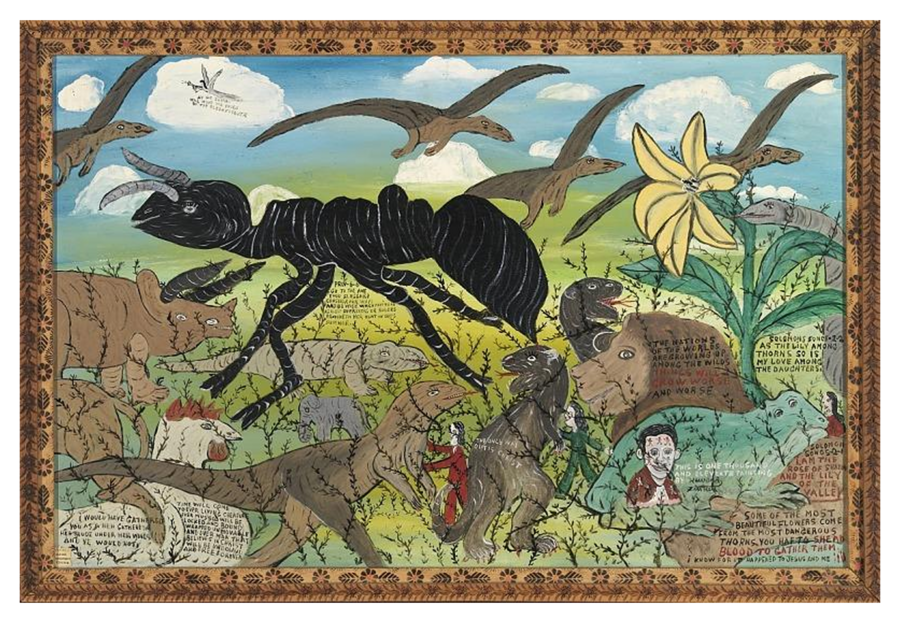
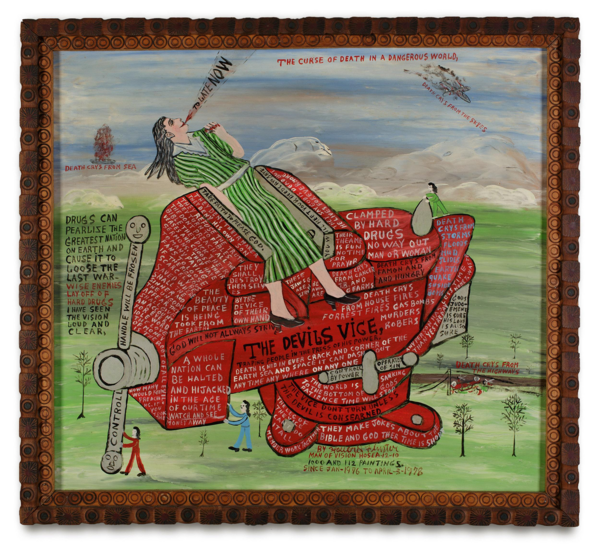
Howard Finster—"God is Love. Seek his will and find his peace he saves from sin» and «The Devil’s Vice»
A similar principle is utilized in the works of Howard Finster. He referred to his paintings as «drawn sermons.» The artist combined biblical narratives, religious symbols, portraits, and numerous inscriptions, transforming the surface of the painting into a space of continuous narrative. In his work Biblical Narrative Painting, the classification itself includes the category of textual material. This underscores the significance of text as a component of the artwork’s content. In other works, Finster created entire compositions from images and cautionary inscriptions dedicated to religious and moral themes.