Christmas in Hogwards
Introduction
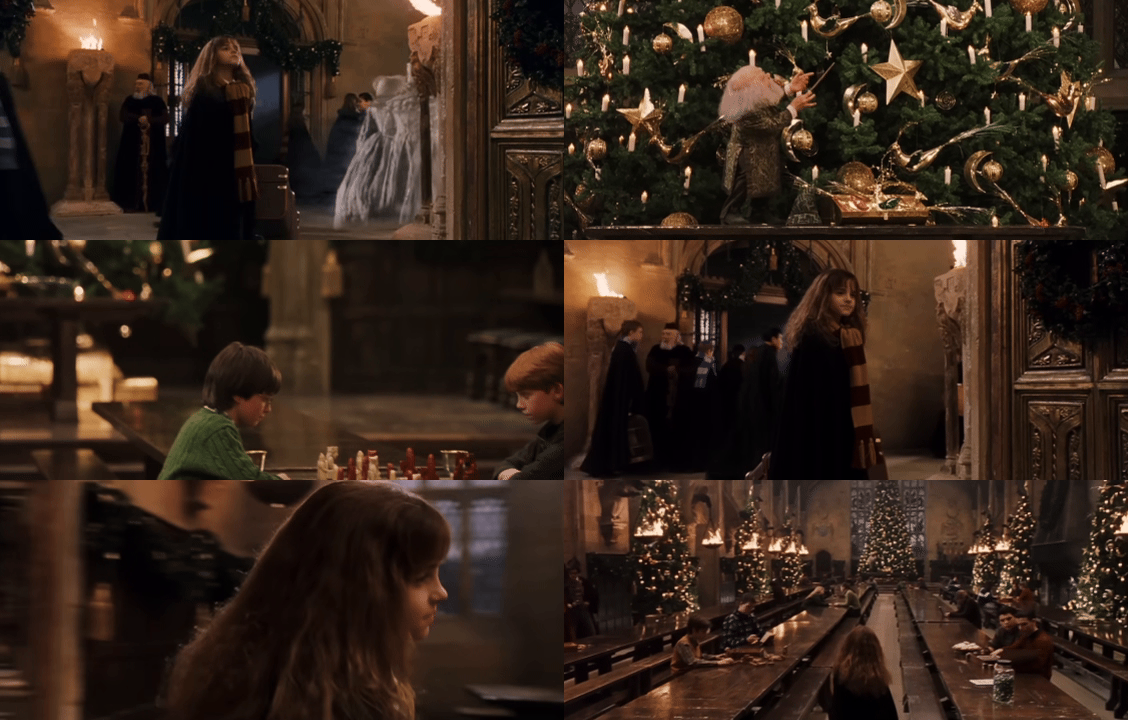
Christmas scene, Harry Potter and the Philosopher’s Stone, 2001
It’s almost winter, and we are slowly moving closer towards the holiday season—a time of year that, for many, is associated with rewatching the Harry Potter film series. This past season was no exception. While watching Harry Potter and the Half-Blood Prince, specifically the Quidditch match scene, something captured my attention. The scene was not only exciting but also visually impressive from a technical perspective. This got me curious: how was this scene actually made? More importantly, what techniques were used throughout the entire Harry Potter series to create the flying scenes—one of the most iconic elements in the franchise?
This visual research is going to answer exactly that question. It explores the different methods used to bring flying scenes to life across the Harry Potter films, from Harry Potter and the Philosopher’s Stone (2001) to Harry Potter and the Deathly Hallows — Part 2 (2011). We’re not only going to look at the visual effects used during the Quidditch games but also investigate other flying sequences throughout the series, including broomstick chases, enchanted objects, magical creatures, and characters like the Dementors. What makes this research particularly interesting is that after digging a little bit deeper, to my biggest surprise, not all of the flying effects in Harry Potter are computer-generated. In fact, a good number of them were achieved through practical, on-set effects—something that has become increasingly rare in modern blockbuster filmmaking.
Under the supervision of special effects supervisor John Richardson, who worked on all eight Harry Potter films, the series became a perfect example of blending practical and digital effects. Richardson, who has over five decades of experience in the industry, has openly stated his preference for practical effects. «My preference is obviously practical effects—that’s what I’ve done for the last 50 years or so. There’s room for both in filmmaking; the challenge is getting the right balance,» he said. This approach resulted in a seamless integration of physical rigs, wirework, puppetry, and CGI, creating a world where magic felt real and believable. It is this combination of techniques that makes the Harry Potter series a perfect subject for this research.
Harry wearing his invisibility cloak, Harry Potter and the Philosopher’s Stone, 2001
The goal of this visual research is to provide a clear look at how flying scenes in the Harry Potter films were made. The study will cover three main areas: practical effects, where objects and actors were physically suspended or manipulated on set; the use of various rigs and wire systems to simulate flight; and the use of full CGI for characters and sequences that required complete digital creation. These categories often overlap—many scenes used a combination of all three methods. However, by breaking down the process into these main techniques, we can better understand how the magic of flying was brought to life in these films.
This research will guide you through how these techniques evolved across the film series. We’ll look at early experiments with simple wirework and green screen work, the development of advanced rig systems like the Matrix rigs used in later films, and the creation of fully digital characters such as the Dementors. By analyzing specific scenes and using information from the VFX teams and crew members involved, this study aims to show both the creative vision and the technical work behind some of the most memorable flying moments in the Harry Potter series. Ultimately, this visual research shows that visual effects are more than just tools for creating spectacle—they are essential to storytelling. In Harry Potter, the ability to fly is more than just a visual effect; it represents freedom, danger, courage, and magic itself. Understanding how these effects were made allows us to appreciate the work and creativity that turned a beloved book series into a cinematic phenomenon. What follows is a detailed look at the methods, challenges, and innovations that gave flight to the magic of Harry Potter.
Harry Potter and the Philosopher’s Stone, 2001
When things where actually made to fly
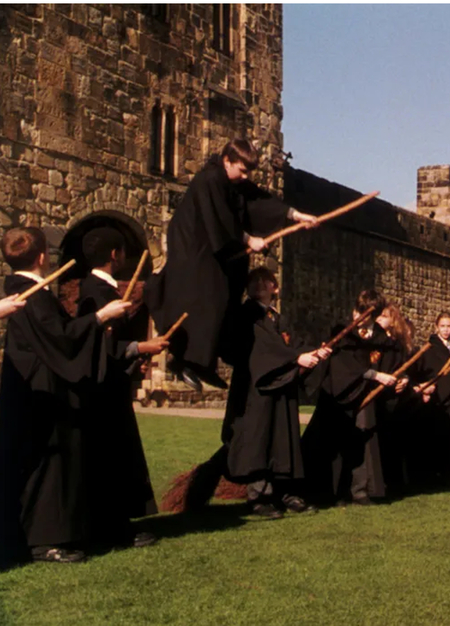
Behind the scenes, Harry Potter and the Philosopher’s Stone, 2001
At the beginning of the Harry Potter journey, in the early 2000s, the production team used a lot of physical effects on set, a more traditional take without heavily relying on computer-generated imagery (CGI). This means a lot of special effects were created physically on set; this included the use of tangible props, makeup, costumes, animatronics, and mechanical technologies.
The magical candles that were used to light the magical Great Hall were suspended physically, each one of them one by one, on the ceiling. This was done with the use of tungsten wires—metallic wires that are fire-resistant and known for having the highest melting point. However, this was not a technique that was used in all of the movies since the candles had a tendency of melting down and, as a result, flipping over, which was dangerous and not as efficient as candles that were later on made using CGI.
Candles attached to the ceiling with the wires
Harry Potter and the Philosopher’s Stone, 2001
This was not the only place where John Richardson, the special effects supervisor, opted for physical on-set special effects without overcomplicating things. We see this again when we are introduced to one of the first magic spells in the Harry Potter movie. In this scene, we see magic come to life when the students attempt to cast their first spell that allows objects to float in the air and move them around.
Hermione successfully levitates the feather using Wingardium Leviosa, making it float and move in the air as she controls it with her wand. What was happening on set was some sort of puppetry control. The feather was attached to a fishing rod, moving it around and matching the movement of Hermione’s magic wand. John Richardson said, «Doing it the simple way puts a natural feeling to things.»
John Richardson showing the fishing rode that was used to film the Wingardium Leviosa scene
Wingardium Leviosa scene, Harry Potter and the Harry Potter and the Chamber of secrets
Such a simple and a perfectly working technique was used in multiple places in the movie. One among them was the scene where Ron’s hat strings are seen to be flying, in the 3rd movie of Harry Potter.
Ron’s hat strings being pulled with a fishing rod and strings, behind the scenes
Ron’s hat strings flying, Harry Potter and the prisoner of Azkaban, 2004
Making small and light candles fly by actually suspending them on set might sound like nothing crazy, but you might be surprised when bigger things were made to fly, like humans, let’s say. Like the time when Harry’s Aunty was sent into mid-air.
According to special effects supervisor John Richardson, «My preference is obviously practical effects—that’s what I’ve done for the last 50 years or so. There’s room for both in filmmaking; the challenge is getting the right balance.» Across the eight Harry Potter films, he noted that the team managed to achieve «a good blend of practical and CGI that fit together pretty seamlessly,» ensuring that whether it was floating candles or flying characters, the effects worked together to create movie magic.»
We all remember this memorable scene that we have at the beginning of the third movie of Harry Potter, Harry Potter and the Prisoner of Azkaban. A little bit about the scene: during a family dinner, Aunt Marge kept on speaking badly of Harry’s parents that passed away. This makes Harry Potter lose control and lose control of his magic, sending a curse on Aunt Marge. As a result, we have Aunt Marge inflating just like a balloon would.
In this scene, Nick Dudman, the supervisor of makeup effects and animatronics supervisor in this movie of Harry Potter, and his team wanted to shoot this scene specifically relying on practical effects only. A group of around 20 people worked on building a complex inflatable costume that was made out of multiple layers of prosthetics, rubber chambers covering both the body and the face of Aunt Marge. The costume was so big that it ended up weighing almost 23kg. In this scene, CGI was used only to remove the strings that the actress was attached to.