Concept
Arkhip Ivanovich Kuindzhi, a distinguished Russian landscape painter of the 19th century, left an indelible mark on art history with his captivating and atmospheric canvases. His friends called him the «profound Greek» because a primary characteristic of Kuindzhi was his propensity for deep reflection. «Uncompromising when his artistic convictions were at stake, brimming with vital energy, authoritative, never deviating from his set course—and yet tender-hearted, benevolent, gentle toward people and animals, especially the suffering, always ready to aid another’s sorrow…» [2]. In his work, Kuindzhi skillfully combined realism and symbolism, creating pieces that simultaneously depicted the physical world while conveying spiritual and metaphysical experiences.
Arkhip Ivanovich painted magnificent landscapes that were not merely depictions of nature but often collective images reflecting important thoughts and ideas for the artist. «Kuyindzhi’s love for nature was somewhat peculiar, reaching a level of sentimentality: he was afraid to step on the grass, accidentally crush a beetle or ant crawling on the path, etc.» [1, p. 66]. His paintings are deeper than they might initially appear. Arkhip Ivanovich’s landscapes invite viewers not only to admire the beauty of nature but also to reflect on more profound questions of life. Kuyindzhi aroused surprise in people because he used incredibly vibrant and saturated colors, imbuing his paintings with intensity and emotional depth. The public found his works mystical, thinking he used spotlights in the studio, but the entire effect of the works was achieved solely through the effort and skill of a talented artist who was especially adept at working with color.
Куindzhi’s paintings are often permeated with symbolism and mysticism. My objective in approaching this topic is to study the various visual elements employed by Arkhip Ivanovich, and through them, to reveal hidden meanings and interpretations. In this work, I will draw upon Kuindzhi’s creations from different periods of his life to fully immerse myself in the artist’s world—to decipher the significance of the symbols and mystical elements, identify the central themes of the canvases, and understand the reflections he invited his viewers to consider and the message he wished to convey. The research will be structured around several key aspects: first, the symbols of nature in Arkhip Ivanovich’s landscapes; second, the mystical motifs; and third, the spiritual dimension of the paintings. Each thesis will be examined in detail, allowing for the uncovering of the meanings Kuindzhi embedded in his works, a deeper understanding of his creativity, inner world, and experiences, and offering a reinterpretation of the artist’s work from a new perspective.
Symbols
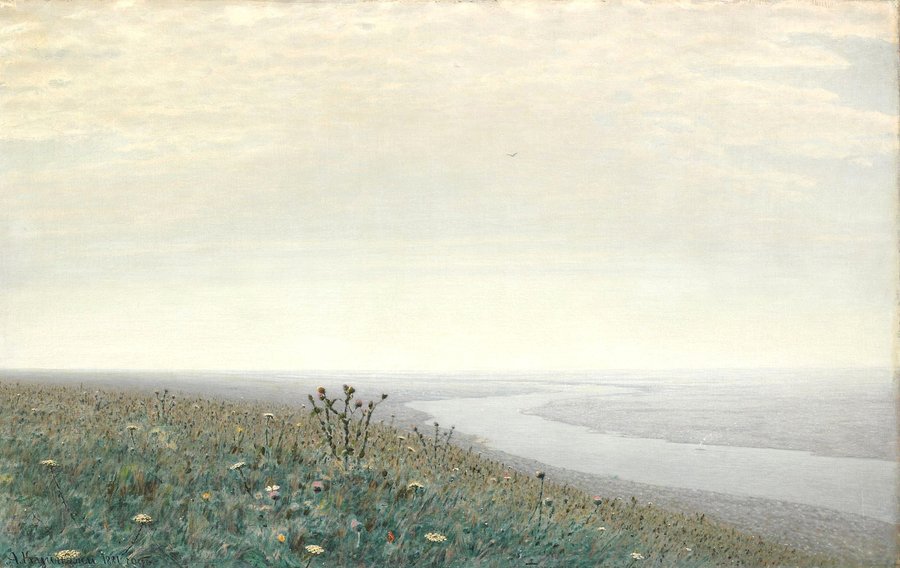
Arkhip Ivanovich Kuindzhi, «The Dnieper in the Morning, ” 1881
Arkhip Ivanovich Kuindzhi, «The North,» 1879
Arkhip Ivanovich Kuindzhi, «Landscape. Steppe, ” c. 1890–1895
Arkhip Ivanovich Kuindzhi, «Noon. A Herd in the Steppe,» c. 1890–1895
Arkhip Ivanovich Kuindzhi, «Cloud, ” c. 1898–1908
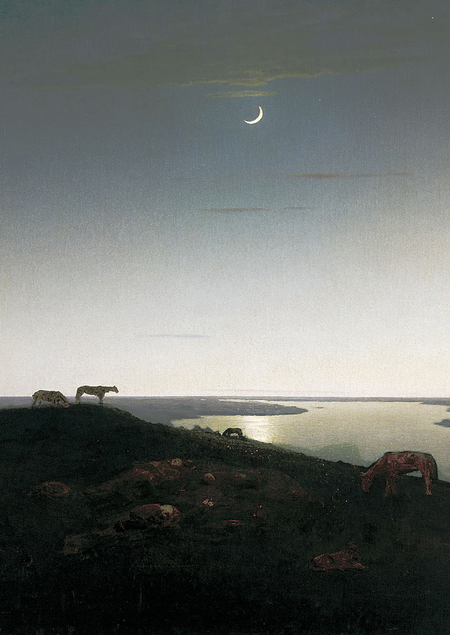
Kuyndzhi translates his worldview through the prism of imagery, employing natural elements to convey meaning and ideas. This is expressed, for instance, in the depiction of the sky as a symbol of eternity, spirituality, and the ineffable divine. Arkhip Ivanovich Kuyndzhi works with emptiness—sometimes rendering only the middle and distant grounds, leaving the foreground untouched—to draw the viewer’s attention to the most significant elements. The boundless expanse and the mutable nature of the sky evoke a sense of awe and humility. It is portrayed as immeasurable and unattainable, prompting contemplation on questions of faith and existence. The clouds in Kuyndzhi’s works are often painted as dynamic and changing, emphasizing the transient nature of time and life. They can symbolize ephemerality, transitional states, or spiritual development.
Archip Ivanovich Kuindzhi, «Red Sunset, ” circa 1900
Arkhip Ivanovich Kuindzhi, «Sunset with Trees,» c. 1870–1890
Arkhip Ivanovich Kuindzhi, «Sunset in the Steppe by the Sea, ” c. 1900
In the paintings of the artist, the sun is often depicted as a source of light and warmth, dispelling darkness and uncertainty. It is associated with hope, new beginnings, enlightenment, universal harmony, and serves as the source of life and energy on Earth. Occasionally, Kuindzhi renders the sun as a static point—something mysterious and unattainable—symbolizing a divine presence, a higher power, and infinity.
Arkhip Ivanovich Kuindzhi, «Oaks, ” 1900–1905
Arkhip Ivanovich Kuindzhi, «The Tree, ” c. 1890–1895 / Arkhip Ivanovich Kuindzhi, „The Oak, ” c. 1898–1908 / Arkhip Ivanovich Kuindzhi, „The Forest, ” c. 1890
Arkhip Ivanovich Kuindzhi, «On Valaam Island,» 1873
Arkhip Ivanovich Kuindzhi, «Pine, ” 1878 / Arkhip Ivanovich Kuindzhi, „At Valaam, ” circa 1870 / Arkhip Ivanovich Kuindzhi, „Pine, ” circa 1898–1908
In the paintings of Arkhip Ivanovich Kuindzhi, the trees embody strength and resilience. They frequently occupy a central place in the compositions. Majestic trunks and sprawling canopies create an impression of monumentality and a connection between earth and sky. Furthermore, the trees can also symbolize solitude, much like the bird that often appears on the canvas.
Arkhip Ivanovich Kuindzhi, «The Sea. Crimea,» circa 1890
Arkhip Ivanovich Kuindzhi, «Dnieper, ” 1901 / Arkhip Ivanovich Kuindzhi, „Dnieper, ” circa 1900
Thistle grew in the areas where Kuindzhi lived, which is why it appeared in many of his paintings. This plant symbolizes hermitage. In the peak of his career, Arkhip Ivanovich moved away, living far from everyone and seeing no one, so the theme of solitude plays a major role in his work. The thistle is also an emblem of perseverance, resilience, and overcoming difficulties.
Arkhip Ivanovich Kuindzhi, «The Sea,» c. 1875–1879
Arkhip Ivanovich Kuindzhi, «Fishing in the Black Sea,» 1900
Arkhip Ivanovich Kuindzhi, «Waves, ” c. 1860
Arkhip Ivanovich Kuindzhi, «The Sea, ” circa 1898–1908
Arkhip Ivanovich Kuindzhi, «Volga,» 1905–1908
Water is another crucial element in Quinberg’s paintings. Its calm, reflective surface creates an illusion of infinity and depth, inviting viewers to contemplate the mysteries hidden beneath its surface, or prompting self-reflection and contemplation of their inner world. Water can also symbolize purity, renewal, and rebirth. The depiction of churning waves symbolizes energy, vital force, and its continuous flow—nature’s capacity for both creation and destruction.
Arkhip Ivanovich Kuindzhi, «Ai-Petri. Crimea,» circa 1890