Categorization
Concept
- The Ideal Body of the Renaissance
- Anatomy as the Artist’s Tool
- The Male Form
- The Female Form
- Conclusion
concept
The human body held a special place in the art of the Renaissance. Artists studied anatomy, proportion, and movement, striving to convey the ideal beauty of humanity. One of the leading masters of this period was Michelangelo Buonarroti, whose works are distinguished by expressive musculature, complex poses, and monumental figures.In his works, Michelangelo often depicted female bodies with developed musculature and a powerful physique that resembled the male form. This raises a question: was the artist striving for a singular ideal of the human body, regardless of the character’s gender?The research hypothesis suggests that the similarity between male and female figures may have stemmed from Michelangelo’s pursuit of a universal ideal of anatomical expressiveness. His interest in studying the human body—including through dissections and working from life models—may have influenced the portrayal of female figures. It is hypothesized that plasticity, musculature, physical strength, and the complexity of movement were particularly important to the artist, rather than merely traditional notions of male and female appearance.The study will examine Michelangelo’s male and female figures, comparing their proportions, body structure, and the characteristics of movement conveyance. This will allow us to test the hypothesis and determine whether the artist genuinely employed a shared artistic principle when representing both genders.
The Ideal Form of the Renaissance Era
«By sculpture, I mean what is created by subtracting the excess.»
The Renaissance ushered in a renewed focus on humanity and the physical body. Artists turned to ancient art, studying anatomy and proportion with the aim of conveying the harmony of the human form. Beauty was increasingly perceived not merely as external perfection, but as a combination of correct proportion, expressiveness, and physical strength.
Ancient sculpture became a crucial reference point for Renaissance masters. However, artists did not simply copy the ancient models; they reinterpreted them, forging their own visions of the ideal human being. This is evident in Michelangelo’s work through his particular attention to musculature, volume, and complex bodily movements.
Michelangelo. «David» 1501–1504
An example of how Michelangelo reinterpreted the ideal male physique: emphasizing musculature, tension, and the figure’s expressiveness.
Anatomy as an Artist’s Tool
Michelangelo viewed the human body not merely as an external form, but as a complex system of muscles, volumes, and movements. He meticulously studied anatomy, made sketches from life, and sought ways to convey the body’s tension through the positioning of the shoulders, the rotation of the torso, and the function of the muscles.
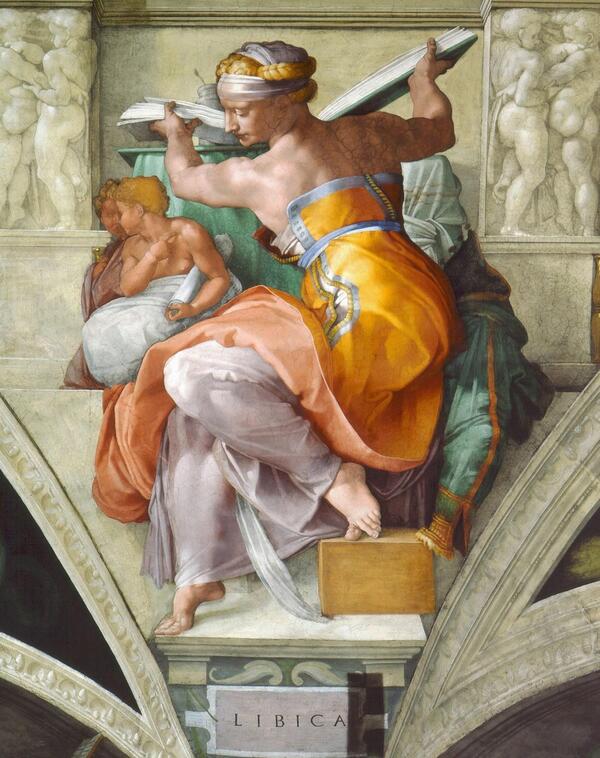
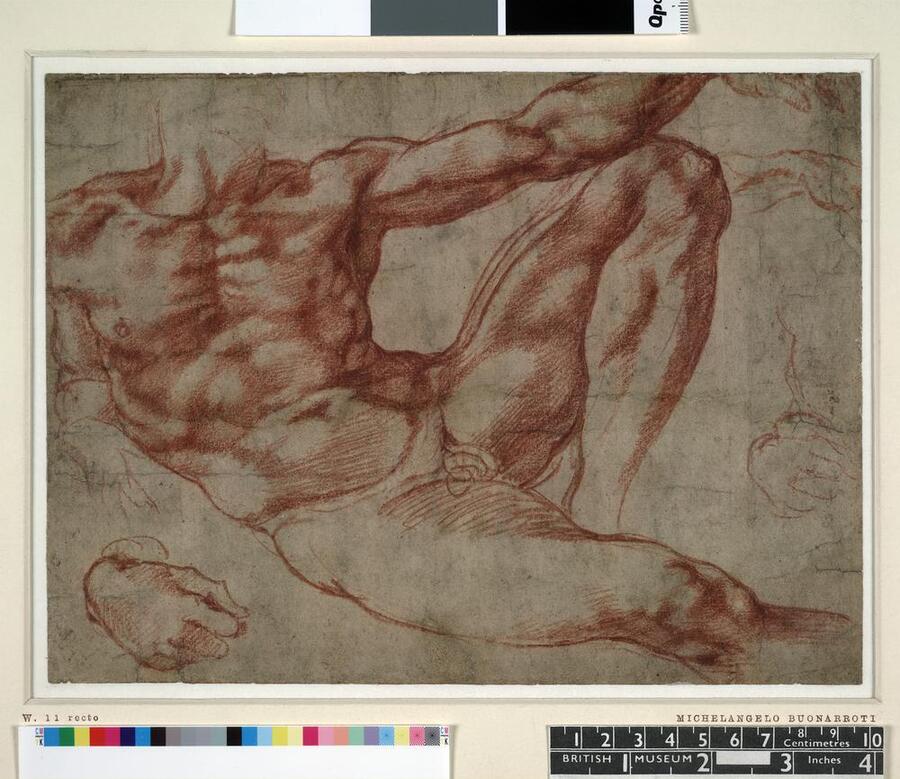
Particularly illustrative is the preliminary drawing for the fresco «The Libyan Sibyl» on the ceiling of the Sistine Chapel. It depicts a muscular figure seen from the back, with raised arms and an expansive torso. According to the Metropolitan Museum of Art, the artist used a male model for the anatomical study of the figure, which later became the image of a prophetess.
Studies after Michelangelo’s «Sibyl in Libya» (c. 1510–1511)
Before creating the fresco, the artist studied the human form. He paid close attention to the posture of the torso, the muscles of the back, shoulders, and arms.
Researching the history of anatomy in art education reveals that Michelangelo performed dissections at the Santo Spirito hospital in Florence as early as the late 15th century. His anatomical knowledge is evident in the convincing rendering of muscles and body forms.
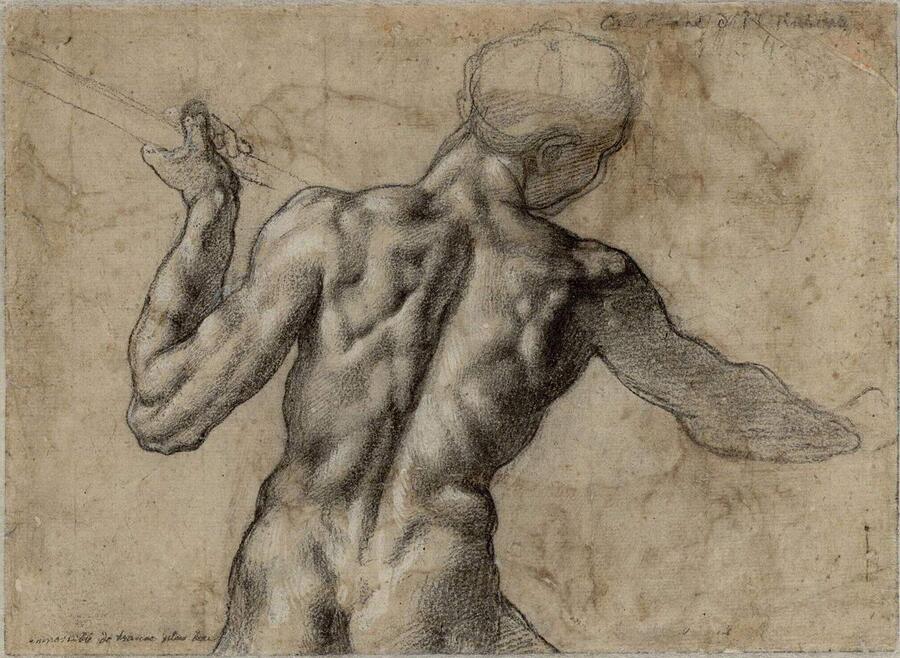
Nude Men Group
1503–1504 · Black Chalk