A poster against noise is silent, yet it must speak about sound. The artist cannot turn off a jackhammer or a car horn for a passerby, so the noise must be drawn: with lines, scale divisions, or a person covering their ears. I am comparing anti-noise campaigns from 20th-century London, New York, and Tokyo to see if there is a common aesthetic shared by these posters across different cities and decades.
Does noise-canceling poster design have its own aesthetic?
Hypothesis. There is no single cohesive style across these posters. London in the 1930s depicts noise as a sickness; New York initially frames it as a violation of civic duty, later as pollution; Tokyo portrays it as bad manners. However, certain techniques recur. Suffering is shown through a person holding their ears, loudness is depicted using a gauge or instrument, and prohibitions are softened with humor. Over time, the blame for noise shifts from the machine to the individual. I consider these repetitions to be the genre’s aesthetic.
The theme emerged from a course on sound studies. Scheffer describes industrial noise as a force that disrupts the urban soundscape and suggests learning to hear it [1, 8]. Civic leagues and city commissions addressed noise forty years prior, and the poster was their public voice. The posters show how, at different times, they decided which sounds were superfluous and who was responsible for them.
The study only included public campaigns from the 20th century commissioned by cities, civic leagues, hospitals, and transportation companies. I show advertisements for goods promising silence only once, for comparison. Factory safety posters were excluded—they served a different purpose. Three cities were chosen because we have dated posters available for each, and there is scholarly work we can reference.
The overarching framework is drawn from Karin Beisterveld’s book, Mechanical Sound, which analyzes anti-noise campaigns in Europe and North America from 1875 to 1975 [2]. For London, I rely on the work of James Mansell [6, 7]; for New York, I reference Emily Thompson’s book [10]; and for Tokyo, I cite Christoph Shimkowski’s article on style posters [9]. The course texts (Schaeffer, Hosokawa on the Walkman, Bull on personal stereo) explain why, by the end of the century, the sound represented in posters moved into headphones [1, 3, 5]. Images are sourced from museum and archival collections and from articles where they are published, with proper citation provided. The numbers in square brackets refer to the bibliography at the end.
1. How Noise Became a Public Problem
The noise of the big city was first attempted to be measured in the late 1920s. In 1928, the Daily Mail and Columbia Graphophone recorded the sounds of London streets; in 1929, New York created the Noise Abatement Commission. Subsequently, the Anti-Noise League appeared in London (1933), the anti-noise congress in Delft (1934), and Noise Week in the Netherlands (1935), while in 1941, posters were sent out to 200 American cities. The law lagged behind—the British Noise Abatement Act was not passed until 1960, and until then, the poster could only persuade. This is the source of its polite tone. [2, 4, 10]
The initial campaigns did not yield results. According to Emily Thompson, the 1929 New York commission is not considered successful [10]. Baesterveld notes that the Dutch campaigns temporarily reduced car horns, but because they were so friendly to automobiles, the overall noise level did not decrease [2]. A recording of London streets from 1928 was released on vinyl records and broadcast by the BBC [4].
Anti-Noise Conference Program (Anti-Lawaai Congres). Delft, November 8, 1934. Source: Sound & Science
Anti-Lawaai Week (Week Against Noise). Netherlands, 1935. By the mid-1930s, the fight against noise had become an international movement, and this poster stood alongside newspaper articles and radio broadcasts. Source: Sound & Science
2. London: Noise as a Sickness (1933–1960)
The Anti-Noise League was founded by Dr. Thomas Horner, and the League addressed noise in medical terms—as if it were eroding nerves. Consequently, London posters measured noise with a thermometer, like temperature, and depicted the affected person seated in a patient’s pose. In 1935, the League held an exhibition at the Museum of Science, where posters hung next to sound meters. In the 1950s, the theme returned to hospitals. Fugasa’s posters, who drew the series «Careless talk costs lives» during the war, first blamed people—chatty nurses and roommates with loud televisions. [6, 7, 11]
The 1935 exhibition was opened by Prime Minister Ramsay MacDonald, while a jackhammer with a muffler operated in the museum’s courtyard. The medical section from the exhibition plan was removed; occupational psychologists disputed the harm of noise to nerves. The scientific argument could not hold up, but its image remained on the posters. Munsell shows that the campaign was driven by a class-based «way of hearing»: silence was needed for people engaged in intellectual labor, while machines and those who operated them were noisy [6, 7].
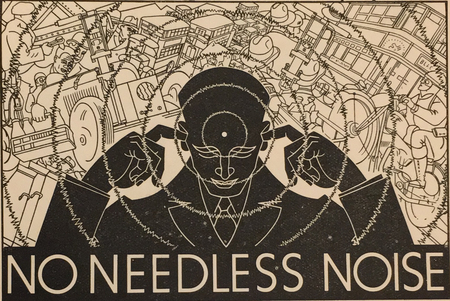
Anti-Noise League. Emblem and «No Needless Noise» poster. 1935. A person is plugging their ears, surrounded by sources of noise: the main figure of the genre, which appears in all three cities. Source: Science Museum Group Journal, Fig. 2
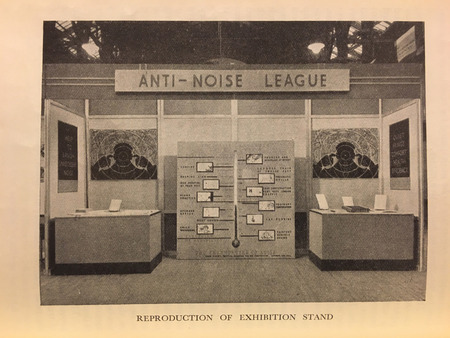
Anti-Noise League. Booth featuring a «noise thermometer.» Quiet magazine, March 1936. Volume is indicated by a thermometer: the device makes the invisible visible and hints at illness. Source: Science Museum Group Journal, Fig. 3
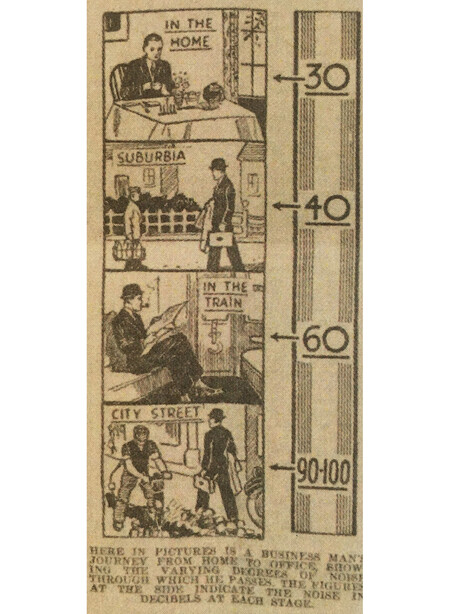
Author unknown. «The Drive Against Din.» Dundee Courier and Advertiser, 1935. Noise levels on the commute from home to the office: the city dweller’s day transformed into a chart. Source: Science Museum Group Journal, Fig. 4
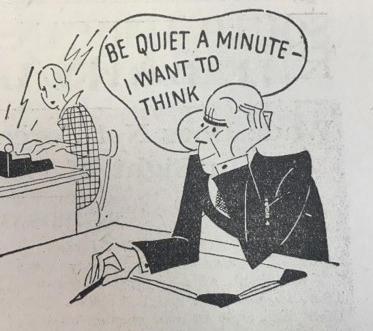
Advertisement for the Remington Noiseless typewriter. The Daily Telegraph, 1935. The only example of commercial advertising in the work: the boss buys silence, while the typist makes noise. Source: Science Museum Group Journal, Fig. 1
Overall view of the Noise Abatement exhibition. Science Museum, London, 1935. The poster hangs next to sound meters, borrowing their scientific authority. Source: Science Museum Group Journal, Fig. 5
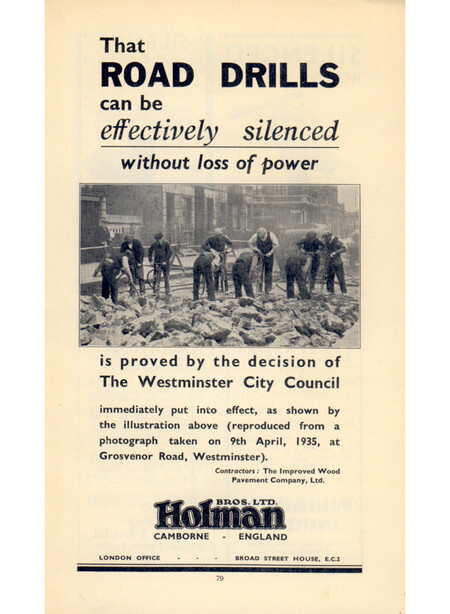
Advertisement for a Holman jackhammer with a muffler. 1935 Exhibition. Silence as a technical achievement. Source: Science Museum Group Journal, Fig. 6
Author unknown. Caricature of hospital noise. Circa 1958–1960. The National Archives, MH 146/44. A patient falls from the bed beneath a Ministry of Health poster: a caricature mocking the campaign itself. Source: The National Archives Blog
3. New York: Noise as Civic Duty and Pollution (1930s–1970s)
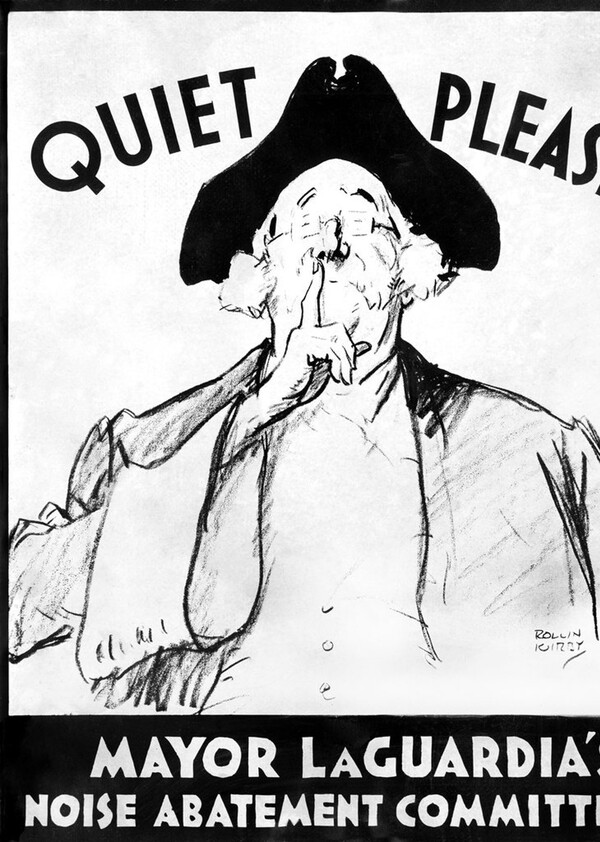
In New York, the poster addresses the city dweller as a participant in a collective effort. In the 1930s, Mayor LaGuardia declared silence a civic duty, and the poster «Quiet, Please!» politely requests it. The second wave arrived in the 1970s alongside the environmental movement. Citizens for a Quieter City placed noise on par with dirty air and water, borrowing techniques from advertising: the pun «Does your food keep you up at night?», a direct question to the viewer, and a parody of the recruitment poster «Join the Ear Force.» Later, the poster appeared in the subway, engaging directly with the passenger. [2, 10]
The organization Citizens for a Quieter City was founded by Robert Alex Barron, author of the book «The Tyranny of Noise.» In the same years, Schaefer writes about soundscapes and acoustic ecology with students, so the poster and the theory speak to the same subject [8]. The 1929 Commission released the City Noise report, where noise was described as a measurable and solvable problem [10].
Mayor LaGuardia’s Noise Control Committee. Poster: «Quiet, Please!» 1930s. Silence as a plea from authority to citizens. Source: NoiseOFF
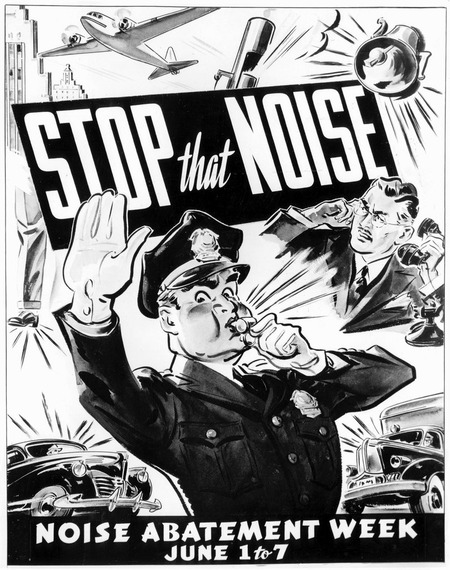
National Noise Abatement Council. Noise Abatement Week poster. June 1–7, 1941. One poster for the entire country, the date is set in large type, like an event poster. Source: NoiseOFF
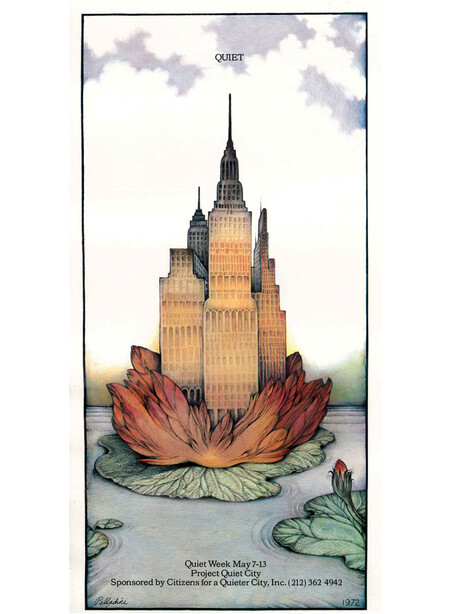
Citizens for a Quieter City. Quiet Week Poster. May 7–13, 1972. The same «week» formula thirty years later, paired with the 1941 poster. Source: NoiseOFF