PLAN: Introduction 1. Heritage Documentation — Ritual and Craft as Visual-Narrative Form. 2. «Coleção Festejo Maior» 2.2. «Napak Tilas: Bamboo» 3. Materiality and Tactility — Resisting Ocularcentrism Through Material Form. 3.2. «Reconstrucción» Conclusion
INTRODUCTION
Examining the history of the photobook through the lens of a specific region allows it to be revealed as a complex print statement in which layout, materiality, and sequence function as methods for reinterpreting the collective past and preserving collective and cultural memory.
RESEARCH QUESTION
How does the visual form of a photobook construct and convey the local historical and cultural context of a community?
HYPOTHESIS
The visual solutions of a book have the capacity to generate cultural meaning on their own—the sequence and materiality function as a curated experience that, in turn, guides the reader through the temporal and spatial dimensions of heritage.
1. Heritage Documentation—Ritual and Craft as Visual-Narrative Forms.
A photobook, in and of itself, establishes a method for reading cultural practice. If the focus of attention is directed toward specific details—the selection of shots, their sequence, captions, format, and physical medium—one can observe how these elements transform disparate evidence into a cohesive narrative. Thus, the photobook’s archive cannot be considered a neutral, isolated object; it simultaneously preserves the traces of an event and offers an interpretation of what ought to be remembered as a particular heritage.
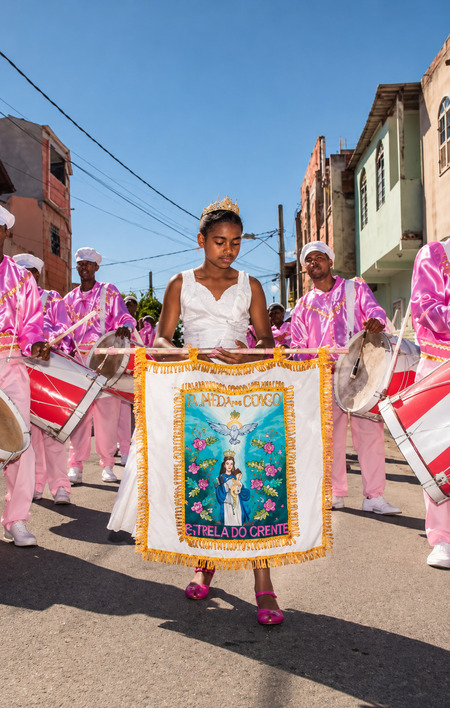
Ethnographic photobooks expand the boundaries of cultural heritage research within specific communities. For instance, the «Coleção Festejo Maior» project in Minas Gerais, Brazil, allowed designers and anthropologists to collaboratively document the rituals of Afro-Catholic Congado brotherhoods through the careful selection of binding, color palette, and typography. Such limited-run editions restore the visibility of traditional local groups and serve as a tool for intangible heritage.
2. «Coleção Festejo Maior» (Celebration Collection) Volume 1
От локального к масштабному
«Coleção Festejo Maior» — a series of six digital photobooks dedicated to the religious brotherhoods (Guardas de Congedo) of the Belém–Horizonte metropolitan area (Brazil). Each volume tells the story of a specific brotherhood, capturing its rituals, symbolism, and festive atmosphere.[2]
We will examine the first volume—"Guarda de Moçambique São Benedito do Reino de Nossa Senhora do Rosário de Prudente de Morais» (The Mozambique Guard of Saint Benedict of the Kingdom of Our Lady of the Rosary of Prudente de Morais).
The volume is organized as a progression between several aspects of the celebration. The content is divided into sections: «A Guarda» (The Guard), «O Reino» (The Realm), «Trono Coroado» (The Crowned Throne), «Bandeiras e Andores» (Banners and Processional Standards), and «Festejo Maior» (The Grand Festival).

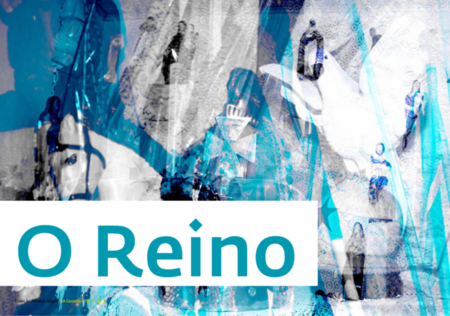
Nery, C.; Magalhães, L. Coleção Festejo Maior. Vol. 1: Guarda de Moçambique São Benedito do Reino de Nossa Senhora do Rosário de Prudente de Morais. Belo Horizonte: Author’s Edition, 2015., pp. 12–13; 22–23
The framing is reinforced by the color scheme.
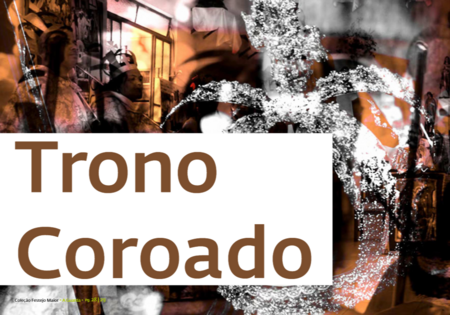
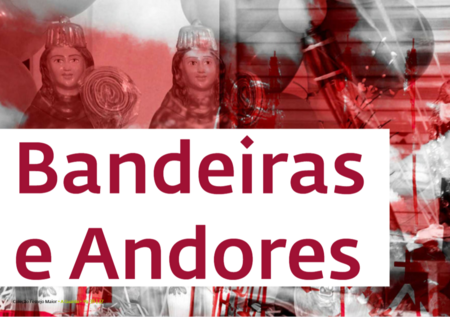
Nery, C.; Magalhães, L. Coleção Festejo Maior. Vol. 1: Guarda de Moçambique São Benedito do Reino de Nossa Senhora do Rosário de Prudente de Morais. Belo Horizonte: Editora do autor, 2015, pp. 28–29; 36–37.
Nery, C.; Magalhães, L. Coleção Festejo Maior. Vol. 1: Guarda de Moçambique São Benedito do Reino de Nossa Senhora do Rosário de Prudente de Morais. Belo Horizonte: Author’s Edition, 2015, pp. 46–47.
In the first volume of this photobook, the reader’s perception is directed primarily by the sequence of themes and sections: starting with the presentation of the Guarda—moving to the Reino, the crowned throne, banners, and palanquins—and then to the festival as a whole.
As researchers point out in the article «OS LIVROS DIGITAIS DE FOTOGRAFIA DA COLEÇÃO FESTEJO MAIOR: NEXOS POSSÍVEIS ENTRE DESIGN, ETNOGRAFIA E ANTROPOLOGIA VISUAL» (DIGITAL PHOTO ALBUMS FROM THE FESTEJO MAIOR COLLECTION: POSSIBLE CONNECTIONS BETWEEN DESIGN, ETHNOGRAPHY, AND VISUAL ANTHROPOLOGY), this division first guides the reader toward the ritual space and objects, and then toward the festival as a collective event. [1]
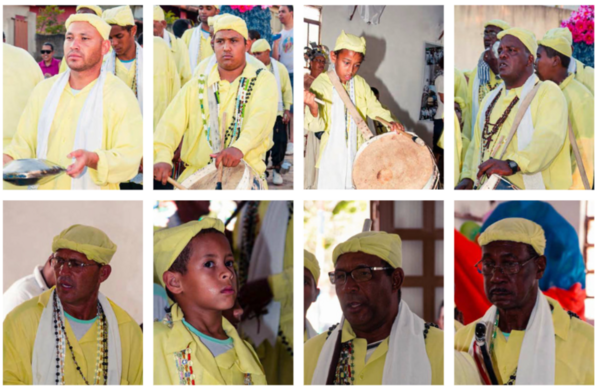
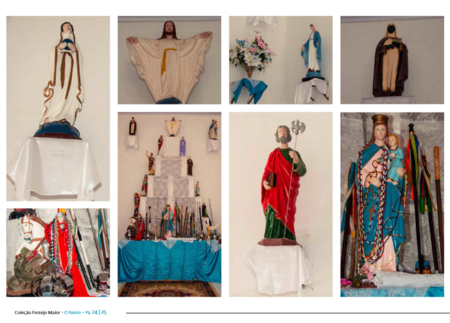
Nery, C.; Magalhães, L. Festejo Maior Collection. Vol. 1: Guarda de Moçambique São Benedito do Reino de Nossa Senhora do Rosário de Prudente de Morais. Belo Horizonte: Author’s Edition, 2015, pp. 12–13; pp. 24–25.
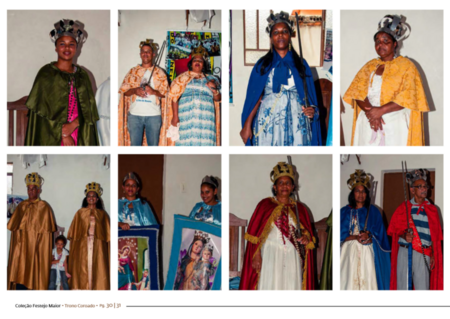
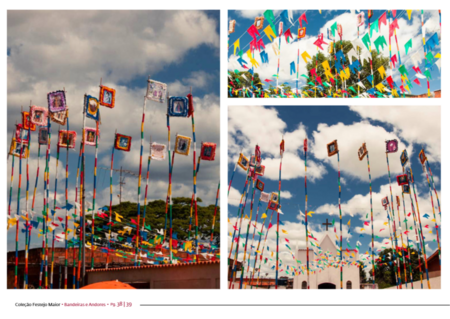
Nery, C.; Magalhães, L. Coleção Festejo Maior. Vol. 1: Guarda de Moçambique São Benedito do Reino de Nossa Senhora do Rosário de Prudente de Morais. Belo Horizonte: Author’s Edition, 2015, pp. 30–31; 38–39.
Following the sections on «Guarda» and «Reino,» the book dedicates several spreads to individual categories of ritual objects before moving on to a broader section on the festival. This technique creates a deliberate pause between familiarizing the reader with the collective and perceiving the event as a whole.
Nery, C.; Magalhães, L. Coleção Festejo Maior. Vol. 1: Guarda de Moçambique São Benedito do Reino de Nossa Senhora do Rosário de Prudente de Morais. Belo Horizonte: Author’s Edition, 2015, pp. 58–59
The article’s authors formulate the principle of the photobook as constructing a narrative through images arranged in a meaningful sequence: «imagens em sequência”—“images in sequence.» They also emphasize the necessity of connection between parts, «evitando que as partes tenham mais importância que o todo”—“avoiding that the parts are more important than the whole.» [1]
The coherence of this photobook is built primarily through its section structure: discrete groups of images are read as stages in a broader narrative about the life and celebration of Guarda. It translates ritual and craft into a visually-narrative form, establishing a unified framework for cultural memory.
1.3. «Napak Tilas: Bamboo» (Following the Trail: Bamboo)
Погружение в эпохи
«Napak Tilas: Bamboo» (Following the Trail: Bamboo) — a documentary photography book about the bamboo heritage of the Indonesian village of Ngadiprono (Dusun Ngadiprono, Kedung Regency, Temanggung Regency, Central Java). It was created by Sena and Arindra Karamoy from Nusantara Multidimensi University and will form the basis of a scholarly publication in the IKAT Journal of Gadjah Mada University in 2026.
The photobook is divided into three chapters that establish a thematic sequence: past, present, and future. This structure organizes the reading as a gradual shift in perspective on bamboo—from a material connected to history and memory, to an everyday resource, and finally, to a symbol of renewal and prospect. The authors of the article «The Photobook as a Medium for Cultural Communication: Documentary» (Photobook as a Means of Cultural Communication: Documentary Photography and Bamboo Heritage in Dusun Ngadiprono) call this sequence «a chronological journey: the past, the present, and the future”—“хронологическим путешествием: от прошлого к настоящему и будущему”—[3]
Chapter 1. «The Past”—black-and-white photographs showing the use of bamboo in traditional architecture and rituals.