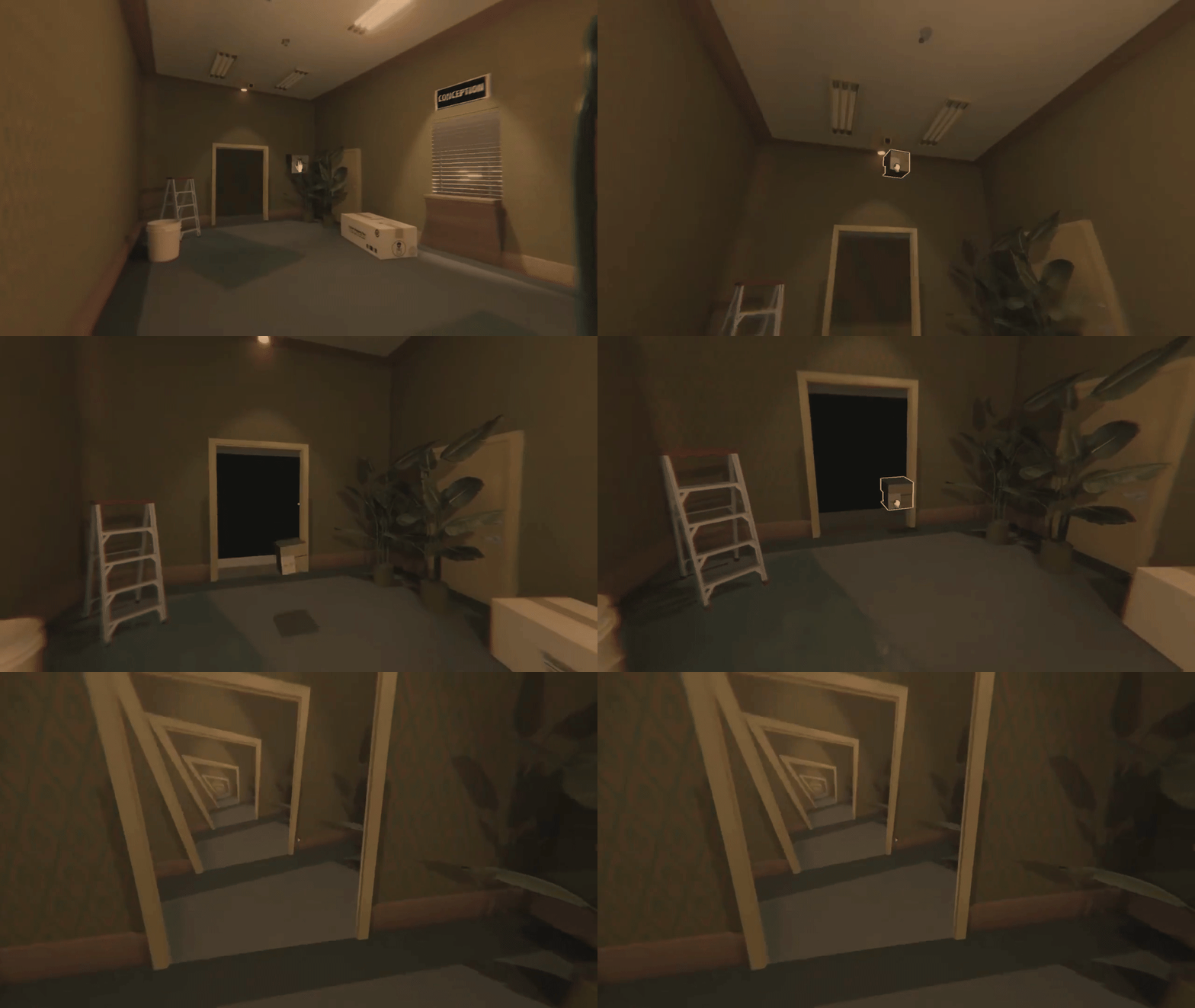
Superliminal. Whitespace.
The World Within: Recursion and the Experience of Infinity in Video Games
How is the space structured in which one can never fully leave? We will examine Portal, Superliminal, Manifold Garden, Outer Wilds, and Maquette: in these games, the image, location, or state of the world returns. The rules differ, but each allows the participant to test their position through action.
The study reveals the narratives and endings of Outer Wilds and Maquette.
Contents
Concept and Ideas — Block 4 1. Seeing Infinity — Portal — 15 2. The Object Becomes the World — Superliminal — 22 3. Moving Forward and Returning — Manifold Garden — 35 4. The World Repeats, Knowledge Changes — Outer Wilds — 41 5. The Scale of Experience — Maquette — 47 Conclusion. Infinity and the Finite Position — 55 Bibliography — 58 Image and GIF Sources — 59
Research Concept. Theme
The depiction of infinity and the experience of dwelling within it differ. A perspective corridor can be viewed from the outside. In a game, one must occupy a space, choose a direction, and test it through action. We are interested in the relationship between the structure of the visible world and the position of the agent acting within it.
The material used involves scenes where it is difficult to separate the observable object from its environment: the model incorporates an observer, movement leads back to the original point, and the repetition of time alters the meaning of the events. Infinity here is understood as the possibility of continuation without a predetermined final boundary; the recording shows only a finite fragment of this experience.
Philosophical Foundations
Oyen Fink distinguishes between the playing individual and their role, the external perspective of the viewer, and the internal perspective of the participant. He also examines image iteration: a picture within a picture and a game within a game [3]. In «Oasis of Happiness, ” play is described as a possible symbol of the world: an inwardly focused thing allows one to question the whole [2, pp. 21–22].
These concepts help us ask how the final participant relates to the world that remains inaccessible to external observation. Fink does not analyze specific video games; comparing his reasoning with in-game scenes constitutes our interpretation, which must be substantiated by observable action.
Question and Hypothesis
How do recursive space and comparable forms of return allow one to experience infinity and comprehend one’s place within the world?
Our hypothesis: return acquires philosophical meaning when the rule makes the whole or its model accessible for action, but does not permit an external vantage point using the same rule. If the repetition does not change the conditions of action or provide a definitive exit outward, the hypothesis is not confirmed for this scenario. In Maquette, the connection between spatial relationships and the alteration of past significance is further examined. The similarity of experiences does not imply the identity of the game mechanics.
Objective and Relevance
The goal is to determine under what conditions spatial or temporal return becomes a contemplation of the participant’s finitude. To achieve this, we differentiate forms of repetition, describe the action and outcome, and compare them with the rules and developers' explanations.
Developers have already discussed the enclosure of worlds, recursive scale, and the expressive potential of game spaces [8; 9; 11]. Vaisanen’s work examines the structure of the narrative world of Outer Wilds [15]. Our research connects specific visual scenes from five games to a common question: what can a participant learn about the whole while remaining inside, and where does the applicability of such a comparison end?
Method and Boundaries of Observation
We conduct a qualitative analysis of gameplay recordings, official footage, and creator schematics. In every scene, we identify the initial state, the action, and the outcome, then formulate a rule and separately propose its philosophical interpretation.
Continuous recording confirms the transition; the schematic clarifies the relationship that is difficult to perceive in real-time. Interviews communicate the intent, but they do not prove that all players reacted identically. The technical looping of a GIF does not imply a time loop within the game. We do not measure psychological effects nor do we assert the therapeutic efficacy of these scenes.
Material and Case Selection
Fink’s texts provide philosophical concepts, while NIST and MathWorld offer definitions of recursion and fractality [4; 5]. Records, official materials, and research help reconstruct scenes; image sources and fragment boundaries are provided at the end.
Five games were selected for comparison to illustrate differences: Portal separates nested perspective from closed-loop routing; Superliminal links the model to the surrounding room; Manifold Garden returns movement across world boundaries; Outer Wilds repeats states over time; and Maquette transports action across scales and connects it to memory. These latter cases are also needed to test the limits of the concept—not every return is recursive.
Recursion and the Final Image
In computer science, a recursive procedure calls itself; a base case allows the computation to terminate [4]. Therefore, recursion by itself does not equal infinite execution. In this context, spatial recursion refers to a relationship where a structure reproduces itself within its own device. This describes a visible rule, not a statement about the game’s source code.
A series of nested images can continue according to one rule, although the screen displays a finite number of discernible repetitions. In such cases, «infinity» refers to the possibility of continuation, not the number of objects displayed simultaneously.
What Not to Confuse with Recursion
Nesting implies that one element is contained within another, but it does not necessarily replicate its structure. Closure binds the boundaries of a route: movement returns the participant to a familiar place without a diminished model of the world. A time loop returns a state, not an image within an image.
Periodicity repeats the form through translation; self-similarity connects different scales. A single external resemblance is insufficient to classify an architecture as a fractal [5]. These distinctions are necessary for analyzing the action: a similar appearance does not yet explain why the player returned or what changed during that return.
Original Scheme. Return Forms.
The Player and the Internal Role
In Finka, the playing person and their role are distinguishable, even though one individual performs both [2, pp. 15–16; 3]. The game world does not become a simple extension of real space and time. Therefore, the appearance of a character within the model does not mean that the person’s room in front of the screen is literally included in the game.
We are interested in the internal position of the action. A character may see their own body from an outside perspective, but they still make the next attempt from a specific location. The external view of one’s own position is not yet equivalent to exiting the world that makes this view possible.
Image within an image
Pink views a picture within a picture as an iteration: the nested image does not become «more imaginary» because of its nesting than the original [3]. This allows for comparing levels of imagery while preserving their distinction from the viewer’s position.
In a video game, action is added to this relationship. One must check whether the nested form remains merely a view, becomes a traversable environment, and whether intervention within it affects the participant’s location. Therefore, every subsequent conclusion is based on a transition or a change in the action’s conditions, rather than solely on the similarity of two frames.
1. Seeing Infinity — Portal
The Portal connects distant sections of the camera. The view through it and the passage through it are related, yet they yield different grounds for conclusion. We will start with a standard connection in Camera 00, and then examine the fall into Camera 18: there, a nested view coexists with a route that can be traversed again.
The comparison illustrates why the protagonist’s self-viewing, the image repetition, and the body’s return cannot be considered the same event.
Portal. Camera 00.
Connecting locations does not create recursion.
In chamber 00, you can see the room and the protagonist on the other side through a portal. A location that is far away via the normal path becomes accessible in a single step. After passing through, the viewpoint changes for the same chamber.
Self-viewing here does not prove an infinite sequence: the protagonist may become the subject of their own gaze without an image within an image. The scene establishes a simpler rule—the connection of two places. Only then can you check under what conditions this transition begins to repeat the view or the route.
Portal. Camera 18.
Nested View and Closed Descent
In Chamber 18, portals on the floor and ceiling form a repeatable path: descending through the lower one leads directly above it. The length of the traveled path increases, even as the position returns. Simultaneously, the next opening is visible through the current aperture, and another one appears within it.
This presents two relationships. One can turn away and stop seeing the nested sequence while continuing to descend; this repetition of the path will not cease. The recording displays the finite number of repetitions and the achievable depth of the image. The conclusion regarding their infinite continuation pertains to the rule of the scene, not to the infinite number of calculated frames.
Author’s diagram. Portal, cameras 00 and 18.
To see yourself is not to be outside
Portal makes its own position visible: the participant sees the body and the portal to which they return. However, action must occur within the same system of connections. A viewpoint external to the body does not become an external position relative to the entire chamber.
Fink’s image iteration helps describe nested views, without discounting one of them as less valid within the game [3]. We connect the philosophical meaning to the rupture between the observability of a position and the inability to abandon the rules with a single change of perspective. In Superliminal, this relationship becomes tangible: the player can pick up a model of their own environment.
2. The Object Becomes a World — Superliminal
In Superliminal, the visible size of an object can become its new scale after release: forced perspective transforms into a game rule [7]. However, scaling an object alone does not create self-containment.
First, we examine Dollhouse: the object changes size and becomes a habitable space. Then, in Whitespace, we investigate a more profound relationship—the model’s door leads into a room that contains the model itself. This distinction allows us to differentiate between scaling and recursive connection.
Superliminal. Dollhouse.
Scaling as a control case
An inflatable castle in a pool is raised and enlarged. Its size and entrance accessibility change. This effect is immediately noticeable, but on its own, it doesn’t show that the castle contains a room inside.
This example limits our concept of recursion: a striking disruption of the familiar scale is not enough. The rule allows for an alternative way to interact with an object, without necessarily enclosing the whole inside it. To establish a different relationship, one must track where the entrance leads and what happens to the environment after interacting with the model.
Superliminal. Dollhouse.
The object becomes the environment of action
In Dollhouse, the portable house is first visible; then, the player passes through its door and finds themselves in a corridor. An object that is visible from the outside becomes a space that must be navigated from within.
The way we relate to a single form changes: from the outside, it can be rearranged; from the inside, it restricts movement and field of vision. However, the transition from object to environment does not yet prove that the interior space contains the same house. Further verification is needed for such a conclusion—a verification provided by the following scene, Whitespace.
Superliminal. Whitespace.
The door model leads to its own space.
In Whitespace, the player enters the door of a small building. A corridor with a vending machine leads into a room with a board displaying a model of this building. The continuity of passage connects the object and the surrounding room.
Here, the shift in scale is not the only important factor. The model is situated within a room, yet the space accessible through it returns the user to the room containing the model. The relationship of «outside the object» ceases to mean «outside the world it represents.» Despite this, the participant still acts from a specific vantage point rather than observing both sides simultaneously.
Superliminal. Whitespace.
Self-activation is evident through the consequences of the action.
Repeating a familiar room could inherently suggest a similar interior design. A stronger basis, however, is provided by the intervention: the model can be moved toward the room’s doorway, which alters the available path. The initial GIF of the study shows the result—a series of doors that repeat the structure of its own environment.
Now, the initial scene can be interpreted through the established connection between the model and the room. Each subsequent opening reproduces the conditions from which it is viewed. The analysis relies on the sequence «object — entrance — environment — path alteration, ” rather than merely the resemblance of the images.