Как изобразить сверхъестественное?
Гибридные существа в искусстве Месопотамии I тысячелетия до н. э.
Concept
Initially, I was drawn to the Assyrian lamassu: it has a recognizable human face, the body of a bull, and wings, yet it is neither purely human nor purely animal. The question turned out to be much broader than just a roster of unusual creatures. I became curious why some depictions were made enormous and placed at entrances, while others were repeated on walls, and a third group was transformed into small protective objects. The difference in scale and placement seems to be just as significant as the difference in anatomy.
What do I want to investigate in my research?
I will try to trace how anatomy, posture, attributes, material, and image placement help convey the supernatural. My main hypothesis is that the hybrid body is just one technique. The image’s meaning is revealed through its form and its mode of interaction with the viewer: a monumental guardian, a relief figure, and a small protective object are perceived differently. I am testing this assumption by comparing not the myths, but the observable properties of specific monuments.
How were the works selected and how were the chapters formed?
Main building — artifacts from the first millennium BCE: Neo-Assyrian lamassu and winged figures, Neo-Babylonian musḫuššu. To broaden the scope of comparison, I refer to catalogs of apotropaic figurines and amulets. These epochs cannot be considered a single artistic school. Comparison is necessary to reveal different solutions to the same problem. For each example, I distinguish between what is visible in the photograph, the museum attribution, and my own interpretation.I compare four properties of the images: body composition, posture and attributes, material, and placement. Each conclusion is tied to a specific artifact. Re-magnification of a single photograph is used only for detailed analysis. Formal similarity alone does not prove identical function.
Chapter 1. The Anatomy of the Impossible
Как соединить знакомые части в тело, которого не существует?
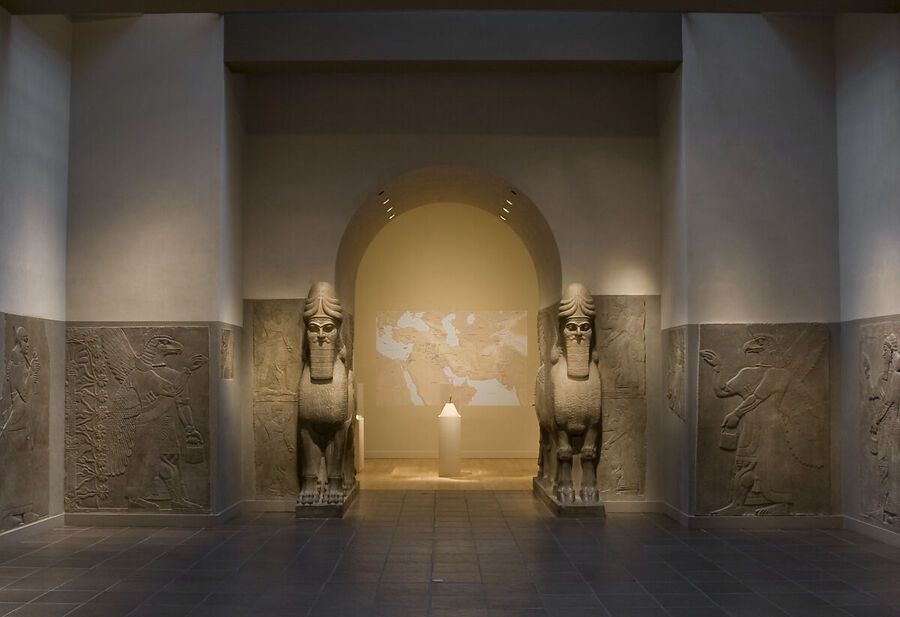
«Human-headed winged bull (lamassu),» 9th century BCE. Nimrud, Northwest Palace of Ashurnasirpal II. Metropolitan Museum of Art, inv. 32.143.1.
Recognizability and Impossibility
The human face and the powerful body of the bull are legible separately, yet they are joined without a visible break. The supernatural does not arise from abstract fantasy, but from very concrete, recognizable elements.
The wings of the lamassu are attached to the massive body of the bull or lion, yet they do not evoke the impression of flight. The figure remains stable and monumental.
By combining the strength of a terrestrial animal with the wings of a bird, the sculptor creates a creature whose potential transcends the natural world. Thus, hybrid anatomy becomes a means of expressing supernatural power.
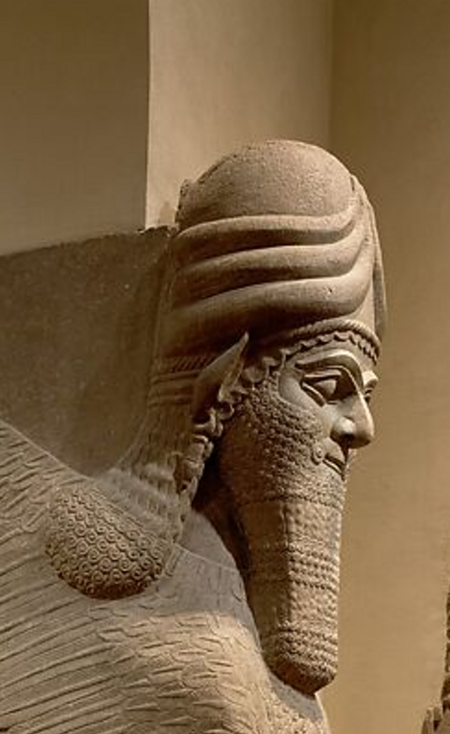
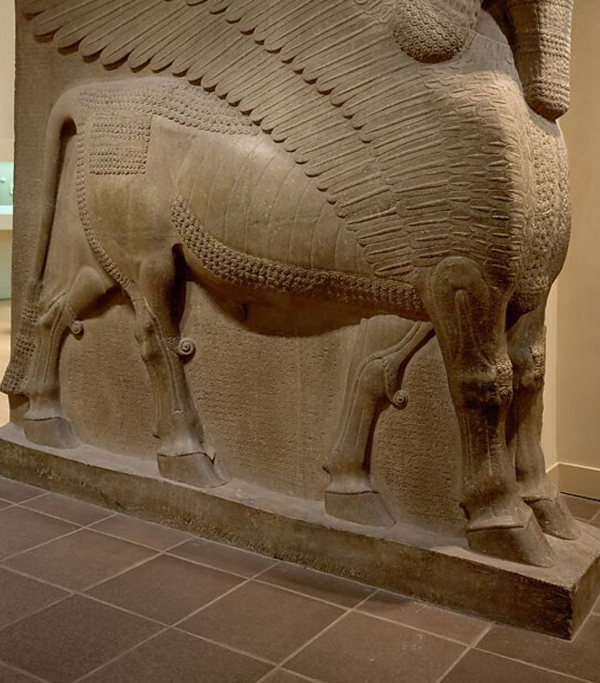
«Human-headed winged bull (lamassu), ” 9th century BCE (fragments) Nimrud, North-Western Palace of Ashurnasirpal II. Metropolitan Museum, inv. 32.143.1.
What holds the image together?
The repeating rows of feathers and the rhythm of the beard make different body parts equally decorative. The gaze glides over the ornament and perceives the hybrid as a single form.
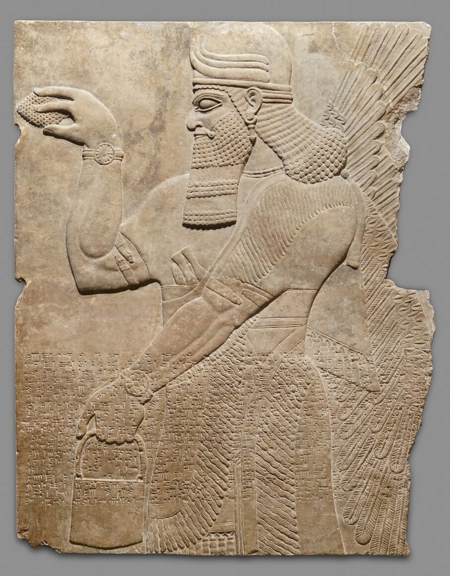
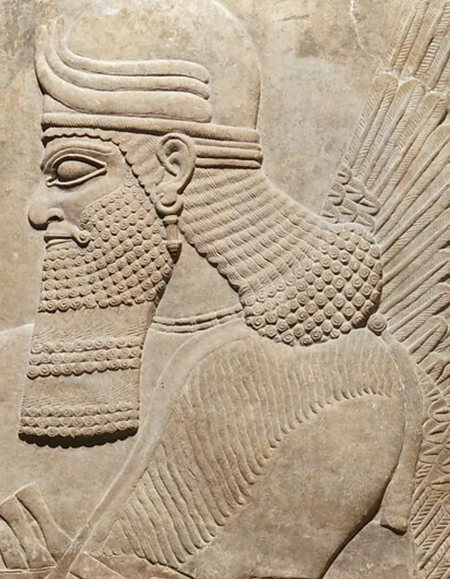
«Winged Figure, ” 9th Century BCE (complete and fragment) Nimrud, Northwest Palace. Assyrian Relief. Metropolitan Museum of Art.
Wings are part of the image, but not the whole image.
On the Assyrian relief, wings coexist with human features, clothing, and objects held by the figure. However, another way exists to construct a fantastic creature—one entirely without human features. The following monument from Babylon illustrates this.
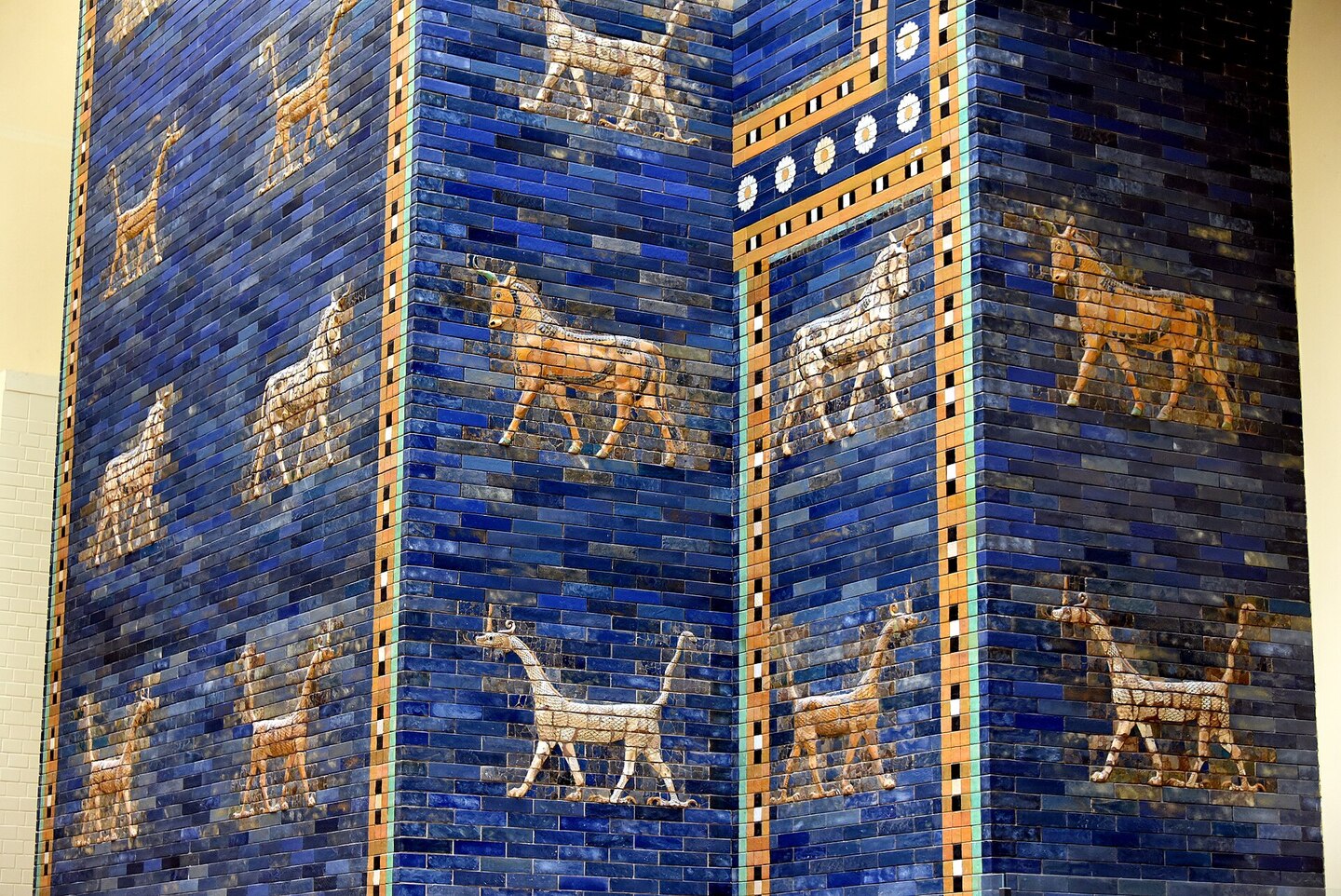
«Mushkhushu at the Gates of Ishtar, ” 6th Century BCE. Babylon. Glazed brick. Pergamon Museum, Berlin.
Face-less Hybrid
The Babylonian Mushhushshu features a elongated neck, a scaly body, and limbs resembling those of various animals. Unlike the Assyrian Lamassu, it lacks a human head. This comparison shows that a supernatural hybrid image can be created even without combining a human with an animal.
Chapter 2. Gesture, Angle, Attribute
Как фигура сообщает о своей роли?
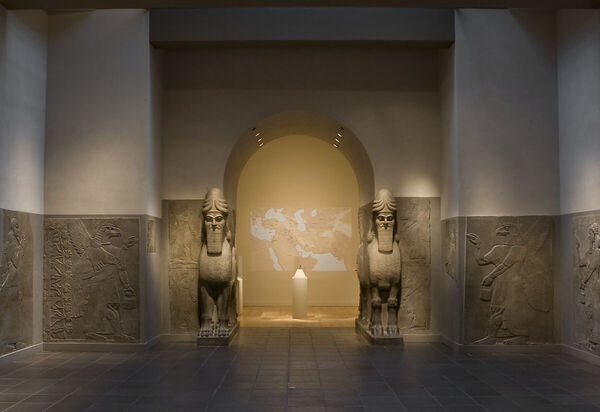
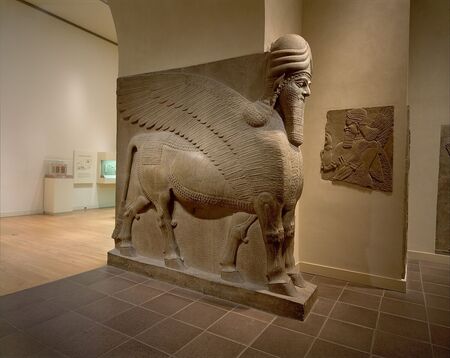
«Human-headed winged bull (lamassu), ” 9th century BCE. Nimrud, North-Western Palace of Ashurnasirpal II. Metropolitan Museum, inventory no. 32.143.1.
Two States of One Figure
The lamassu has five legs so that the sculpture can be perceived from two different viewpoints. From the front, the creature appears still and stable, while from the side—it seems to be striding forward.
This technique transforms the viewer’s movement into part of the artistic concept: by changing the angle, the person sees either a calm guardian or a powerful creature in motion.
Thus, the sculptor unites two opposing qualities—stillness and movement—emphasizing the superhuman power of the lamassu.
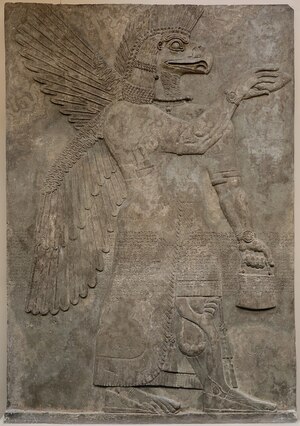
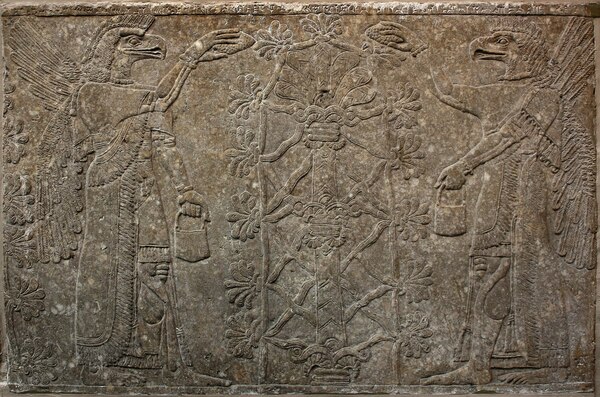
«Bird-Headed Protective Spirit with Vessel and Conical Object,» 9th century BCE. Nimrud, Northwest Palace of Ashurnasirpal II. Stone relief. British Museum, London, Inv. 124576. «Two Bird-Headed Protective Spirits by the Sacred Tree,» 9th century BCE. Nimrud, Northwest Palace of Ashurnasirpal II. Stone relief. British Museum, London, Inv. 124583.
One Gesture—Multiple Compositions
The image on the left depicts the bird-headed guardian separately: the vessel and the cerebriform object are clearly discernible in his hands. On the right, two similar beings face the sacred tree. This juxtaposition shows that the gesture is not accidental—it recurs across different compositions, linking the hybrid figure with a ritual action. In this context, the objects in their hands and the direction of their movement help convey the protective and purifying meaning of the image.
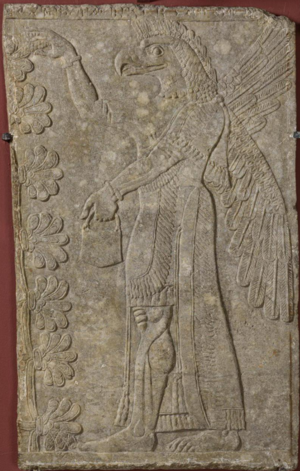
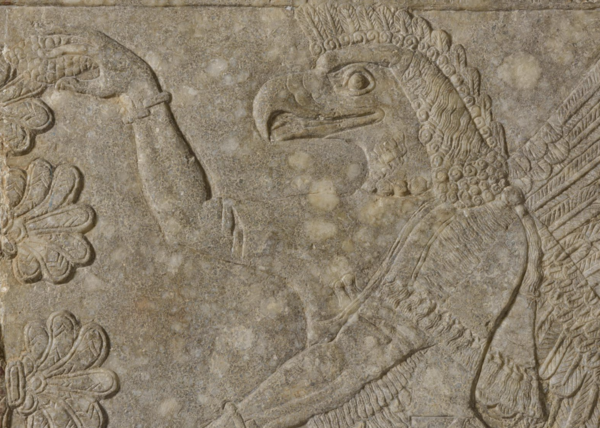
«Bird-Headed Winged Figure, ” 9th century BCE. Nimrud. State Hermitage Museum, Inventory No. DV-3942.
Iconic Defender Imagery
Comparing the reliefs from the British Museum with the winged figure in the Hermitage collection reveals the remarkable consistency of the supernatural protector’s image. Not only are physical characteristics repeated, but so are the gestures and the objects held—a vessel and an ovoid object. It is this combination of traits that allows the protective figure to be recognized across various depictions. The supernatural essence is conveyed not by a single unusual detail, but by an entire system of visual signifiers.