Sound, Gesture, and Sound Design in Todd Field’s «Tár»
To hear the whole and distinguish the details
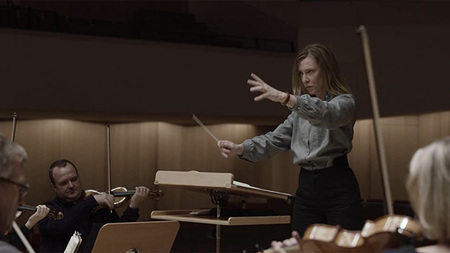
After watching the film «Tár» (2022) with Cate Blanchett, I became interested in understanding how a conductor’s work functions. What drew me to Lydia Tár was the combination of acute hearing and precise movement. An entire orchestra plays before her. She must perceive the music as a whole while simultaneously discerning the details—which part overlaps the melody, why the overall chord sounds uneven, where the phrase loses momentum. Then, she must find the movement or the words that will guide the musicians on exactly what needs to change.
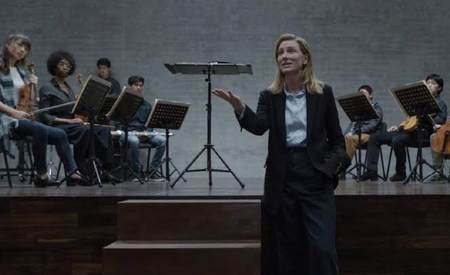
I was particularly interested in the connection between what the conductor heard, what they showed, and what the musicians executed on their instruments. When the bow movement, breath support, or striking moment changes, the overall sound changes too. The conductor listens again and decides if another adjustment is needed. This exchange continues throughout the entire rehearsal. Through it, you can understand the conductor’s work and observe more closely how the film depicts Lydia’s hearing.
Malar’s Fifth Symphony.
From Trumpet Call to Funeral March
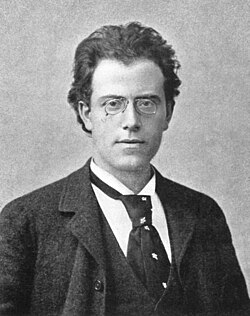
Gustav Mahler (July 7, 1860, Kalisch — May 18, 1911, Vienna) was an Austrian composer and operatic and symphonic conductor. During his lifetime, the composer maintained a small circle of devoted admirers, but half a century after his death, he achieved widespread recognition as one of the foremost symphonists of the 20th century. Mahler’s work, which served as a bridge between late 19th-century Austro-German Romanticism and early 20th-century Modernism, influenced many composers—from the members of the New Vienna School on one hand, to Dmitry Shostakovich and Benjamin Britten on the other.
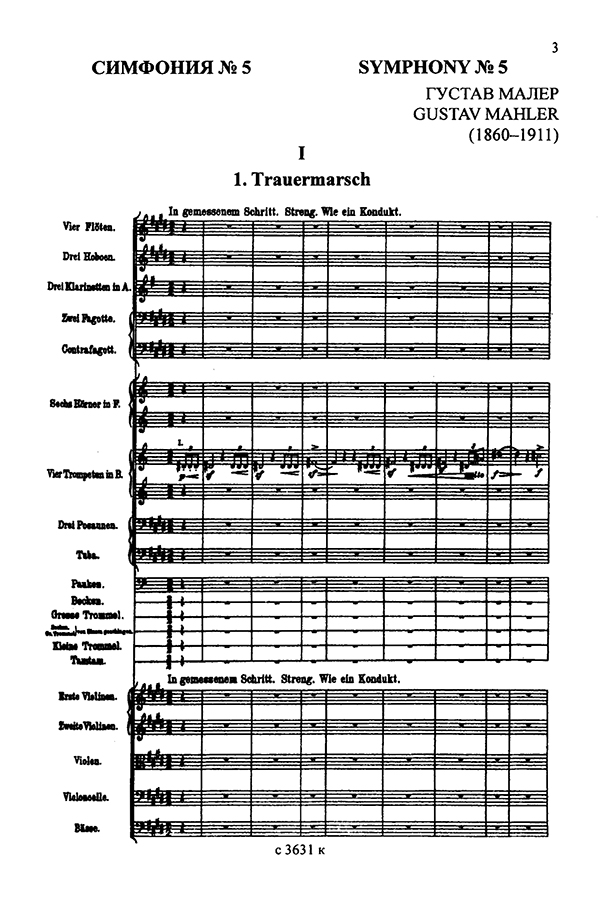
In «Tar,» Lidia prepares a concert recording of Gustav Mahler’s Fifth Symphony. Its first movement opens with a solo trumpet call. The short, repeating notes evoke a military fanfare. While the trumpet sounds, it is especially clear how distinctly each note begins and how the pauses segment the signal into individual phrases. Then the orchestra enters, and the sound abruptly shifts in scope. Other timbres are added to the initial one, and from the short signals and pauses, a measured movement of a funeral march gradually emerges.
Mahler described the character of the first movement with the words, «Measured step. Strict. Like a funeral procession.» This instruction describes both the tempo and the sensation of movement. The pulse must be clear enough that the step can be discerned in the music. Simultaneously, within this overall motion, there must be room for sharp accents, pauses, and dynamic changes. This is where the conductor’s work becomes audible. How we perceive this step depends on how the orchestra sustains pauses, gathers accents, and carries the pulse following a powerful introduction.
At the beginning of the recording, the transition from a single instrument to the full orchestra is particularly clear. Initially, attention is focused on how the trumpet breaks the silence. After the orchestra enters, one can discern how a general marching rhythm emerges from the multitude of sounds.
What does it mean to have a keen ear?
In the conductor’s work, keen hearing is demonstrated by the ability to discern the root cause of a sonic impression. Suppose a melody sounds unexpressive. Perhaps it is being overpowered by the accompaniment. Or, perhaps it is audible enough, but the musicians articulate every note uniformly, causing the direction within the phrase to become lost. Aurally, both scenarios can be described with the phrase «the melody disappears, ” yet the methods to correct them will differ. In the first case, the conductor will adjust the balance between the sections. In the second, they will ask for a different distribution of accents or a change in the build.
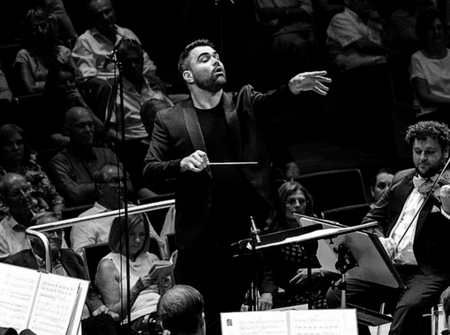
As an architect, I relate to the concept of sound as a space with multiple planes. The foreground can change even if the lead instrument plays at the same volume. For example, woodwinds carry the melody while strings provide accompaniment. If the strings become quieter, the timbre of the winds becomes more distinct, and the melody’s movement becomes clearer. A change in one section allows you to hear what has been happening in another all along. This is how the balance between parts guides the listener’s attention.
How precise movement becomes precise sound
The precision of a conductor’s gesture can be assessed by how clearly the musicians perceive it in time. The hand moves toward the beat, and through this movement, the performers anticipate the overall pulse and character of the action. The trumpeter prepares to inhale, the violinist prepares the bow stroke, and the percussionist calculates the moment of contact with the instrument. These actions require different preparation, though their result may sound simultaneous. The overarching gesture coordinates various movements that combine to form the orchestra’s sound.
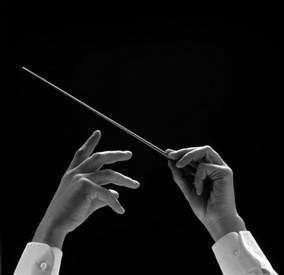
This coordination is necessary even when the music is already playing. If the tempo gradually slows down, the temporal distance between the beats increases. The conductor shows this through movement, while the musicians continue to listen to each other so that the parts maintain coherence. The study, «The Question of Lag,» which compared the movements of conductors with the sound of instrumental ensembles, showed that the time lag between the gesture and the sonic response varies depending on the ensemble and the musical material. Accuracy here relates to how well the movement allows one to anticipate the continuation of the music and coordinate actions within the group.
What exactly does the gesture change in the sound
Two sounds of the same pitch and approximately equal volume can be perceived differently. One emerges softly, while the other asserts itself immediately. The difference is audible in the attack—the initial moments of the sound. To soften the attack, the violinist alters how the bow begins to move across the string, and the trumpeter can change the articulation of the note’s onset. The conductor indicates the overall quality of the sound, and each performer finds a corresponding physical action on their instrument.
The gesture can convey the nature of the connection between notes. Smooth, continuous movement suggests legato—a performance where sounds are joined into a line. Shorter, more distinct movement can denote staccato—sounds that are separated from each other. In the first case, the audience can more easily follow the phrase as a whole; in the second, individual attacks and the intervals between notes are better distinguished. The direction of the gesture helps indicate where the phrase is moving, while the release signifies the moment of a collective ending. After the musicians have stopped playing, the sound may still slowly fade in the hall for some time. The listener hears both the coordinated action of the orchestra and the acoustic response of the space.
What lies behind a simple gesture
During rehearsal, the conductor listens to how the different parts relate. If the accompaniment overwhelms the melody, they might ask one section to play softer. When the orchestra repeats the passage, it becomes clear whether that adjustment helped. At a concert, a similar agreement can be signaled with a small hand gesture. From an outside perspective, it looks almost imperceptible, but the musicians know which part it refers to and exactly what needs to change in the sound.
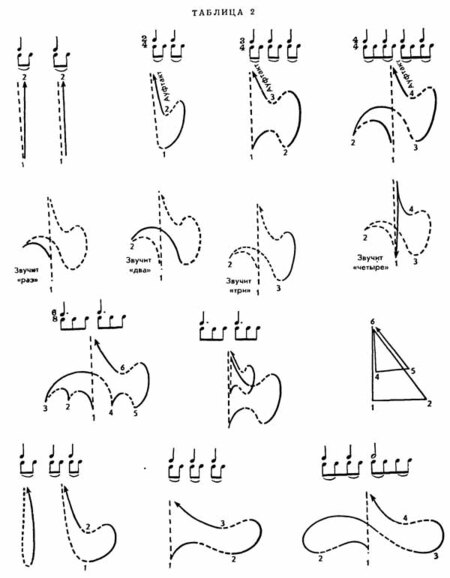
The precision of the conductor’s gesture is born in rehearsal. The conductor hears where the melody falters, and musicians, together with them, find the balance where it can be discerned again. On stage, a single, brief movement of the hand is enough to restore that balance. In an instant that the audience barely notices, lies the realization that the orchestra has learned to listen as one.