
Introduction
AI is valuable to businesses not for its own sake, but when it solves a specific operational problem. Our project is the concept for a service that helps small companies identify repetitive processes, select appropriate tools, and verify their effectiveness in practice. The goal is not to replace employees, but to reduce the volume of manual labor and free up time for client engagement, service quality enhancement, and company growth.
Why This Is a Problem
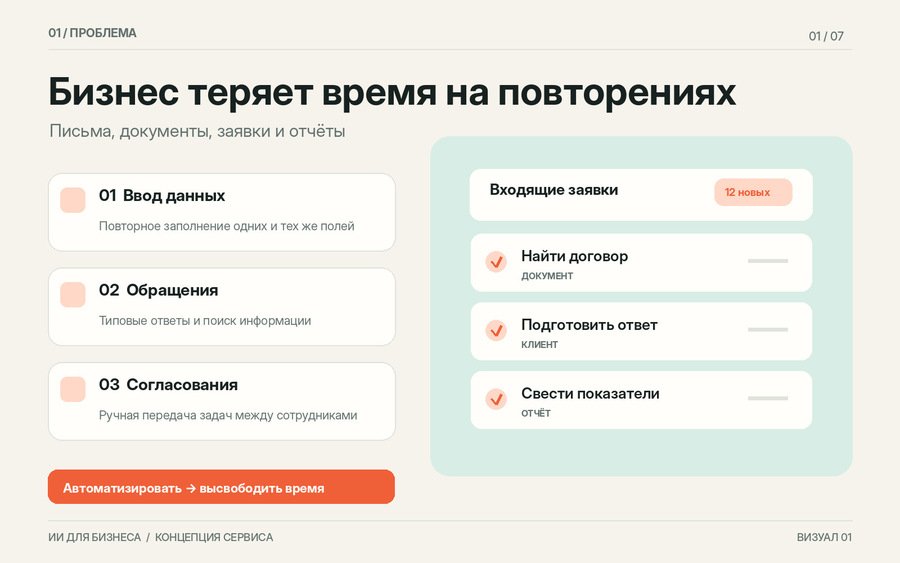
In small teams, one employee often juggles multiple roles. They respond to repetitive requests, transfer data between spreadsheets, prepare documents, and search for information scattered across various files. Each task might seem minor, but cumulatively, they consume significant working hours. Furthermore, simply purchasing a «trendy AI tool» without analyzing the process doesn’t guarantee any benefit. First, it is crucial to understand where time is being lost, who is responsible for the outcome, and what errors are unacceptable.
Research Commentary
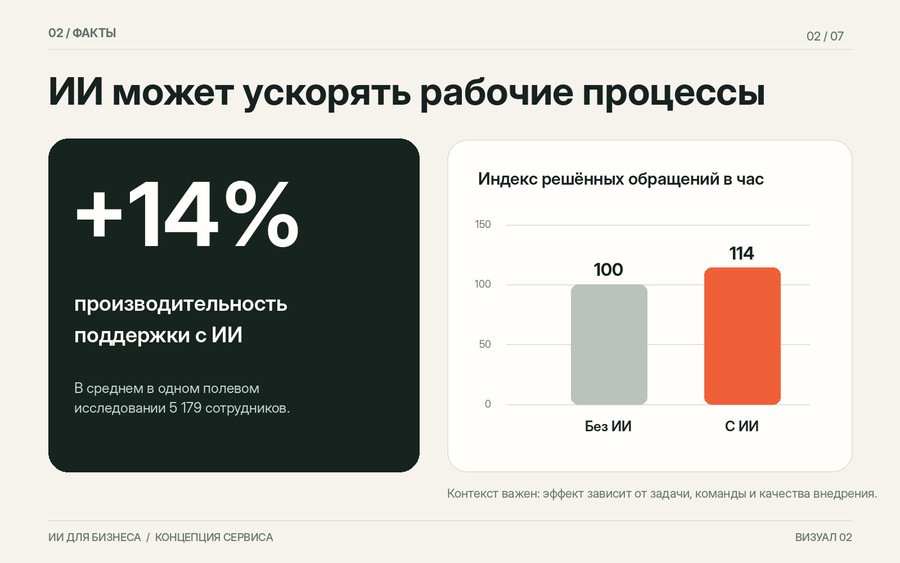
A study by Erik Brynjolfsson, Danielle Li, and Lindsey R. Raymond, which analyzed data from 5,179 customer support employees, showed an average increase of 14% in resolved inquiries per hour after the implementation of an AI assistant. This is the result of a specific study, not a universal forecast for every business. It demonstrates why the impact of AI must be tested within measurable processes rather than being evaluated subjectively. Source: Generative AI at Work, NBER Working Paper 31161; published in the Quarterly Journal of Economics in 2025.
What We Offer
The service combines process diagnostics, automation scenario selection, pilot solution setup, and results evaluation. The company receives not an abstract consultation on artificial intelligence, but a concrete plan: which task to automate, how to integrate the tool into current workflows, who verifies the outcome, and which metrics to use to decide whether to continue. Within the concept, we examine existing AI models and current business tools without the need to develop a proprietary model from scratch.
What We Automate
For the initial pilot, tasks that are frequent and verifiable are suitable. For example: drafting customer responses based on a knowledge base; extracting fields from standard documents; locating specific snippets within internal instructions. At the start, the solutions operate with human oversight. Complex, ambiguous, or sensitive cases must be forwarded to the responsible employee.
Workflow
The first stage involves a brief interview with the team and mapping of the current process. Then, a single task is selected, and its frequency, time expenditure, and quality of execution are documented. The second stage focuses on prototyping and outlining the rules for its use. The third stage is a limited pilot: employees work according to the new scenario, and metrics are compared against the initial baseline. Based on these results, the company decides whether to scale the solution, modify it, or abandon its implementation.
What the Client Receives
In the long term, the client receives a functional automation scenario, clear instructions for employees, and a pilot report. The interface allows tracking of selected processes, task statuses, and metrics before and after changes. The illustration shows the proposed service interface, not a screenshot of the running product: the project is still in the conceptual stage.
How We Measure
The main criterion is not the number of connected neural networks, but the change in the company’s operations. For the pilot, we track task completion time, the percentage of correct results, the volume of manual review, implementation cost, and current usage. Risks are also assessed separately: data confidentiality, generation errors, supplier dependency, and the possibility of reverting the task to a human. The decision to scale is made only after evaluating the overall impact.
Economic Explanation
Assume a team processes 60 recurring tasks per week. If an AI assistant, coupled with mandatory review, reduces the time required for one task by 12 minutes, this frees up 12 hours per week. This is a model example, not a test result. To evaluate the economic benefit, you must convert the saved hours into monetary value, and then subtract the costs of implementation, licensing, support, and quality control.
Conclusion
The integration of AI into small and medium-sized businesses should begin not with selecting a model, but with a clearly defined problem. Our approach is based on a simple principle: study the process, test a single solution, and validate the results using data. The project is currently in the conceptual stage; the next step is to interview small business representatives and launch an initial limited pilot.
Source
Brynjolfsson E., Li D., Raymond L. Generative AI at Work. NBER Working Paper 31161 (2023, revised 2023); The Quarterly Journal of Economics, 2025. https://www.nber.org/papers/w31161