Research Concept
Why a Home Becomes Unreliable
In a horror game, space can be frightening even before an enemy appears. This can happen when a familiar interior stops adhering to expected rules: an exit returns you to the beginning, a turn alters the environment, and an ordinary room begins to feel like part of another organism. I am interested in the moment when the player continues to control movement but can no longer confidently predict where it will lead. In this study, I examine this situation as a loss of trust in the game space.
In ANATOMY, the voice makes the darkness more vibrant and mystical for me. It is unclear whose voice it is, but it sets the context for the story and creates the feeling that there is no escape from this space. I am interested in how this impression arises even when recognizable objects are still visible in the room.
Architecture is active in the experienceTheme selection is connected to the very structure of the gameplay experience. It is crucial for the player not only to see the world but also to understand the relationship between their actions and their outcomes. Architecture is a participant in this relationship: a door promises transition, a hallway sets direction, and a familiar object helps identify a location. If these cues cease to function, familiar actions become questionable. Studying such situations allows for a more precise description of how level design contributes to the creation of fear. The practical significance of this topic lies in the ability to differentiate between techniques of spatial disorientation and methods for their visual analysis.
P.T., Layers of Fear, and ANATOMY converge on themes of domestic interiors and environmental exploration, yet each game poses a distinct question. P.T. emphasizes a recurring route [3]. Layers of Fear focuses on how the environment changes based on the camera’s rotation [4]. ANATOMY, in contrast, proposes a link between domestic architecture and human physiology [5]. My analysis is limited to the original 2016 version of Layers of Fear; the 2023 version is excluded from this study. This comparison does not aim to prove any mutual influence between the games.
Three Houses. Three Ways to Lose Your Ground
The research material consists of three first-person horror games: P.T. (2014), Layers of Fear (2016), and ANATOMY (2016).
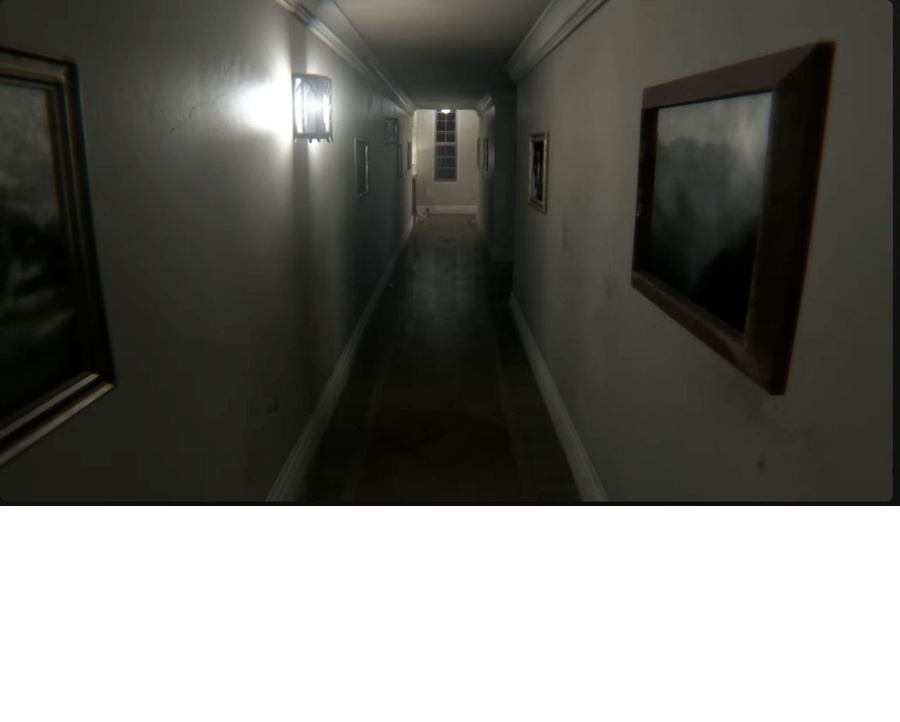
Kojima Productions. P.T., 2014. Frame 02:55 [7]. Citation: 11.13.2026.
Bloober Team. Layers of Fear, 2016. 34:33 [10]. Presentation Date: November 13, 2026.
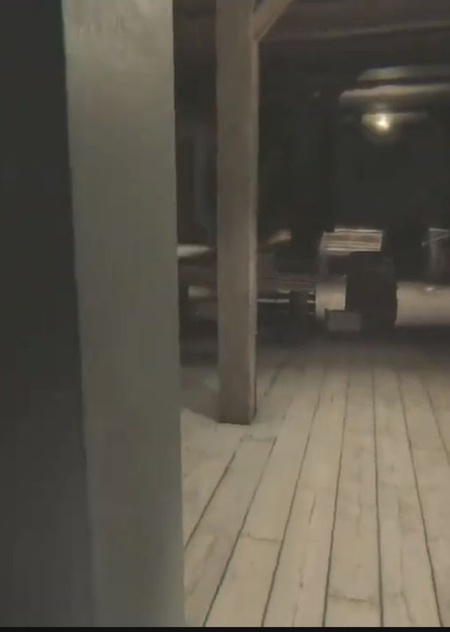
Kitty Horrorshow. ANATOMY, 2016. 14:10.45 [9]. Date of Access: 11/13/2026.
Research QuestionCore research question: How does the home space in horror disrupt the connection between player movement and the expectation of its outcome?
Working HypothesisThe working hypothesis is that loss of control does not necessarily result from constrained control. Rather, it may stem from a conflict between available action and the unreliability of orientation cues: a player can walk, look, and return, but these actions cease to provide stable knowledge of location. Comparing repeated routes, transitions between rooms, and changes in familiar details will allow us to test this hypothesis.
Ilinx and Domestic DreadThe theoretical foundation is Roger Caillois’s book, Games and People. The author highlights ilinx—the drive toward a temporary disruption of perceptual stability [1, pp. 23–26, English edition]. I use this concept as a tool for comparison, not as a ready-made classification of horror. Spatial disorientation before a screen is not equivalent to bodily vertigo. Therefore, the research must identify both the similarity to ilinx and the limits of such a comparison. Ethan Kirkland’s article on the uncanny in video games helps connect the analysis to the transformation of the domestic and familiar into something unsettling [2, pp. 2–3].
Comparison over Narration
The visual material is constructed from comparable frames and short sequences. The primary unit of analysis is a single spatial segment before and after an event. For each sequence, I document the initial landmark, the player’s action, the visible change, and the expectation that was violated. Preference is given to materials that illustrate a transition, rather than merely showing its result. Official descriptions are used to verify game information, while playthrough recordings are used to analyze specific episodes. The source, game version, and time stamp must be provided for every borrowed recording.
How the research is structured
The material is organized according to the following plan:
- Controlling movement and understanding space: concepts and method.
- P.T.: route repetition and recognition unreliability.
- Layers of Fear: gaze and environmental alteration.
- ANATOMY: domestic interior and body image.
- Three ways to lose ground: comparison.
- Conclusion: results, hypothesis boundaries, and future questions.
Boundaries of Analysis
This work does not aim to measure fear or prove that all players react identically. Visual analysis allows us to describe the structure of an episode and propose an interpretation, but it does not substitute for audience research. Therefore, the conclusions will pertain to the organization of the selected spaces. If a particular scene turns out to be explainable by a standard pathfinding search rather than a violation of a familiar rule, this will provide a basis for refining the hypothesis.
Action and Spatial Expectation
Act and UnderstandControlling an action and being confident in its outcome are two different things. A player can move and turn the camera while remaining uncertain about where the door will lead or what lies behind them. In this work, the loss of control primarily signifies unreliable spatial expectation. This is a working definition, not a measure of every player’s reaction.
Ilinx: The Boundary of StabilityKayua describes ilinx through a temporary disruption of perceptual stability [1, pp. 23–26]. This raises the question of how a game deprives a person of familiar grounding. However, an unusual interior and fear are not equivalent to ilinx. Spatial disorientation in front of a screen is not identical to physical dizziness. Here, the concept is used as a limited analogy. The player’s attempt to restore order is as crucial as the disorientation itself. It illustrates the tension between perceptual disruption and the effort to maintain composure [1, pp. 30–31].
What Constitutes Evidence
Four elements are considered for each episode: the initial orientation, the action, the observed state, and the violated expectation. The image shows the visible state. Continuous recording allows for checking the transition. The developer’s narrative explains the intent. None of these sources automatically replaces another. A dark room, by itself, does not prove disorientation. Different angles do not prove restructuring. A shot of the door by itself does not prove a loop.
Four Levels of Spatial Expectation
I separate four questions: where does the path lead, what can bear the weight of an object, can the image be disassembled, and what significance does the room hold? These levels can be violated independently.
Kojima Productions. P.T., 2014. 02:50 [7]. / Bloober Team. Layers of Fear, 2016. 35:28 [10]. / Kitty Horrorshow. ANATOMY, 2016. 14:13.59 [9].
For evaluation, a specific, visible anchor is important—a door, a floor, an object’s outline, or its practical function. This framework helps compare the three games without assuming they all operate in the same way.
Angle and Transformation: Different Testimonies
If an object has shifted within the frame, the cause might be a camera rotation. Therefore, I am comparing not screen coordinates, but relationships: is the object on the floor, does the portrait occupy a doorway, is the player recognizable on the table? In this pair, ANATOMY preserves the connection between the object and its support.
Kitty Horrorshow. ANATOMY, 2016. 03:35, 12:20 [9].
Two images alone do not establish an event between them [9].
P.T. / Return
The Loop Does Not Guarantee an Exit
The corridor loop is described in official Konami materials [3]. The player continues walking, but the route leads him back into the familiar domestic environment. Four moments were selected for analysis: 02:40, 02:45, 02:50, and 02:55 [7]. These moments illustrate the descent, the door, and the subsequent view of the corridor.
Kojima Productions. P.T., 2014. 02:55 [7].
Approach to the Door
The sequence directs the gaze into the depth. The doorway and descent create an anticipation of moving into the next section.
Kojima Productions. P.T., 2014. 02:40, 02:45 [7].
Door and Return
The comparison allows the transition to be read as a return. In sequential playback, a descent, approach to the door, opening, and the appearance of a lit corridor are observed. Saved individual frames should be viewed in conjunction with the original recording [7].
Kojima Productions. P.T., 2014. 02:50, 02:55 [7].
Progression During Playback
Top row: approach and descent. Middle row: approach to the door and opening. Bottom row: illuminated corridor and movement through it. This supplementary capture clarifies the sequence of events. Screenshots are shown as fragments; the original footage serves as the basis for movement analysis [7].
Kojima Productions. P.T., 2014. approx. 02:40–03:00, fragments [7].
P.T.: The direction is perceived before the objective.
In the shot before the descent, an opening is visible, but the space behind it does not open up immediately. The player receives the direction of movement before they can assess its outcome. The dark area reduces the available visual information, but the path remains sufficiently defined to continue moving forward.
Kojima Productions. P.T., 2014. 02:40, 02:45 [7].
It is important here to distinguish between a limited overview and a route loss: the former is already visible, while the latter requires sequence verification [7].
The Threshold Divides the Path into Promise and Result
A large door obscures the view of the next segment. Before being opened, it denotes a boundary rather than revealing a destination. Therefore, the frames on either side of the threshold serve different functions: one builds anticipation, and the other allows for its verification.
Kojima Productions. P.T., 2014. 02:50, 02:55 [7].