Четвертая стена вечности: фаюмский портрет и его современный зритель
Concept

The Fayum portraits are one of the most vibrant phenomena in art history, chronicling the synthesis of two entirely different cultures: Egyptian and Roman. The birthplace of this cultural phenomenon is the Fayum Oasis, located southwest of Cairo. Traditionally, it is believed that the term «Fayum» became associated with these portraits after a major find in 1887 within the Fayum Oasis. However, as the National Archaeological Museum of Athens (NAMUSEUM) notes, similar portraits existed before that—the Italian traveler Pietro della Valle discovered them in Egypt as early as 1615. It was later discovered that they are scattered across the entire country—from the Nile Delta to Nubia—and that the designation «Fayum» was only solidified because the majority of the discoveries were made in this specific region.
Fayum portraits evolved from the ancient Egyptian tradition of cartonnage burial masks. However, during the Greco-Roman period, this tradition changed radically: instead of a linen or papyrus mask placed over the mummy’s face, a naturalistic portrait painted on a wooden board was used—rendered in the Greek pictorial style, featuring a three-quarter turn, a single light source, and realistic chiaroscuro. The Greek pictorial tradition provided the Fayum portrait with its technical language. Nevertheless, technique is only a means to convey a specific idea.
The foundation of it all is the function the portrait was meant to fulfill: Egyptian funerary practice demanded magical recognition, while the Roman tradition required social representation. For this reason, in the second chapter of my research, I examine the Greco-Egyptian synthesis.
The main research question
It is precisely this Greco-Egyptian fusion that births the central paradox I aim to explore in my visual research. Fayum portraits were not painted for museums or for living viewers—they were integral to funerary rites, created for the soul of the deceased and for the gods. Yet today, two millennia later, when we look at a portrait, we perceive a personality and an astonishingly vivid, «yesterday’s» face.
Images intended for eternity somehow offer the contemporary viewer a sense of presence.
The question arises: why does a Fayum portrait, intended to serve the deceased in the afterlife, continue to look at us as contemporaries? What exactly in its optics creates this stunning effect of «life» and presence?
My visual research is not based on chronology, but on the principle of moving from effect to cause. Chapter I addresses the question of what constitutes the visual effect of life and tangibility (here I analyze optics, materiality, and visual mechanisms). Chapter II explains why the image had to be precisely as it was, considering the synthesis of two cultures—Egyptian and Roman. Finally, Chapter III explains why we, as external viewers, interpret this gaze as contemporary, directed toward us, and seemingly awaiting a response from us after two millennia; in this concluding chapter, I examine the effect of address.
Chronological scope—the 1st–4th centuries CE. The lower limit of the first century is associated with the beginning of mass portrait production on wooden panels and the spread of encaustic. The upper limit (4th century) marks the decline of the tradition. According to Barbara Borg, production largely ceased by the 3rd century, but late tempera works from the 4th century are also important for understanding the shift in optical perception.
Chapter 1. The Face That Seems Alive: Visual Mechanisms
The chapter’s goal is to analyze the visual elements that create a sense of living presence.
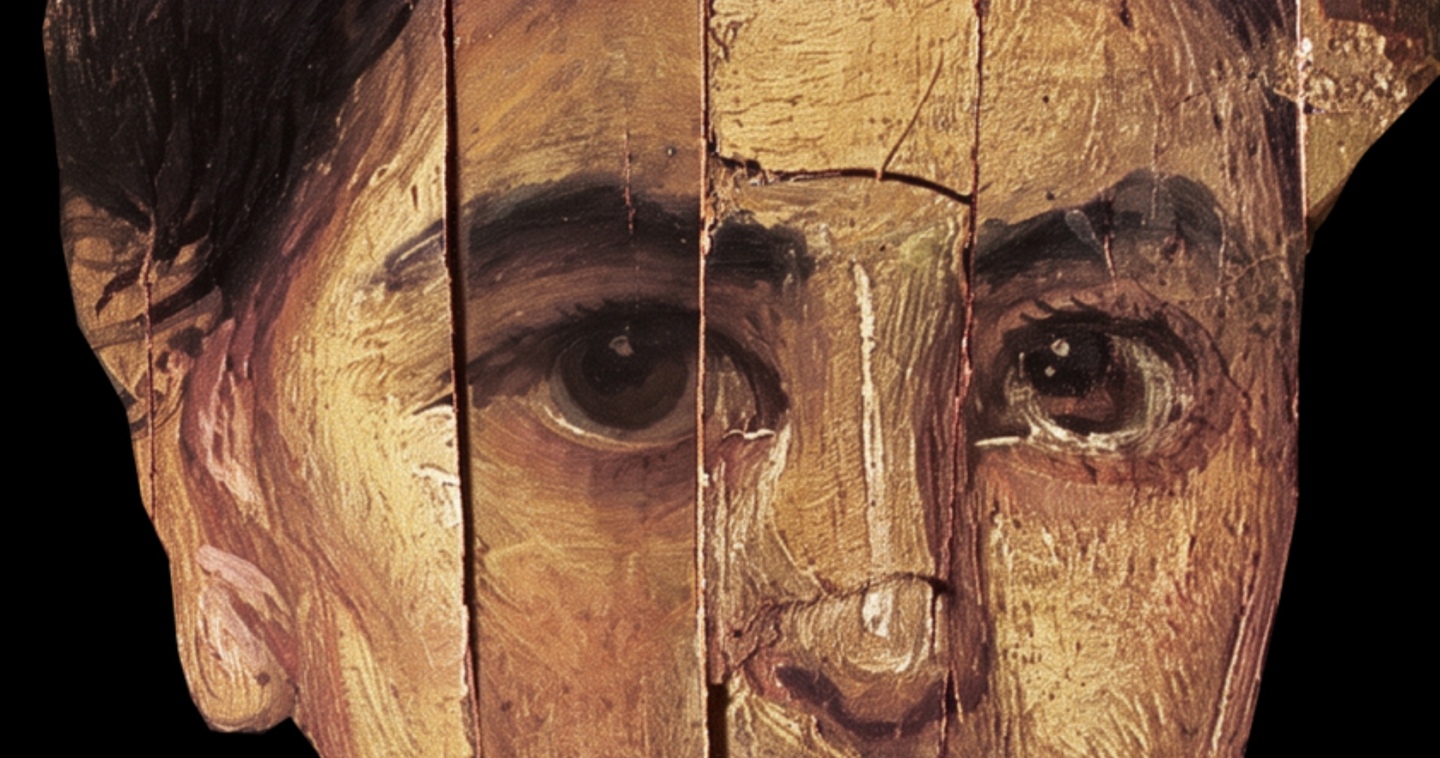
The first thing that captivates in a Fayum portrait is the eyes. This is because portraits possess stunning optics: the person depicted is shown either frontally or in three-quarter profile, yet their eyes are almost always directed straight at the viewer.
This characteristic differentiates the Fayum portrait from the Egyptian funerary mask—which, while not an exact posthumous depiction of a person’s appearance, was rather an idealized image of them—and from the Roman sculptural bust, which can be individualized but lacks a directed gaze (this refers to the tradition of Republican verism, where the gaze had not yet become the primary expressive means).
A Comparative Analysis of the Optics of Egyptian Cardboard Masks, Roman Sculptural Portraits, and Fayum Portraits
This optical system—three-quarter turn, chiaroscuro, single light source—has Greco-Roman origins. For Egyptian funerary tradition, it represented something radically new. Thus, the uniqueness of the Fayum portrait lies not in the invention of this optics, but in its application to the Egyptian mummy.
The Metropolitan Museum describes the effect of these portraits as a «direct encounter» with the inhabitants of ancient Egypt [6], while the National Archaeological Museum in Athens speaks of a «shocking naturalism» that literally «captures» the gaze [8]. The ritual gaze into eternity and the almost direct gaze toward the viewer merge here, creating that very sense of presence.
1.2. Individualization: The individual, not the type
Even though the masters worked with repetitive formulas—pose, proportions, costume—which were quite standard, looking at Fayum portraits still evokes the feeling that we are looking at unique and inimitable faces. Individuality is created not through photographic accuracy, but through the variation within a unified scheme. This range encompasses several key components.
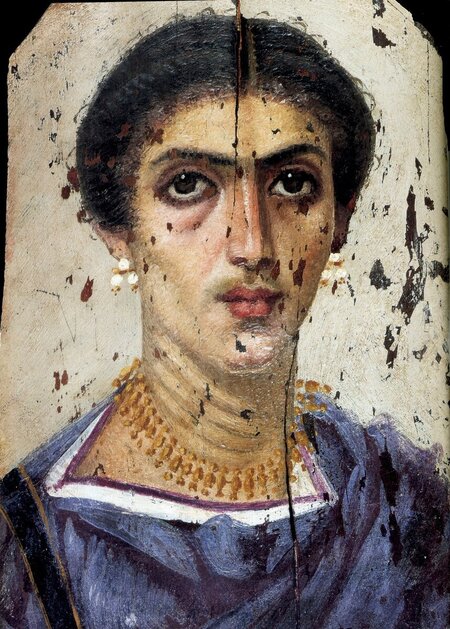
First, there are details related to age and character: wrinkles, facial asymmetry, the shape of the nose, lips, and chin. Some monuments also feature images of scars or signs of past surgery, which also contribute to creating the image of a specific, living person.
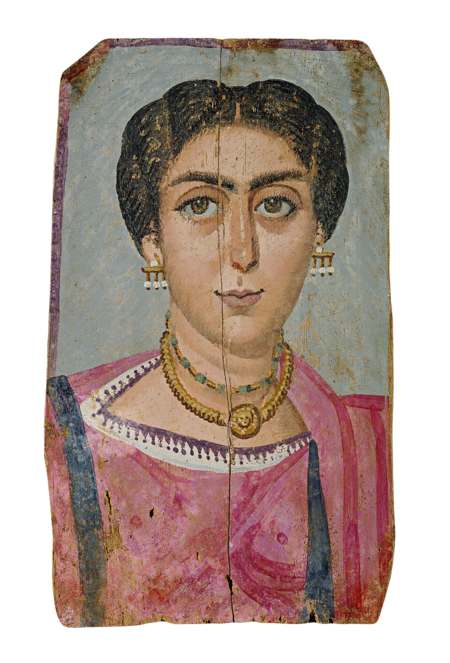
Secondarily, hairstyles and beards served as crucial markers of individuation. Researchers, notably Barbara Borg, demonstrated that the hairstyles in Fayum portraits often copied the fashion of the imperial court [2]. This not only aids in dating the artifacts but also illustrates how a unique likeness was constructed through a shared style of the era. It was these specific elements—the hairstyle and the beard—that provided the most straightforward means of giving a depiction, created using a specific method, a sense of naturalism. This practice was not an invention of the Fayum masters; rather, it traces back to older traditions where the basic schema was «animated» through varying details.
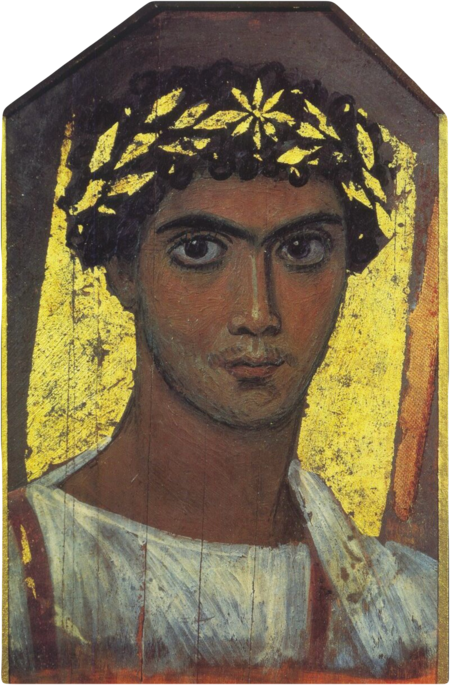
Finally, thirdly, individualization was reinforced by social markers—clothing and adornments. Susan Walker explicitly frames this as a dual motivation for patrons: they believed in Egyptian cults yet wished to be immortalized «in the Roman manner, ” with clothing and accessories signaling their social standing [1]. Some of these markers included the clavus—a colored vertical stripe on the tunic denoting membership in the upper class—as well as the golden wreath, which signified high social status.
So, the portrait simultaneously solved two tasks: functional recognition for Ka and Ba (in the ancient Egyptian conception, these were fundamental properties of the multidimensional system of the human soul—resemblance necessary for afterlife existence) and social representation (designating status). It was this layering that created the degree of visual individuality and specificity that allows the viewer to perceive the personality behind the features unique to each portrait.
«Portrait of an Elderly Man in a Blue Cloak» from the Pushkin State Museum of Fine Arts
Featured here is «Portrait of an Elderly Man in a Blue Cloak» from the Pushkin State Museum of Fine Arts. Without knowing anything about the subject, one can draw rather somber conclusions about the life path this queer (Roman citizen) endured before his passing. Deep wrinkles, mournful lines at the corners of his mouth, and a piercing, seasoned gaze reveal a personality behind an individual life story. And, of course, the man’s origin is not in doubt. He is a Roman. Here, the ethnographic affiliation is clear and understandable primarily due to his hairstyle. It corresponds to Roman fashion during the time of Emperor Trajan (53–117 AD). It is remarkable how accurately and masterfully the painter rendered this face—one worn by a difficult life—yet one that is also distinguished and individualized.
1.3. The Substance of Gaze: Encaustic and Texture
The lifelike quality in Fayum portraits arises not only from the subject’s specific facial expression and individual physical features, but also from the texture of the painting. Encaustic (painting with hot wax) provides a physical density that tempera lacks. The wax set quickly, which dictated the style of painting—using small, dense brushstrokes and cautery—a heated metal tool used to compress the pigment layer and create relief [5].
In encaustic portraits, the brushstroke is often not hidden but deliberately displayed: it lies large and in high relief. The paint layer retains traces of the tools, making the painting’s surface appear uneven and voluminous. The freedom of the brushstroke is so evident here that some researchers compare this texture to painting from much later periods—even impressionism. It is this «mobility» of the surface that makes the Fayum portrait tangibly close to the contemporary viewer.