Concept
The medieval manuscript was not merely a space for transmitting text, but also a unique world of visual imagery. Alongside religious scenes, depictions of saints, and decorative elements on the pages, fantastic creatures, human-animal hybrids, animals in human clothing, and unusual everyday vignettes appeared. These images, known as marginalia, often created the impression of an alternative reality existing at the edge of the main narrative.
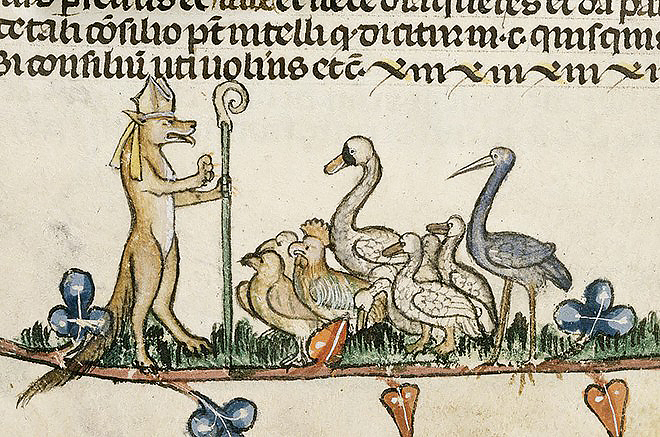
Unknown author. Fox preaches to a flock of birds. Smithfield decretals. 1330–1340.
In this world, conventional notions of reality could be warped: animals adopted human characteristics, familiar characters found themselves in unexpected roles, and the human body transformed into a foundation for fantastical combinations. Grotesque imagery, exaggeration, and the disruption of conventional proportions became means of creating images that simultaneously drew attention, surprised, and evoked a sense of comedy.
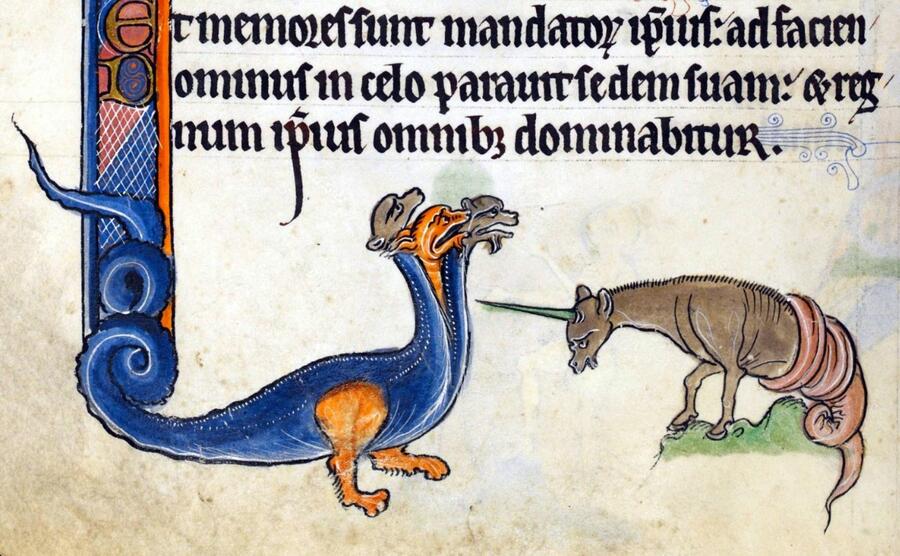
Unknown Artist, Three-Headed Serpent vs. Unicorn Ratland Psalter. c. 1260s
This study examines 13th–14th-century marginalia as an independent artistic space where medieval masters experimented with form, imagery, and conceptions of the surrounding world. Particular attention is paid to the methods of transforming human and animal figures, creating fantastic hybrids, subverting conventional roles, and the visual techniques that generated effects of grotesquerie and absurdity.
How did medieval artists create alternative worlds in the margins of manuscripts?
In answering this question, the research draws upon fantastical creatures, unconventional plots, and artistic techniques that subverted the conventional understanding of reality. Particular attention is given to how familiar images were transformed into impossible forms and how a distinct visual world emerged within the pages of the book.
Marginalia from the 13th–14th centuries can be seen as a unique artistic space where masters created an alternative reality. This arose from the combination of incompatible forms, the alteration of familiar roles, and the use of grotesque.
The core material for this study consists of English medieval manuscripts from the 13th–14th centuries. The central piece is the «Luttrell Psalter» (England, c. 1325–1340). Its margins feature a variety of illustrations—ranging from fantastic hybrids and grotesque creatures to animals and scenes of daily life. For comparative analysis, we have selected the «Rutland Psalter» (c. 1260), the «Smithfield Decretals» (14th century), and the Harley MS 6563 Book of Hours (c. 1320–1330).
Chapter 1. The Birth of a Fantastical World
On the pages of medieval manuscripts, one encounters an entire world of unusual creatures. Alongside ordinary animals, fantastic beasts appear—humanoid figures with bird heads and beings composed of parts from several different bodies. Artists were not limited to depicting familiar nature. They combined human and animal traits, drew upon mythological imagery, and invented creatures that had no real-world counterparts. Thus, a unique gallery of fantastical characters emerged on the pages of books.
Unknown artist. Hybrid dragon figure. Lattrell Psalter. 1325–1340.
Among the most unusual characters are hybrids—creatures that combine human and animal traits. The human body might be augmented with a bird’s head, animal paws, wings, or a tail. Sometimes the figure looks almost human, but one or more details completely transform its appearance.
Unknown artist. Hybrid Figure with Wings. The Psalter of Lattrell. 1325–1340.
Lattrell’s Psalter features a variety of hybrid creatures. For instance, plate 163r depicts a character with avian features. This example illustrates the extent to which artists freely combined familiar forms.
Unknown artist. Hybrid figure with a bird’s head. Psalter of Lattrell. 1325–1340.
Hybrids occupy an intermediate position between human and animal. They cannot be classified into a single, defined species; they exist on the boundary of several forms.
Unknown artist. Centaur and Siren. Rutland Psalter. c. 1260
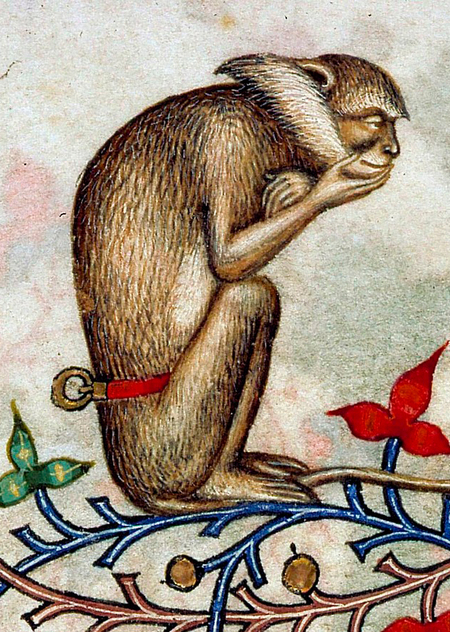
Unknown artist. Monkey riding a ostrich. Rutland Psalter. c. 1260
Unknown artist. Hybrid with a human face. Rutland Psalter. c. 1260
Another group of images comprises fantastic animals and creatures known from myths and medieval worldviews. Among them are dragons, centaurs, harpies, and unicorns. The «Rutland Psalter» preserves about a hundred individual marginal illustrations. These include fantastic beings—dragons, centaurs, and harpies. Plate 66v depicts a monkey riding a ostrich—an example of an unusual combination of real animals in a fantastic scene.
Unknown artist. Smithfield decretals. 1330–1340.
Such imagery expanded the familiar animal kingdom of manuscripts. Alongside real beasts, creatures from legends, myths, and medieval conceptions of unknown lands appeared on the pages.
Grills occupy a special place among fantastic creatures—grotesque beings with unusual body structures. Their appearance often defies conventional notions of how a living figure should look. Instead of a complete human or animal body, the artist might depict a head connected to another body part, multiple heads, or an unusual combination of limbs. As a result, creatures emerged that seemed to be pieced together from separate fragments.
Unknown Artist. Fantastic Creatures. Rutland Psalter. c. 1260
Chapter 2. The Upside-Down World
If the first chapter introduced us to the fantastical creatures inhabiting the margins of medieval manuscripts, now we will explore what happened in their world. On the book margins, the usual order of things often shifted: animals took on human occupations, prey became hunters, and small, weak creatures triumphed over stronger ones. Familiar situations transformed into unusual and comical tales.
Unknown Artist. Hunter Rabbit aiming at a Dog. Harley Clock Book MS 6563. Circa 1320–1330.
Rabbits were depicted with bows and arrows, chasing dogs and hunting themselves. In the Harley book of hours MS 6563, on folios 20r–20v, the rabbit goes hunting and returns with its prey. On folios 96v–97r, it is already aiming an arrow at a dog. This reversal of roles transformed the familiar hunting scene into a comical situation, where the seemingly weaker character often unexpectedly became the pursuer.