Categories
1. Military Attire of Japan During the Heian and Kamakura Periods
2. Construction and Functionality of Samurai Armor
3. Materials, Color, and Decorative Elements
4. Historical Costume as the Foundation of the Visual World in Ghost of Tsushima
5. The Samurai Persona in the Costumes of Jin Sakai
6. From Samurai to Ghost: The Transformation of Costume
7. Diversity of Japanese Costume Interpretations in the Game
8. Historical Prototype and Contemporary Gaming Interpretation
9. Conclusion
Concept
The traditional Japanese military costume is a system where the construction, materials, and decorative elements were shaped by military traditions and the cultural characteristics of their era. Samurai armor served not only a protective function but also reflected the warrior’s social status. Its characteristic silhouette, layering, and methods of joining plates formed a recognizable image that continues to be used in contemporary visual culture.
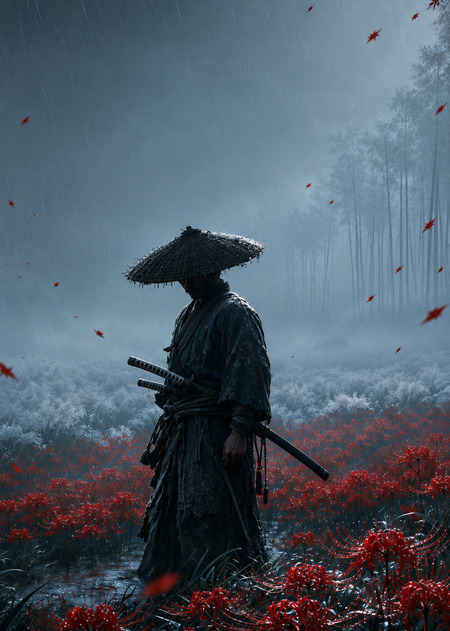
In video game design, historical costumes often become the foundation for artistic interpretation. Developers retain the signature elements but alter the proportions, materials, and silhouettes to suit the specific needs of the game world. A prime example of this approach is Ghost of Tsushima (2020), set in 13th-century Japan. The main character, Jin Sakai’s, costumes blend historical forms with modern design solutions, evolving as the character transitions from a samurai to a Ghost.
While historical armor is thoroughly examined in museum catalogs and scholarly research, official materials from Sucker Punch Productions reveal the artistic principles behind developing game costumes. However, comparing these two approaches allows for a specific inquiry: how does historical construction acquire new visual and narrative functions in character design?
Thus, this study focuses on the transformation of the traditional Japanese military costume in Ghost of Tsushima, with an emphasis on preserving and reinterpreting historical elements.
Material Selection PrincipleThe research is grounded in museum specimens of Heian and Kamakura period Japanese armor, historical depictions of samurai, as well as official concept art and in-game character models from Ghost of Tsushima.Particular attention is paid to the structure of ō-yoroi armor, its individual components, materials, silhouette, and decorative embellishments. Among the in-game costumes reviewed are Samurai Clan Armor, Sakai Clan Armor, Ghost Armor, Tadayori’s Armor, Ronin Attire, Kensei Armor, and Traveler’s Attire.The primary selection criterion is the feasibility of visually correlating the historical and in-game specimens. Later armor pieces may also be used to identify artistic borrowings, but their dating must be explicitly noted.Categorization PrincipleThe study progresses systematically from the historical warrior costume to its in-game interpretation.Initially, the formation of samurai armor—its structure, functionality, materials, and decorative features—is examined. Next, the developers' approach in Ghost of Tsushima to historical sources and the principles of stylizing traditional forms are analyzed.Special focus is given to the depiction of Jin Sakai and the evolution of his costume throughout the narrative. Other in-game ensembles that reflect various interpretations of Japanese attire are also considered. The concluding section is dedicated to a direct comparison between the museum artifacts and the in-game costumes.Throughout this process, the historical and in-game images are juxtaposed, allowing us to trace the relationship between the traditional construction and modern character design.
Principles for Selecting and Analyzing Textual SourcesFor this research, we utilize museum catalogs and scholarly publications from The Metropolitan Museum of Art, the Tokyo National Museum, Japanese e-Museums, and other collections that allow us to establish the historical specifics of the armor. The second group consists of official materials from PlayStation and Sucker Punch Productions, including concept art and artist commentary from Ghost of Tsushima.Comparing these sources allows us to differentiate between historically confirmed costume features and the artistic decisions made by the developers. The primary method employed is comparative visual analysis of the silhouette, construction, materials, color, and decorative elements.Research QuestionHow are traditional elements of Japanese warrior attire transformed in the character designs of Ghost of Tsushima, and what role do these transformations play in shaping the in-game persona?HypothesisIn Ghost of Tsushima, the historical samurai costume is not used as an exact reconstruction, but rather as a foundation for creating an artistic image. The retention of characteristic structural elements maintains a connection to Japanese martial tradition, while changes in silhouette, materials, and color help reveal the character’s nature.This is particularly evident in Jin Sakai’s transition from bulky samurai armor to the lighter, more stealthy Ghost costume. Thus, the historical costume serves not only as a source of visual forms but also as a narrative tool.
esdfa