
Navigation
- Concept
- Studio History
- Continuity of Movement
- Rhythm and Metamorphosis
- Interaction of Environment and Sound
- Conclusion
- Bibliography
Concept
The animation of the Fleischer Studios from the 1930s represents a unique instance of music and image interaction, where the jazz examined in this visual study functions not merely as a soundtrack, but as a guiding principle for constructing the visual world. The choice of subject is motivated by the fact that the relationship between musical rhythm and animation plasticity remains insufficiently explored: while the cultural influence of jazz on cinema and mass art has been extensively researched, the question of how jazz structure specifically manifests in character movement, frame dynamics, and the philosophy of visual form has yet to receive adequate analysis. The Fleischer Studios are also particularly interesting for their aesthetic of «rubber plasticity» and the constant transformations of their characters.
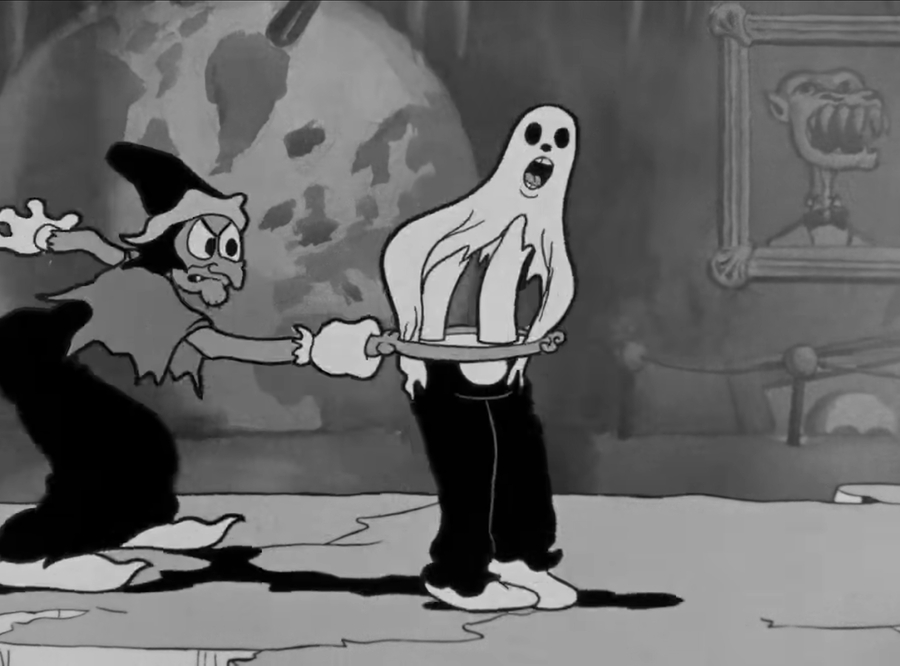
A frame capturing the metamorphoses of the characters from «Snow White» (1933)
A frame from «Minnie the Moocher» (1932)
In the 1930s, jazz established itself as a leading popular music genre in the United States, forming a style where musicians could freely shift accents and play against the audience’s expectations. The central principle of jazz became improvisation—the ability to construct a melody in the moment of performance, departing from a pre-fixed structure to create a unique, unpredictable sonic statement. This improvisational freedom and plasticity turned jazz into a cultural symbol of mobility and constant change. It was these very characteristics that made jazz ideal for animation, particularly in the work of the Fleischer Studios, where the visual form could transform and undergo metamorphosis with equal freedom.
Opening titles for «Minnie the Moocher» (1932), featuring Cab Calloway and his jazz orchestra.
Opening title sequence from «I’ll Be Glad When You’re Dead» (1932), featuring Louis Armstrong and the orchestra.
The material selection is based on the need to identify the most representative animated films where the musical component plays a structuring role. This is why the research incorporates films created in close collaboration with jazz performers—“Minnie the Moocher» (1932), «The Old Man Of The Mountain» (1933), and «Snow-White» (1933) featuring Cab Calloway, as well as «I’ll Be Glad When You’re Dead, You Rascal You» (1932) with Louis Armstrong. These films demonstrate pronounced rhythmic movement, synchronization between animation and music, consistent character motion, and the inclusion of the surrounding environment in the musical dynamics.
Max Fleischer with Betty Boop
The core question of this research is how jazz influences the visual language of the studio’s animation in the 1930s and shapes its rhythmic structure. The hypothesis proposes that in Fleischer’s animated films, jazz rhythms do not merely accompany the visuals—they define them: the movement of characters, the dynamism of space, and the editing are subservient to the musical beat.
In addition to analyzing the films themselves, the study also examined scholarly articles regarding the Fleischer studio’s work and trajectory, the characteristics of jazz as a musical genre, and the role of music and its influence on animation during the Golden Age.
Studio History
The Fleischer Studio emerged in New York during the 1910s and 1920s—a time when animation was only beginning to form as an industry. Max (the technician and inventor) and Dave (the director and producer) began working together in 1915–1917, when Max created his famous patented invention—the rotoscope. This device allowed them to redraw a real actor’s movements frame by frame and became one of the first technologies that established their recognizable style.
The brothers' first significant work was the series «Out of the Inkwell» (1918), where they blended live action and animation. These films quickly stood out among others due to the characters' unusual plasticity and experimental visual solutions, earning the Fleischers a reputation as avant-garde and technologically bold animators of their era.
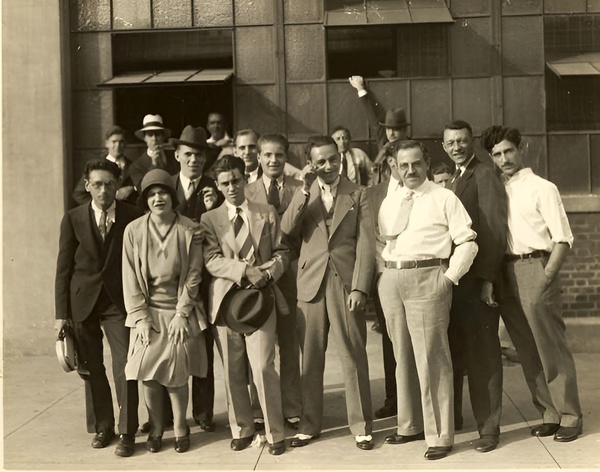
Команда студии Флейшеров
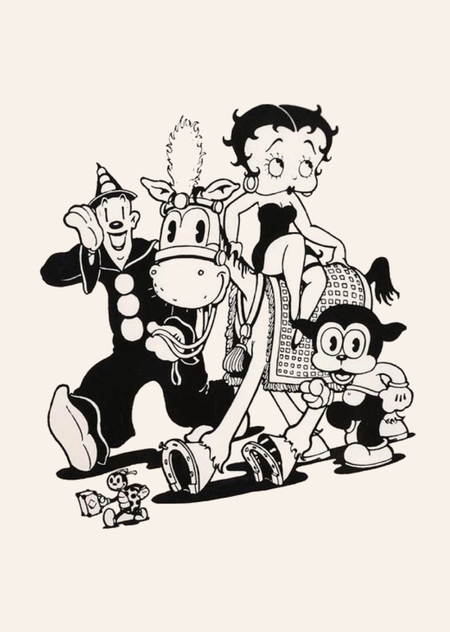
Бетти, Коко и Бимбо
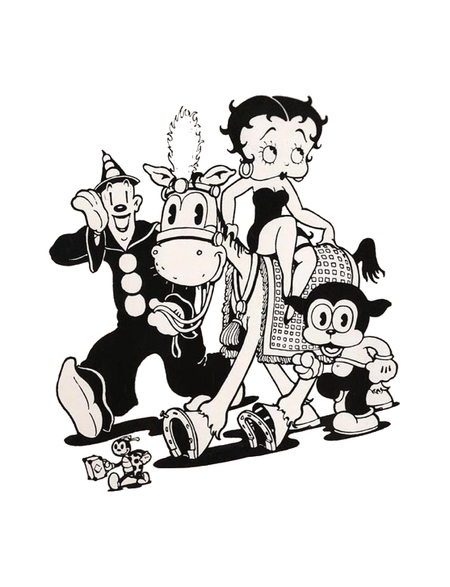
The studio’s work gained popularity following the creation of Betty Boop, who first appeared in the 1930 cartoon «Dizzy Dishes.» Interestingly, unlike other popular animation figures of that era, the Flasher characters—Betty Boop, Grumpy, and Coco Clown—were modeled after real people.
With their surreal and somber urban worlds, the Flashers represented the so-called East Coast school of animation, sharply contrasting with the West Coast style, exemplified by animators at Disney who preferred rural themes and animal characters.
Of all the Flashers' cartoons, «Snow White» is perhaps the most well-known. And this is fair because it fully showcases Flashers’ unique surrealist style—a style rich with captivating imagery, unexpected metamorphoses, and a narrative flow reminiscent of stream of consciousness.
Fleischer Studios became one of the leading technological innovators of early animation, repeatedly surpassing its competitors and shaping the evolution of animation as an art form. Rotoscoping was mentioned previously, but it was not the only technology invented. Another significant invention was the multi-plane camera, which allowed for the creation of a three-dimensional effect in the frame and enabled foreground and background elements to be situated on different planes.
The studio was also a pioneer in sound animation, being one of the first in the United States to master the synchronization of music and image. It was the Fleischers who brought the famous «ball-jumping songs» into popular culture with their «Song Car-Tunes» series in the 1920s, transforming animation into a form of collective musical participation long before karaoke existed.
Jazz became the dominant music in America by the 1930s.
By the early 1920s, a new musical style originating in New Orleans had spread north, beginning to permeate various forms of popular culture and entertainment—from literature and painting to classical music. In just a few years, jazz had permeated American musical culture.
Over time, jazz began to play an increasingly important role in animated films. To understand why composers incorporated jazz elements, one must consider the common perceptions of jazz in the 1920s: the rhythm of jazz seemed unconventional and captivating, especially to white audiences who held racial stereotypes, making it suitable for dynamic animation.
Jazz readily allows for the expression of specific emotional nuances and the creation of vibrant, dynamic storytelling for films that portrayed perceptions of the «primitive,» innocent, dangerous, and sensual life of Black people. Through humor, the socially negative aspects of jazz were softened and transformed into objects of laughter, making them less alarming to a broad audience.
One of the earliest examples of jazz appearing in animation is the film «King of Jazz» (1930). However, the Fleischer brothers occupied an unusual position in the late 1920s and early 1930s; they treated jazz not merely as background accompaniment, but as a distinct genre worthy of recognition. Instead of simply using jazz elements in the music, they incorporated popular songs by famous artists directly into their cartoons.
Fleischer Studios had actively collaborated with Paramount Pictures since 1929, which became the distributor of their films. This collaboration also allowed the studio to release cartoons to a wide audience and to invite famous musicians, such as Louis Armstrong and Cab Calloway, for filming.
It is especially significant that Paramount itself actively produced jazz music, giving the Fleischers direct access to popular compositions and artists. The music of these performers set the rhythm for the characters' movements, shaped the plastic structure of the scenes, and transformed jazz into an organic visual element.
In just three films, one can observe the studio’s collaboration with Cab Calloway, whose movements formed the basis of the easily recognizable shots of various characters. Furthermore, for example, in «Minnie the Moocher» (1932) and «I’ll Be Glad When You’re Dead» (1932), shots featuring real orchestras and performers are demonstrated, a trend that can later be traced in the visual imagery.
A frame from a Keb Callaway performance recording, used for rotoscoping
Still from «Minnie the Moocher» (1932), capturing the performer’s movements
Stills from «The Old Man Of The Mountain» (1933)
The studio’s work marked an audiovisual breakthrough, where sound and image interacted closely to create a unique animation style. During that period, jazz was also associated with primitivism—both in racial context and in the rhythm of the music. The Flashers' animations allowed viewers across the country to experience the atmosphere of New York nightlife and made jazz accessible to a wide audience.
Continuity of Motion