
Navigation
[1] Concept
[2] Alien Suffering as Spectacle
[3] The Repulsive Body
[4] Beyond the Permissible
[5] The Habit of Gazing at Horror
[6] The Psychology of Repulsive Attraction
[7] Conclusion
[8] Findings
[9] Bibliography
[10] Image Sources
Concept
At the core of visual investigation lies the contradiction between the human desire to avoid unpleasant experiences and the urge to engage with images that evoke fear, disgust, or anxiety. Violence, death, suffering, and bodily deformation elicit intense emotional responses, yet within art, they become subjects of attention and contemplation. A person might turn away from an unpleasant event in real life, but they can voluntarily choose a horror film, examine a shocking photograph, or study a piece depicting violence. This raises a question: why do images that one instinctively wants to look away from generate a desire to keep watching? Perhaps the distance between the viewer and the depicted event plays a crucial role—art allows one to approach a frightening subject without experiencing it directly.
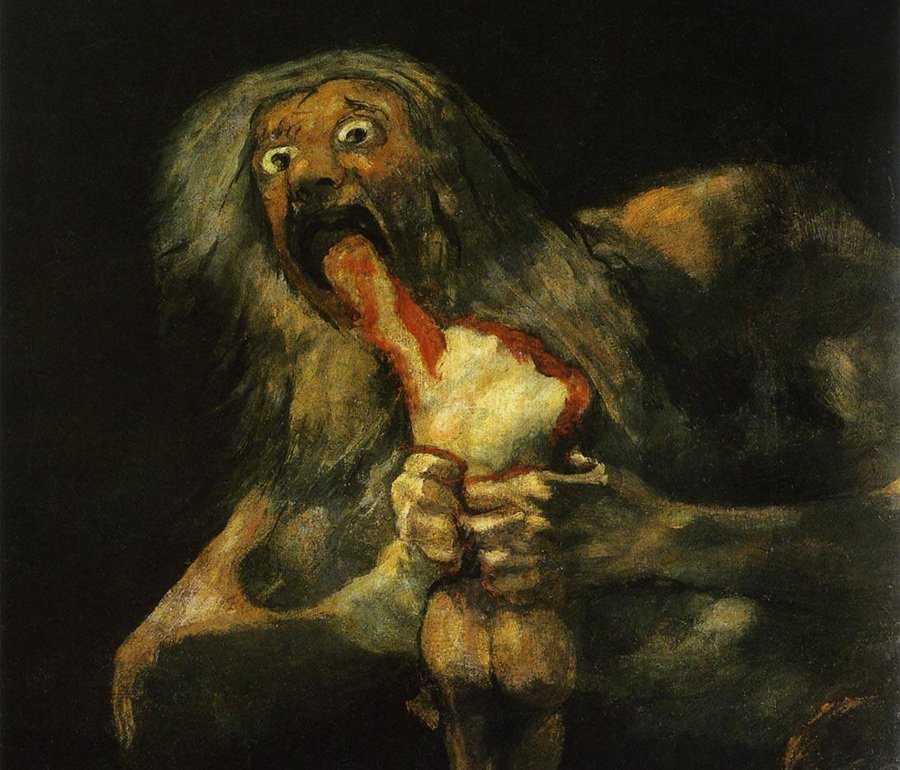
Francisco Goya. «Saturn Devouring His Son,» 1820–1823. Prado Museum, Madrid.
This study examines attraction through repulsion, using painting, photography, sculpture, performance, and cinema as case studies. The focus is on the interaction between the artwork and the viewer, and the techniques that capture attention. The theoretical framework draws upon Edmund Burke’s concept of the Sublime, Aristotle’s concept of catharsis, and Noël Carroll’s paradox of horror. These approaches allow for an exploration of fear not only as a reaction of aversion, but also as an experience that a person may voluntarily engage with.
Francis Bacon. «Three Studies for Figures at the Base of a Crucifixion, ” 1944. Tate Collection, London.
Research subject: frightening and repulsive imagery in art and visual culture. The object of study: artistic techniques and perception mechanisms through which images of fear, violence, death, and bodily deformation capture attention. Research question: why do people continue to look at images that evoke fear or disgust? Research objective: to determine what properties of an artistic image transform an unpleasant depiction into an object of interest. This involves examining philosophical interpretations of the sublime and horror, works from various art forms, and the role of provocation and taboo.
Rembrandt van Rijn. «The Anatomy Lesson of Dr Nicolaes Tulp, ” 1632. Mauritshuis, The Hague
The hypothesis posits that the attraction to repellent imagery arises from a combination of emotional impact, curiosity, and psychological distance. Artistic form allows us to examine fear and disgust as subjects for contemplation. Moreover, the desire to look does not always equate to pleasure; it can be linked to an attempt to understand the unknown or to empathize with the depicted subject. The study seeks to define where the boundary lies between repulsion and aesthetic interest, and why a person continues to watch even when they want to look away. This is the paradox of the gaze.
Andy Warhol. «Orange Car Crash Fourteen Times, ” 1963. Museum of Modern Art (MoMA), New York.
I. The Spectacle of Alien Suffering
Fear of violent imagery
The first piece is a painting by Francisco Goya, which depicts a mythological scene of Saturn devouring his own son. The artist captures a moment of violence, leaving the viewer no opportunity to look away from what is happening. The composition is particularly significant: Saturn’s figure bursts from the dark space, and his wide-open eyes and tense posture create a sense of madness. The lack of a detailed background concentrates attention solely on the action. The work is interesting because the viewer confronts an image that is difficult to perceive calmly, yet it simultaneously provokes a desire to examine it in greater detail. This allows us to pose the initial research question: why can a visually repellent image hold one’s attention?
Francisco Goya. «Saturn Devouring His Son, ” 1820–1823. Museo del Prado, Madrid.
Human tragedy and compassion
Unlike Goya’s mythological scene, Théodore Géricault’s work is based on a real historical disaster—the sinking of the frigate Méduse in 1816. The artist depicts people stranded on a raft in the middle of the sea. The composition features the dead, the dying, and those who still hold onto the hope of rescue. The viewer gradually moves their gaze from the bodies in the lower part of the painting toward the figures desperately trying to attract the attention of a ship on the horizon. Here, the importance lies not only in the depiction of suffering but also in the emotional connection the work establishes with the viewer. Rather than provoking immediate shock, the painting elicits empathy and a desire to understand the fates of the depicted people. This allows for a reference to the Aristotelian concept of catharsis and an exploration of how tragic content becomes a source of aesthetic experience.
Théodore Géricault. «The Raft of the Medusa, ” 1818–1819. Louvre Museum, Paris.
Violence as a Theatrical Stage
In Artemisia Gentileschi’s painting, the biblical subject of Judith beheading Holofernes is depicted. The artist selects the most intense moment of the narrative—the action is already underway and cannot be stopped. The composition is structured so that the viewer is placed almost directly before the event. The direction of the characters' arms, the tension in their bodies, and the contrasting lighting amplify the drama of the scene. Furthermore, the image possesses a meticulously constructed artistic structure. An interesting contradiction arises here: the viewer feels discomfort from the content, yet simultaneously perceives the scene as a masterfully organized composition. Violence becomes not just an event, but a visual spectacle.
Artemisia Gentileschi. «Judith Slaying Holofernes, ” c. 1620. Uffizi Gallery, Florence.
The Viewer as Witness to the Event
In Goya’s painting, «The Third of May 1808 in Madrid,» the execution of Spanish insurgents by French soldiers is depicted. The artist does not present a heroic moment of battle, but rather the helplessness of people facing death. The posture of the central figure with raised arms is particularly significant. She is illuminated by the bright light of a lantern, while the soldiers are shown from behind and are virtually devoid of individual features. The viewer sees the event from the perspective of the victims, not those committing the violence. The work allows us to explore how composition and the distribution of attention shape the viewer’s emotional stance. We are not merely observing a scene; we find ourselves in the position of a tragedy’s witness.
Francisco Goya. «Third of May 1808 in Madrid, ” 1814. Prado Museum, Madrid.
When aversion transforms into the desire to learn
Rembrandt’s work depicts a public anatomical demonstration during which Dr. Nicolaes Tulp performs a human dissection. Unlike his previous works, the image of death here is not directly tied to violence or emotional tragedy. Instead, it becomes part of scientific inquiry. The viewer’s attention is distributed between the deceased body and the observing physicians. The composition creates an interesting parallel: the characters within the painting examine the body, while the viewer observes them and the object of their study. This piece allows for an expanded investigation—an unpleasant image can attract interest not only through fear or shock, but also through curiosity, the desire to study the unknown, and the will to overcome one’s own aversion.
Rembrandt van Rijn. «The Anatomy Lesson of Dr. Tournefort,» 1632. Mauritshuis, The Hague.
II. The Repelling Body
The boundary between life and death
In Egon Schiele’s painting «Dead Mother I,» the artist addresses the themes of motherhood, death, and the vulnerability of the human body. At the center of the composition is a child surrounded by the figure of a mother, whose face and body take on an almost spectral quality. The dark space and the contrast between the two figures create a sense of confinement and anxiety. Although the image does not depict an explicit scene of violence, it evokes strong emotional discomfort simply through the proximity of life and death. This work is significant for research because it demonstrates that a repelling effect can arise not only from the depiction of physical harm but also from complex emotional associations.