Categories
► Concept
► Artists and Their Contributions ▹ Pablo Picasso ▹ Georges Braque ▹ Juan Gris
► Influence on Art Development ▹ Conclusion and Summary
Concept
Cubism is one of the most vibrant movements—a visual revolution in art.
His founders—Georges Braque, Pablo Picasso, Juan Gris, and others—rejected traditional methods of representation and academic standards in favor of experimentation. Forms broken down into simple geometric elements, fragmented lines, and distorted perspective—this is what is so captivating about Cubism.
Masks, statuettes, and ornaments equally unconventional in form can be found in African culture.
The continent, which had long remained a mystery, suddenly revealed its secrets and became a source of inspiration for many artists, including the Cubists.
African culture spurred creators toward bold decisions and the introduction of new elements into their works. The use of motifs and symbols from the southern continent imbued Cubism with fresh colors and new meanings. This immersion in another culture became not just a catalyst for new artistic achievements in the 20th century, but also a unique bridge between European and African cultures.
In my research, I delve into an analysis of what drew the Cubists to African culture, which elements were most intensely borrowed from it, and how this influenced not only Cubism itself but also modern art as a whole.
This topic caught my attention because it is known that masters such as Pablo Picasso possessed extensive collections of African artifacts. This led me to consider how similar the styles and themes might be in the works of European artists and the creations of African masters.
The research is based on E. E. Agratina’s textbook on 20th-century art, articles about the artists included in the subsequent analysis, and my own observations derived from studying the listed course materials. The images were primarily taken from museum websites, and in some cases, from African artifacts listed on auction sites.
I will begin my analysis with the creative works of Pablo Picasso and conclude with those of George Braque and Juan Gris. I chose this structure not only because Picasso is considered one of the founders of Cubism but also because examining the work of these artists allows for a deeper understanding of how much, and in what manner, they adapted African elements into their own art, and how these borrowings contributed to the development of Cubism as an independent artistic movement. Throughout this research, I aim to trace which specific features and motifs of African art most influenced European artists and how this manifested in their subsequent works.
Pablo Picasso
By the end of the 19th century, thousands of African artifacts entered Europe as a result of imperialism. At that time, they were not considered works of art and held little economic value. However, in the early 20th century, Pablo Picasso discovered African culture, and its aesthetic became one of the primary sources of inspiration for the Parisian school.
Unknown artist. Figure of Willy from the Democratic Republic of Congo, acquired by Henri Matisse. Date of creation unknown.
In the spring of 1907, Henri Matisse traveled to visit the American writer and collector Gertrude Stein. During his visit, he stopped by a so-called «antiques shop» to purchase a small African sculpture. Picasso was also staying with Stein at the time. The sculpture immediately caught his eye, and it was later identified as the figure of Willy from the present-day Democratic Republic of Congo.
Picasso was captivated by the «magic» of sculpture and masks—the way «wild» art affected the viewer.
Pablo Picasso in his Montmartre studio, 1908
In African art, narrative was ignored; instead, focus was placed on posture, the expression in the gaze, and the overall presence of the figure within the world. African artists most frequently chose wood or stone for their work. These hard materials were difficult to manipulate, which resulted in forms that were angular and rigid. It is these very qualities that will later transition into Cubism.
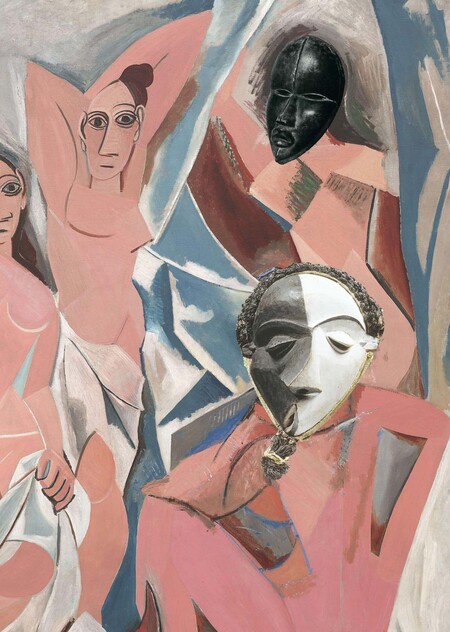
Pablo Picasso. «Les Demoiselles d’Avignon,» June–July 1907
Picasso’s «Young Ladies of Avignon» is generally categorized as proto-cubism—a period when cubism was just beginning to emerge as a movement.
Artists from Africa have simplified the human figure into basic forms for centuries. It is difficult not to notice this simplification in Picasso’s painting. The viewer’s eye can still discern the features of the girls’ bodies, but they certainly cannot be called realistic. However, it is the faces that most attract researchers.
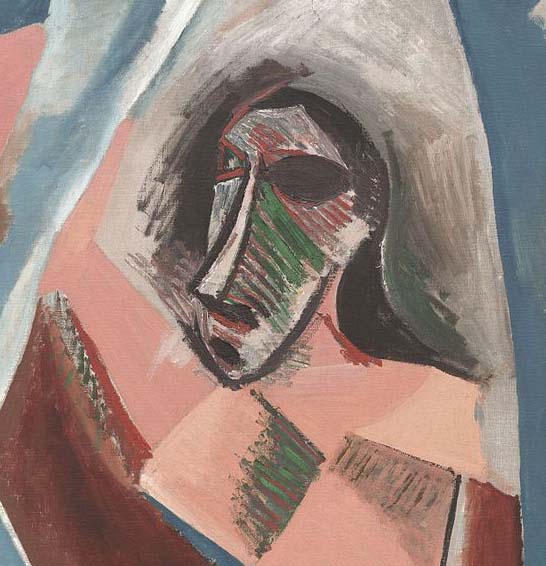
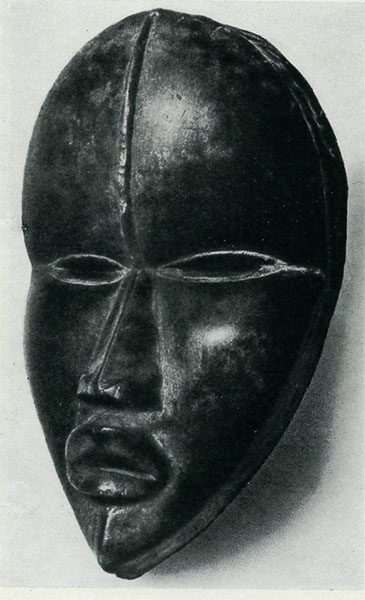
Pablo Picasso. «Les Demoiselles d’Avignon, ” fragment, June–July 1907; Unknown Artist. Dan Mask, Republic of Ivory Coast. Date unknown.
The frozen features of the two girls in the center were inspired by archaic busts from his native Iberia, while the figure of the woman in the upper right corner was influenced by masks of the Dan tribe from the Ivory Coast. These masks can be recognized by the narrowed forehead, puffed lips, elongated bridge of the nose, and pointed chin.
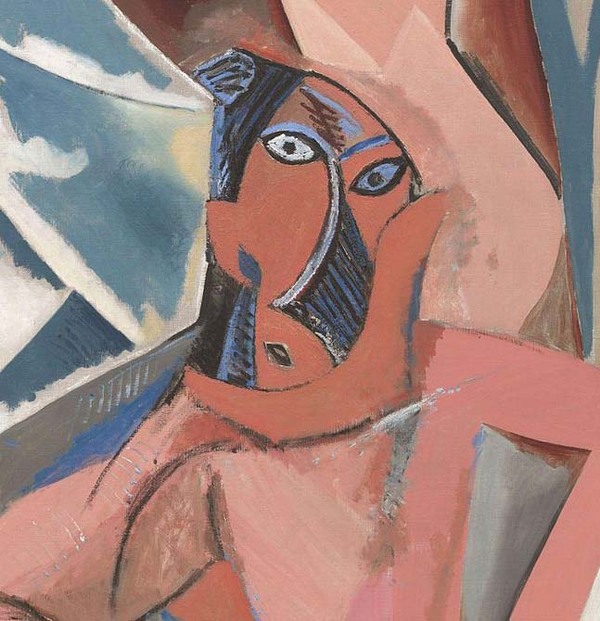
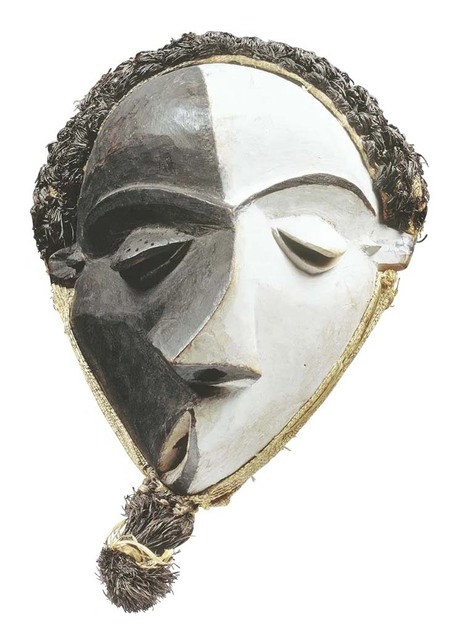
Pablo Picasso. «Les Demoiselles d’Avignon,» fragment, June–July 1907; Unknown artist. Mbuyia Mask «Mbanju,» belonging to the Pende people. Date unknown.
In the bottom right corner, we see a completely different young woman whose face resembles the masks of the Mbuyia tribe of the Pende people. Her face is simultaneously frightening and captivating because of its extraordinary nature: a triangular nose skewed to one side, slanted eyebrows, and a re-narrowed forehead around her eyes.
One cannot help but note the color palette Picasso uses to depict the two women described above.
The thing is, the African palette is quite limited. Primarily, tribes used white, black, and reddish-brown, with yellow—also called «lemon color"—used in rare instances. Blue and green were more commonly reserved for sculpture and paintings.
Picasso extensively utilizes shades of red, black, and white, alongside blue and green, primarily for backgrounds and to emphasize female figures. This directly connects his work to African art.
«The Avignon Girls» represented a radical departure from naturalism, shattering preconceived notions of what art should look like. The strange women, with mask-like faces, were considered utterly unfeminine. The work was met with negative reception from both artists and critics.
Pablo Picasso. «Dance with the Cloaks, ” 1907
Nevertheless, Picasso did not abandon the African Period.
Over the following years, he continued to borrow various elements from African art, creating a series of paintings and sculptures in which he continued to reduce facial features to simple geometric forms, channeling the aesthetics of West and Central African art. It is noticeable how Picasso’s paintings begin to adopt increasingly bold, rough brushstrokes that already foreshadow analytical cubism.
For instance, in «Head of a Sleeping Woman» (study for «Dance with Blankets»), he sharply defined the face and created volume using dense, shaded cross-hatching in multiple directions.
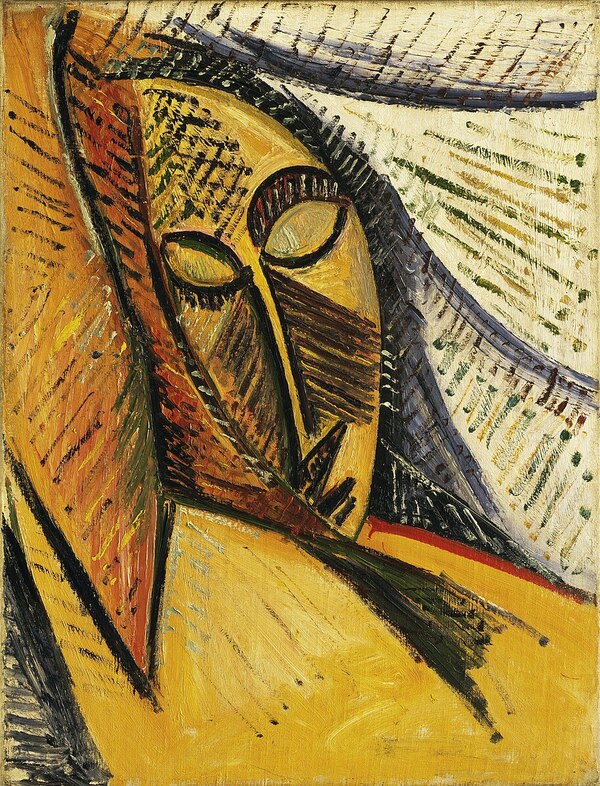
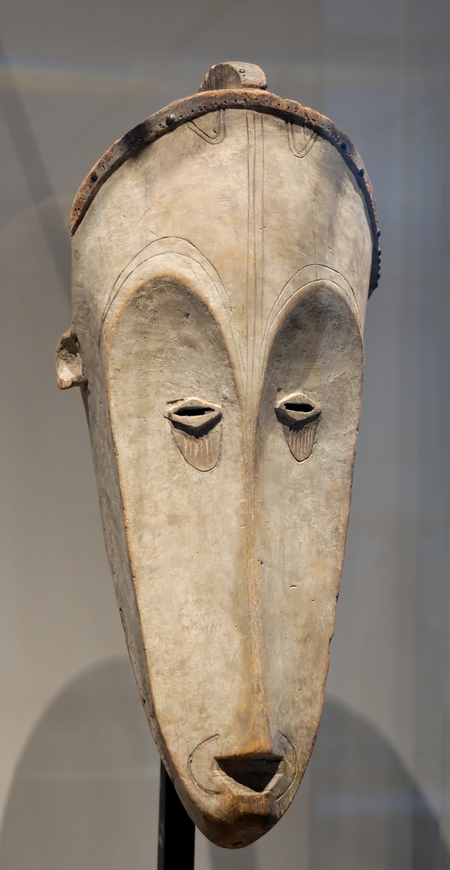
Pablo Picasso. «Head of a Sleeping Woman (Study for The Dance with Curtains),» Summer 1907; Unknown artist. Fang Mask from the Republic of Gabon. Date unknown
The end of the African period was increasingly beginning to resemble analytical Cubism—not so much in color as in form. The stone faces of the people acquire a mask of serenity, a trait that can be traced in Picasso’s later Cubist works.