Concept
For a very long time, women in many areas of life were oppressed by society. Art was no exception. History before the advent of Impressionism records very few female artists, and it is impossible to even place truly great women—those who could stand alongside geniuses like Leonardo da Vinci or Michelangelo—in the same league. However, this does not mean that there were no geniuses among female artists: «…the answer to why there weren’t great female artists does not lie in the nature of individual genius or its scarcity, but in the nature of existing social institutions and what they prohibit or encourage regarding different social classes and groups» []. Women were never deprived of talent, but their education was severely limited, and they often remained in the shadow of men (fathers and husbands).
When women finally gained access to education on par with men, many names resonated throughout the culture—names that remain familiar to the general public even today. Women are innovators; they create their unique styles and bring fresh, engaging ideas into art—their genius is in no way inferior to that of men. Progress, which has brought increasing freedom and equality, has helped unlock this potential. Unfortunately, this topic remains highly relevant. Our world is imperfect; there are underdeveloped nations where women hold marginalized positions. Even in more enlightened regions, patriarchal structures can persist within families, oppressing women. Moreover, there exist various demeaning prejudices and stereotypes. Yet, a woman can be a talented artist, a genius. Therefore, to demonstrate the significance of her role in the development of art, this visual study will examine the techniques, motifs, and styles that women employed in their work—how diverse they were—and how they compare to the same parameters of male art. It is vital to understand: did access to a quality education truly help unleash women’s potential?
Thus, the following principle of categorization will be used in this work: it should begin with images of women depicting themselves and other women, as this «world» is the most familiar and understandable to female artists; it would then be interesting to continue with the theme of family and children, which is often considered closer to women; and finally, it would be desirable to conclude by examining the innovative motifs, styles, and techniques introduced specifically by women.
To create this visual study, textual resources and literature meeting the following criteria were examined: articles that are sought after by the academic community, where the authors' expertise is confirmed, and articles that are timely.
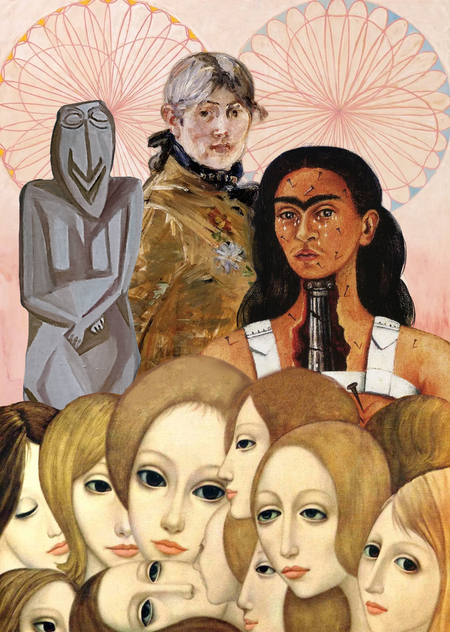
The selected works belong to both popular artists and less widely known creators. Readers will find it easier to engage with the research through examples of more famous artists, while works by less popular creators, such as Margaret Keane, will allow the reader to become interested in their work and discover new favorite female artists.
Self-Representation
Self-portraiture holds a special significance in art because it allows the artist to express their individuality. In the context of women’s art, self-representation can carry even greater weight, given that women have historically been limited in their ability to express themselves fully. The self-portrait allows a woman to present herself as she is, drawing attention to her inner world—her thoughts and emotions.
Self-Portraits: Herrada von Landsberg, c. 1180 // Artemisia Gentileschi, 1630s // Adelaide Labile-Giar, 1785
The female self-portrait has traveled a long path and is directly connected to the time in which the woman created it.
Berta Morisot, Self-Portrait, 1885 // «Self-Portrait with Julie, ” 1887
Gabriel Münter Self-Portrait, 1908 // Zinaida Serebriakova «Self-Portrait in a Scarf, ” 1911 // Helena Sophia Scherfbeck „Self-Portrait in Blue, ” 1912
Starting in the late 19th century, a trend emerged in female self-portraits to focus more heavily on technique, diminishing the importance of outward appearance as it once held. This shift is connected both to the development of photography and the emergence of various artistic styles—Impressionism and so forth.
Tamara Lempitska «Self-Portrait in a Green Bugatti, ” 1929
Praskovya Vazhnova «Self-Portrait (Tractor Driver)», 1930
Rita Kerrn-Larsen, Self-Portrait, 1937
Alisa Poret, «The Artist and His Models. Self-Portrait, ” 1958
In the 20th century, women, just as men, developed their own styles, drawing in a wide variety of techniques. Masculine and feminine self-portraits no longer possess any definitive global distinctions: «while in former times women overtly emphasized their femininity, proudly asserting their exclusive status, today, in the pursuit of equality, gender boundaries are blurring» [].
Frida Kahlo Self-Portraits: «Self-Portrait with Cropped Hair, ” 1940 // „Broken Column, ” 1944 // „Fraternal Embraces of the Universe, Earth (Mexico), Me, Diego, and Señor Xolotl, ” 1949
Women bring highly personal themes into art, making their work more autobiographical. For example, for the artist Frida Kahlo, the self-portrait became a central theme in her works; through it, she could tell her story and fully express her emotions and pain.
Image of a woman
Depictions of women by women are just as vital and fascinating a part of women’s art as the self-portrait.
Through this, one can see how female artists likely portrayed a woman’s place in society—their perspective on themselves and others, their relationship to society, and cultural stereotypes.
Zinaida Serebryakova, «Bathing Girl, ” 1911 // „Whitening of Canvas, ” 1917
Tamara Lempitskaya «Portrait of Duchess de la Salle, ” 1925 // „Dream (Rafael on Green Background), ” 1927 // „Portrait of Ira P., ” 1930
Often, female artists depicted other women as monumental, resilient, temperamental, and willful.
Edgar Degas, «Ukrainian Dancers, ” 1899 // Gustav Klimt, Hygieia. Fragment of the painting „Medicine, ” 1901 // Kazimir Malevich, „The Sowers, ” 1929
However, women of this type were also present in men’s art.
Mary Cassatt «Woman with a Red Chrysanthemum, ” 1891 // „Child Ripping a Blossom, ” 1893 // „Lesson in Banjo Playing, ” 1894 // „Augusta Reading to Her Daughter, ” 1910
And women were depicted in other archetypes as well: fragile, graceful, sensual young women, caring mothers.
In general, both men and women portrayed female figures in various ways. The result depended solely on the artists themselves—their worldview, their emotions. The advancing times freed art from rigid canons.
However, a distinction remained between male and female representations of women. This is especially clear when comparing the ballerinas in paintings by Zinaida Serebryakova and Edgar Degas.
Zinaida Serebryakova, «Ballerinas in the Restroom, ” 1923 // Edgar Degas, „Ballet Rehearsal, ” 1873
Zinaida Serebryakova, «Ballet Dressing Room. Snowflakes (The Nutcracker Ballet),» 1923 // Edgar Degas, «Three Dancers in a Rehearsal Hall,» 1873
Both artists depict backstage life in the theater, but while Degas captures moments of dynamic dance in his paintings—often during rehearsal—Serebryakova demonstrates the most secret parts of the theater: the dressing rooms. «She is concerned with the atmosphere of the festival’s inception—when the ordinariness vanishes, and the young actresses gradually transform into scenic figures of swans, snowflakes, and sylphs internally and through costume and makeup» []. A man can only watch the dance from the outside, but a woman, better understanding another woman, can capture on canvas not just simple movements, but something deeper, more profound.