
In the modern world, design and art increasingly function not only as forms of aesthetic expression but also as complete systems of communication. Visual imagery, form, color, material, and structure assume the role of meaning carriers, participating in the social construction of reality. Communication theory interprets this process not as a one-way transmission of a message, but as a dynamic interaction between the object and its interpreter, through which meaning is co-created within a specific cultural and social context. In this sense, design and art become spaces of dialogue that reflect values, norms, and worldviews.
The media and visual environment in which contemporary individuals exist profoundly influence how they perceive reality. Much like the visual imagery and narratives disseminated through various communication channels, design does not simply mirror the surrounding world—it interprets and transforms it, establishing specific frameworks of meaning.
In this process, the artist and designer act not merely as creators of form but as mediators of meaning, shaping the field of perception and guiding the viewer’s interpretation.
The public sphere plays a particularly vital role in meaning-making, as artistic and design objects become integrated into social discourse. Once situated in an urban space, an exhibition, or a digital environment, these objects generate reactions, discussions, and reinterpretations, thereby contributing to the formation of a collective experience. In this context, meaning no longer belongs solely to the author—it emerges through the interaction with the audience, their cultural codes, expectations, and emotional engagement.
Communication in design is largely dialogical: a person does not merely perceive an object but enters into a relationship with it, responding to it physically and emotionally and imbuing it with personal meaning. Through this process, visual form becomes a language capable of conveying values, moods, and ideas without the use of words, activating associations, memories, and emotions.

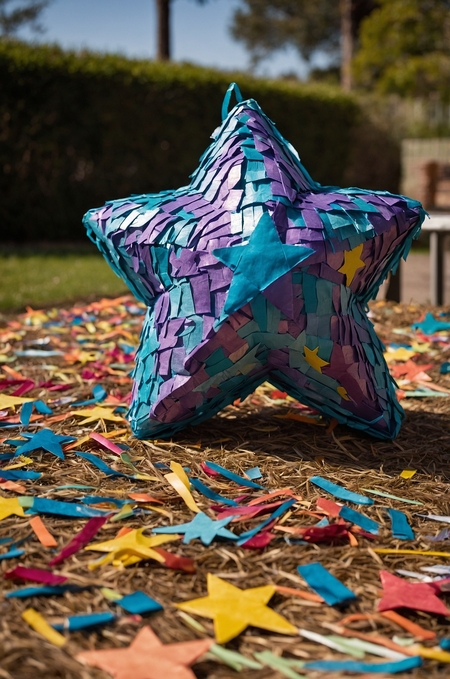
Images of AI-generated piñatas
In this context, the piñata as a design object transcends the boundaries of a typical festive attribute. It functions as a communicative statement about joy, play, collectivity, and emotional release. Through its form, color, imagery, and the very ritual of interaction, a unique semantic and emotional space is created—one in which a person experiences not merely a game, but a moment of transformation: from anticipation to release, from tension to joy.
Thus, the Piñata brand can be viewed not only as a product for entertainment but also as a tool for communication and shared experience, where design serves as a language and action becomes a means of establishing connection among people, space, and emotion.
Piñata is a brand specializing in the production of piñatas.
A piñata is a bright and colorful object, usually made of cardboard and filled with candies, small toys, or other treats. It is traditionally hung up, and participants take turns hitting it with a stick (often while blindfolded) until it breaks open and the contents spill out.
Image from URL: https://wrightbabyblog.wordpress.com/


Images of piñatas generated by AI
You choose the shape, theme, and mood, and we transform it into a vibrant, colorful object that hides sweets, surprises, and a genuine explosion of emotion inside.
This is more than just a decoration—it’s a moment that brings everyone together, makes them laugh, film videos, and truly experience the celebration.
The Piñata is designed for those who value experiences and know how to enjoy simple yet powerful moments. It works perfectly at a kids' birthday party, a lively college gathering, or a cozy family celebration.
It is the element that turns an «ordinary day» into an event people will remember for years to come.


Images of AI-generated piñatas
You can choose one of our ready-made piñatas or create your own—unique, matching your party’s style, favorite character, or meaningful symbol.
And you don’t have to overpay: we make piñatas intentionally affordable so that joy isn’t a luxury, but a part of everyday life.
Concept: The brand makes it easy to order any piñata from a huge assortment of shapes and sizes—whether as a gift or an entertainment option—and allows customers to create their own custom designs, which we bring to life. All this while keeping prices affordable and delivery convenient.
Images of piñatas generated by AI
This product appeals to a wide audience that values fun and unique entertainment for celebrations. Whether it’s a child’s birthday or a corporate event, piñatas are suitable for all ages.
The target audience can be divided into subgroups to better understand their values:
• Parents who want to create an unforgettable celebration for their children • Students and young adults who want affordable and unconventional entertainment options • Office workers who are interested in corporate events, colleagues’ birthdays, and team-building activities to strengthen team spirit.


Images of piñatas generated by AI
For young people and students, affordability and ease of ordering are especially important; parents prioritize safety and product quality; working professionals and teams need high-quality, personalized piñatas to create unforgettable events. Piñata meets these needs by offering a wide selection, custom designs, and streamlined ordering and delivery, making celebrations more accessible and memorable.
Tone and style of communication: Friendly and energetic.
Main communication channels: • Social media • Website • Outdoor advertising • Collaborations with influencers and bloggers • Event participation
Channel integration: key principles
• Unified brand book: Strict adherence to brand identity (colors, fonts, logo) across all platforms to increase recognition. • Message consistency: Communicate unified key messages and slogans across all channels. • Cross-promotion: Promote channels mutually (e.g., link to the website on social media, encourage social media subscriptions offline). • Synchronized launches: Simultaneous campaign and promotion rollouts across all platforms to maximize reach and impact. • Centralized analytics: Consolidated data analysis from all sources to gain deep audience insights and optimize strategy.


Images of AI-generated piñatas
Key Ideas and Concepts:
• Theme of Joy and Celebration: All communications focus on creating an atmosphere of fun and happiness associated with piñatas. • Piñata Personification: Introduce piñata characters with stories and personalities to capture attention and build an emotional connection with the audience. • Creative Contests and Challenges: Encourage participation in contests for the best piñata design or custom creation, stimulating creativity and brand engagement.
Formats and Content Types:
• Video: Short clips showcasing the piñata creation process, usage ideas, and events where piñatas are the centerpiece. • Infographics: Visual guides for selecting piñatas, assembly instructions, and usage tips. • Articles: Blog posts covering piñata traditions, interesting facts, and party planning advice. • Blog and Social Media Posts: Regular updates featuring promotions, contests, and piñata usage ideas. • Advertising Banners: Bright, eye-catching banners for both online and offline advertising.
The development of the Piñata brand concept and presentation was based on understanding communication as a complex, multi-level process in which meaning is not mechanically transmitted from sender to receiver, but is formed through social interaction, interpretation, and collective experience.
This approach aligns with the contemporary paradigm in communication theory, which considers visual and material objects as active participants in meaning-making. In this context, the piñata is understood not merely as a source of entertainment or a decorative element of a celebration, but as a communicative object capable of evoking emotions, initiating interaction, and creating shared experiences among people.
Images of AI-generated piñatas
The theoretical understanding of communication processes allowed the Piñata brand to be constructed as an integrated system, encompassing visual language, action scripts, emotional impact, and the social space of interaction.
The product’s form, visual characteristics, methods of use at events, as well as the channels and style of audience communication, were all designed as elements of a unified semantic structure.
Thus, communication theory served not as a secondary addition, but as the methodological foundation for the brand concept.
Symbolic Interactionism (G. H. Mead, H. Blumer)