Categorization:
1. Concept
2. Space and People
3. The Man: Suit as Message
4. Labor: The Bead as Unit of Measure
5. Children: Status Without Merit
6. Signs Outside Clothing: Discs, Horses, Scepters
7. Conclusion
8. Sources
Concept
How did people communicate their group affiliation, social standing, or personal identity to one another before the advent of writing? One possible method of such communication might have been the objects people surrounded themselves with and elements of their outward appearance. Clothing, jewelry, and other features of appearance not only serve practical or decorative functions but can also acquire the meaning of signs understandable to others. It is particularly interesting to examine this question using Paleolithic materials—an era for which no written records or direct explanations survive regarding the significance people attached to their possessions. One of the most illustrative monuments for such a study is the Sungir settlement, located on the outskirts of modern Vladimir. Around 30,000 years ago, burials were conducted here, among which the graves of an adult male and two teens are particularly noteworthy. Their bodies were accompanied by numerous ornaments made of mammoth ivory, animal tusks, and other materials: thousands of beads, bracelets, pendants, and elaborate costume elements. This quantity and diversity of objects prompts reflection: were the ornaments merely an expression of aesthetic preference and part of funerary rites, or could they have served a more complex function—communicating something about the individual to others? Could the placement of ornaments on the body, their quantity, shape, and material indicate affiliation with a specific group, social status, or a particular role of the person within the community?
The objective of this research is to determine whether the ornaments and elements of the Sungir burial costume could have functioned as markers of social identity and differentiation within Paleolithic society. To achieve this, I examine the distinctive features of the costumes of various buried individuals, the labor intensity of crafting the ornaments, their placement on the body, and items not directly related to the clothing. For each object, I ask one question: what message can be read within it, and what might viewers 30,000 years ago have understood from it?
Hypothesis
Jewelry and costume elements in the Paleolithic served as a form of non-verbal «language» for social communication. Their form, quantity, material, and placement on the body could convey information to others about an individual’s social identity, their affiliation with a specific group, and their standing within the community. Thus, a person’s external appearance could function as a system of signs through which society recognized social distinctions.
Place and People
Who and what was buried at Sungir?
Before deciphering the symbols, one must understand who wore them. The settlement was discovered in 1955 during the development of a clay quarry on the eastern outskirts of Vladimir; the following year, an expedition from the Institute of Archaeology of the USSR Academy of Sciences, led by O. N. Bader, began excavations. In 1964, they uncovered a man’s grave, and in 1969, a double grave belonging to adolescents. The entire collection is housed at the Museum of Archaeology and Ethnography. Its size is estimated differently: the museum states that artifacts were selected from 70,000 items, while V. S. Zhitenev writes of a collection exceeding 80,000 items. The burials date back approximately 34,000 calendar years.
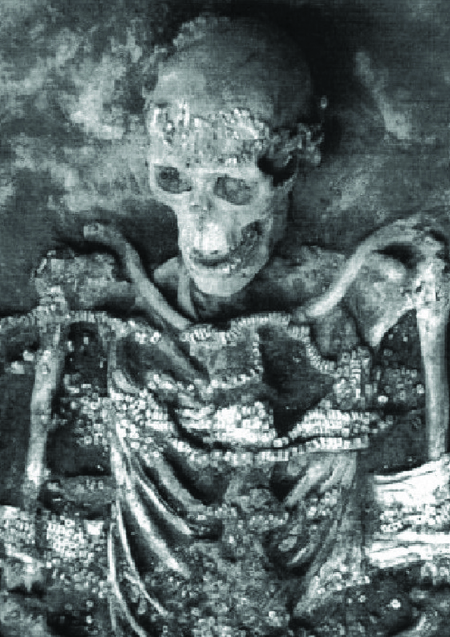
Fig. 1. Burial of a man (Sungir-1) during excavation. Sungir, excavations by O. N. Bader, 1964.
The man was laid on his back, stretched out, and covered with ochre. According to Tricaus and Buzhilova, he died suddenly from a cut in the lower part of his neck. But here, the cause of death is less important than its consequence: the person was not prepared for death in advance, which means his jewelry belonged to him during his life.
Fig. 2. Double burial of teens (Sungir-2 and Sungir-3) at the Sungir site. Excavations by O. N. Bader, 1969.
Two teens lay facing each other. This place holds the most items: dozens of bracelets, ivory spears, discs, and figurines. One of them, according to Trikaus and Buzhilova, was about 12 years old, and the other about 10.
The number of beads differs among various authors: Trikaus and Buzhilova estimate approximately 13,400 beads across three individuals; supplementary materials accompanying the dating article cite around 9,730 in two graves, while Zhitenyev considers not individual beads, but entire ornaments: about 3,600 in the male burial and 9,343 whole pieces in the children’s burial. This discrepancy arises because the authors count whole beads, fragments, and beads unattached to a specific person differently. Therefore, in my work, I present not a single figure, but a range, and attribute it to the author.
Man: A suit as a message
Let’s start with one person. Sungyri-1 is convenient because its costume can be disassembled into parts: something worn on the head, something on the body, something on the arms. We will look at each part as an individual word.
Fig. 3. Grave 1 with male burial (Sungir-1). Color photomontage. Sungir, c. 30 thousand years B.C. Photo: K. Gavrilov, 2018.
Rings of beads lie along the arms, legs, and torso on the skeleton. Based on their placement, researchers reconstruct the clothing: according to the materials detailed in the article on dating, the beads on the clothing helped determine the shape and size of the costume. This is the first argument supporting a «language”—what we see before us is not a handful of ornaments, but a deliberately designed ensemble.
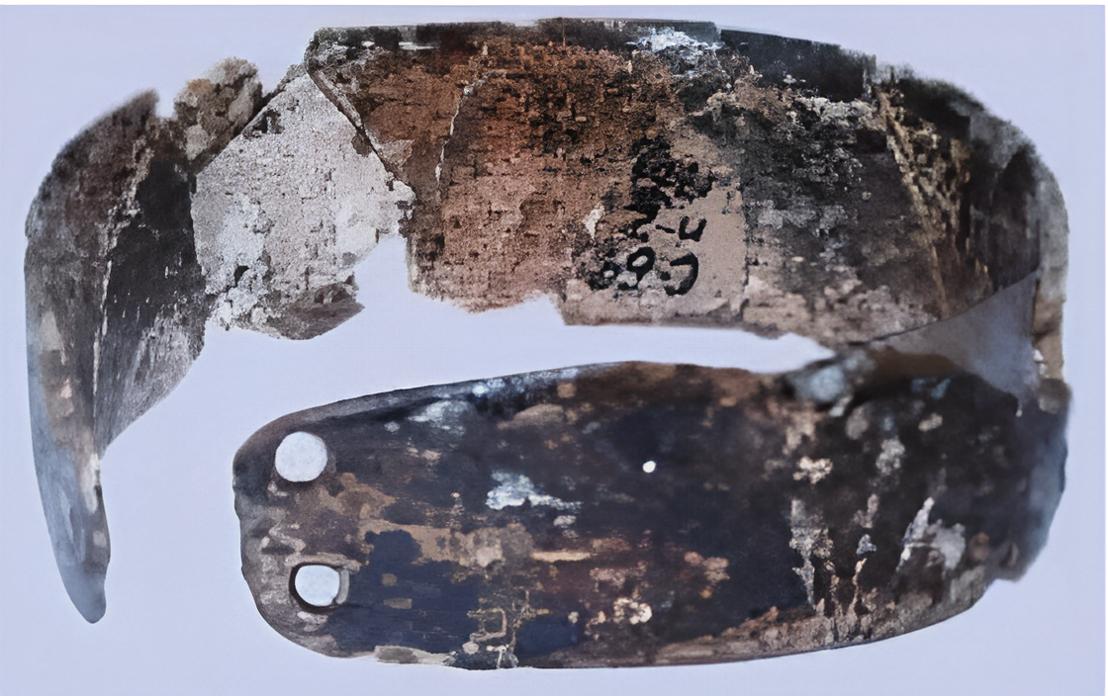
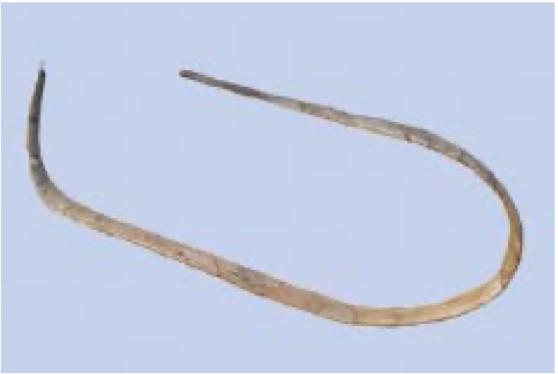
Fig. 4. Disc bracelets made from mammoth ivory from a male burial: cat. No. 1 (intact, 26.4 cm) and cat. No. 40 (with dotted ornamentation). Sungir, c. 30 thousand years BP.
Bracelets were made from thin ivory plates, measuring 1–3 mm thick and 5 to 22 mm wide. The catalog compiler identifies two types: wide (13 examples) and narrow (16). Some of the plates were short and had holes at the ends, and these bracelets were sewn onto or tied to clothing; the longer ones were worn on the bare arm. On one wide bracelet, a dotted ornament was revealed during restoration: 15 dots on the interior side and 4 on the exterior side. Since the inner surface of the worn bracelet is not visible, such an ornament might have been a private rather than a public sign. The exact number of bracelets remains a point of debate. The reason is simple: many bracelets crumbled into fragments when the monoliths were disassembled. But the main takeaway is that the man was not wearing a single adornment, but an entire set.