Navigation Menu
- Concept
- Antiquity. Sleep as an Image of Tranquility
- Sarcophagi: When Sleep Becomes Eternal
- Early Middle Ages. Death as Transition
- Late Middle Ages. The Body as a Testament to Loss
- Renaissance. Beauty and the Idealization of the Dead Body
- Comparison. The Boundary Between Sleep and Death
- Conclusion. The Motif of Sleep and Death in Art from Antiquity to the Renaissance
- Bibliography
- Image Sources
Concept
In this visual study, I intend to examine how the depiction of the inert human body evolved in European art from Antiquity through the Renaissance. I am interested in the boundary between sleep and death: why can a sleeping and a deceased person be portrayed almost identically, and what artistic devices help to differentiate these states? Using examples from ancient sculpture, funerary sarcophagi, medieval religious imagery, and Renaissance works, I plan to trace how the perception of the human body and its stillness changed across different historical periods.
The main objective of this study is to trace the evolution of artistic representation of the still body and to identify how the meaning of dream and death imagery changed from Antiquity to the Renaissance. I want to pay particular attention to the body’s posture, hand gestures, closed eyes, and drapery, and to understand how these elements shape the visual ambiguity between transient repose and ultimate stillness.
When selecting works for my research, I focused on images that depict the human body in states of sleep and death. As primary examples, I chose «Sleeping Ariadne,» ancient sarcophagi featuring sleeping figures, the medieval sculpture «Lying in State,» and Michelangelo’s «Pietà.» For me, it was important not only to trace the historical evolution of the artistic language but also to examine the common visual techniques artists employed to convey the stillness of the body. Therefore, my research paid particular attention to the comparative analysis of postures, gestures, facial expressions, and drapery.
Antiquity. Sleep as an Image of Tranquility
In ancient art, sleep was often depicted as a natural state of the human body. A sleeping person temporarily loses control over movement and the surrounding world, but this stillness does not signify the final loss of life.
It seems to me that the sculpture «Sleeping Ariadne» serves as a fine example. According to the myth, Ariadne helped Theseus escape the labyrinth, but afterward, he left her on the island of Naxos. It is in the moment of sleep that the sculptor portrays her. Later, Dionysus finds her, and he becomes her husband.
Sleeping Ariadne. Roman copy of an Hellenistic original from the 2nd century BCE. Vatican Museums
I want to start with the overall composition. Ariadne’s figure is placed diagonally. Her body appears relaxed: her head rests on her arm, one hand is raised above her head, and her legs are extended and slightly crossed. Her closed eyes and the lack of tension in her face enhance the feeling of deep sleep.Yet, the pose does not look entirely arbitrary. The lines of the arms, legs, and fabric folds form a single, smooth composition, creating a calm rhythm.I believe we can discuss the idealization of the human body here. The sculptor is not merely reproducing anatomy; rather, they are creating an aesthetically expressive image of sleep. This relates to the concept of mimesis—the imitation of nature and reality.
I feel that in Ariadne’s image, stillness is not frightening. On the contrary, it becomes part of idealized beauty. The body appears vulnerable, yet not dead—its stillness is temporary, and the narrative suggests awakening.
Sarcophagi: When Sleep Becomes Eternal
In antiquity, the image of sleep acquired additional meaning when it appeared on funerary monuments. Here, the form of the sarcophagus—an object intended for the interment of a body—is particularly significant.The sarcophagus from the Metropolitan Museum of Art depicts the myth of Selene and Endymion. The goddess of the Moon fell in love with the beautiful youth Endymion, who was granted eternal sleep and everlasting youth. Selene comes to him while he is asleep.
Marble sarcophagus with the myth of Selene and Endymion. Rome, early 3rd century AD. The Metropolitan Museum of Art
In the center of the composition is Selene, descending in her chariot. To the right, Endymion lies with an elongated and relaxed body. Unlike Ariadne, he is not simply asleep—his sleep becomes eternal. As I looked closer, I noticed a particular interaction between the figures: Selene moves toward her beloved, and figures accompany her. It seems to me that this creates a contrast between the active movement of the surrounding world and the stillness of the sleeping young man.
I liked the example with the sarcophagus because it allows one to observe how context shifts depending on the object’s intended purpose. If Ariadne is depicted in a moment of temporary sleep, then Endymion is connected to the idea of eternal repose. Since the narrative is placed on a sarcophagus, the myth acquires an additional funerary meaning. It seems to me that in this case, the image of sleep can become a metaphor for death. It enables us to discuss a person’s departure from life not through the depiction of bodily decay, but through the concept of peace and the continuation of existence.
Thus, the ancient sarcophagus connects two images: the physical body of the deceased inside, and the artistic representation of eternal sleep on the exterior.
Early Middle Ages. Death as Transition
In Christian art, the relationship with death gradually takes on a different meaning. If in ancient myths eternal sleep could symbolize repose and the preservation of youth, in the Christian tradition, death is associated with the concept of transition to eternal life. For the next example, I decided to use an image of the Dormition of the Theotokos. The Greek word Koimesis translates to «falling asleep.» Even the title of the subject combines two states—sleep and death.
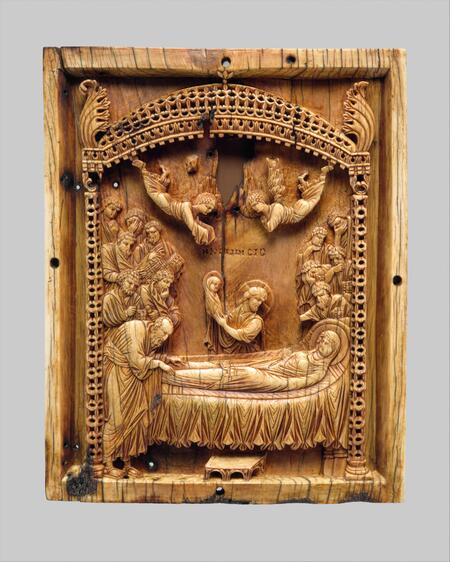
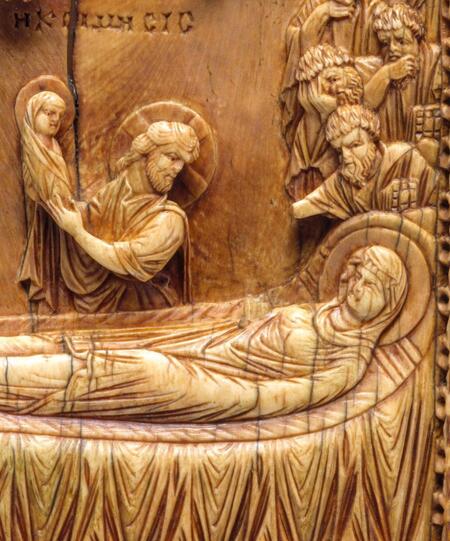
Assumption of the Mother of God. Ivory plaque. Late 10th century. Metropolitan Museum of Art, New York
At the center of the composition is the Theotokos lying on a bier. Her body is motionless, her eyes closed. The apostles are gathered around her, and Christ is depicted above the bier, holding the Theotokos’s soul in the form of an infant.
I noticed that the artist is conveying not just the physical death, but also the spiritual meaning of the event. If one looks closely, the Theotokos’s body remains on the bier, but the depiction of Christ with her soul points to the continuation of life after death.
I want to point out that, unlike in ancient sculpture where the primary focus was often on the beauty and plasticity of the nude body, here the figure is incorporated into a religious composition. The significance lies not so much in anatomical accuracy as in the meaning of what is happening.
I think this can also be seen in the spatial organization: the figures are arranged around the central bier, and Christ stands out due to his position and importance.
Thus, in the «Dormition,» the stillness of the body is no longer perceived merely as a physical state; it becomes an integral part of the religious narrative. Sleep and death converge, but death does not imply absolute disappearance—it anticipates a spiritual continuation.
Late Middle Ages. The body as a testament to loss
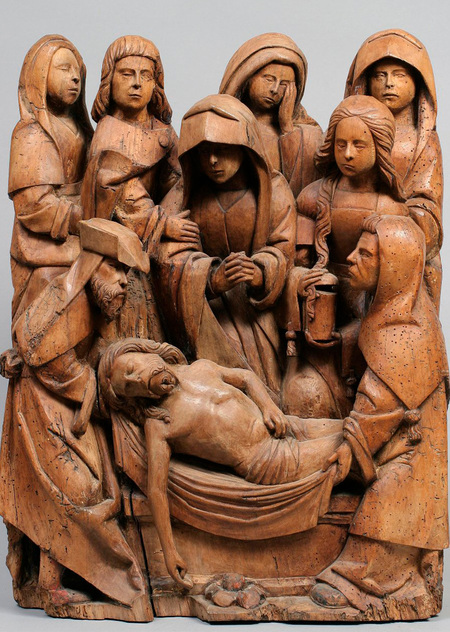
In late medieval art, the depiction of death becomes more emotionally charged. Artists are interested not only in the religious significance of the event but also in the human reaction to loss. When I visited the Pushkin State Museum of Fine Arts, my attention was drawn to an unknown master’s work due to its unusual rendition of the theme, «Laying in State.»
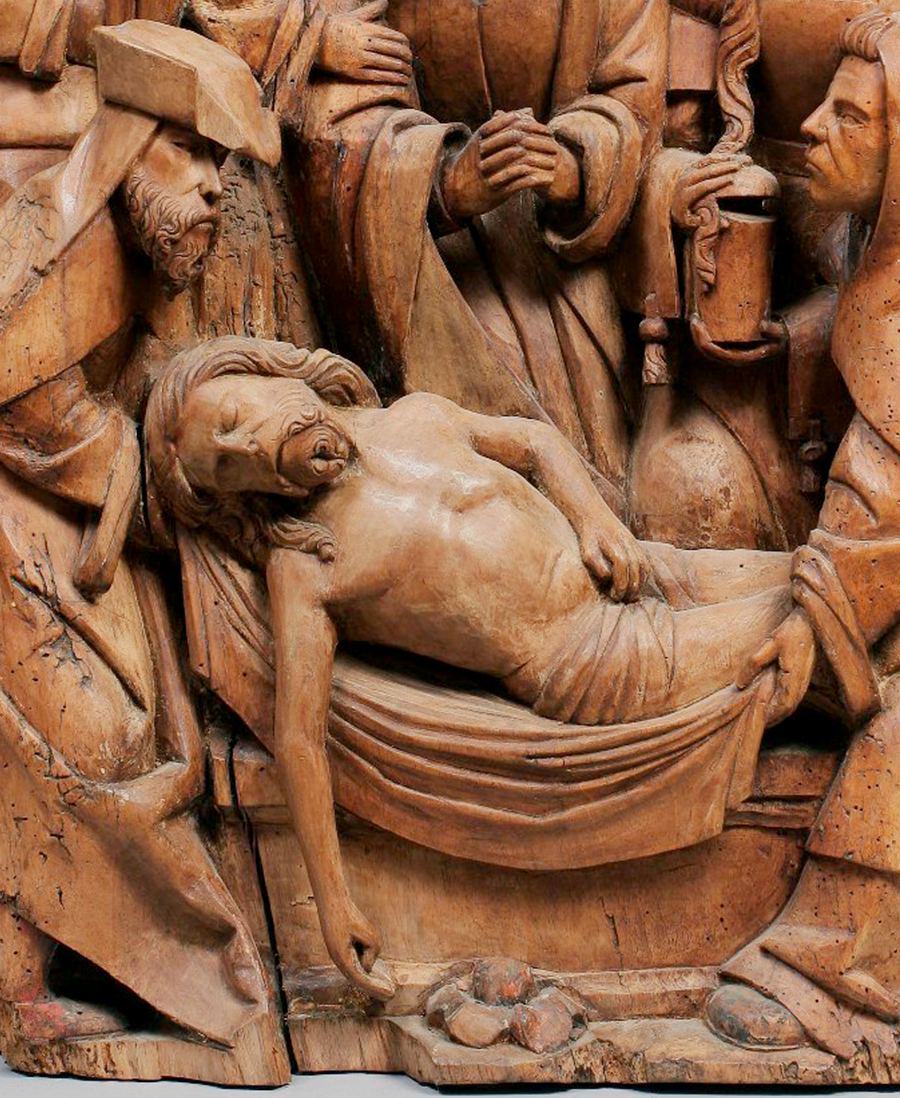
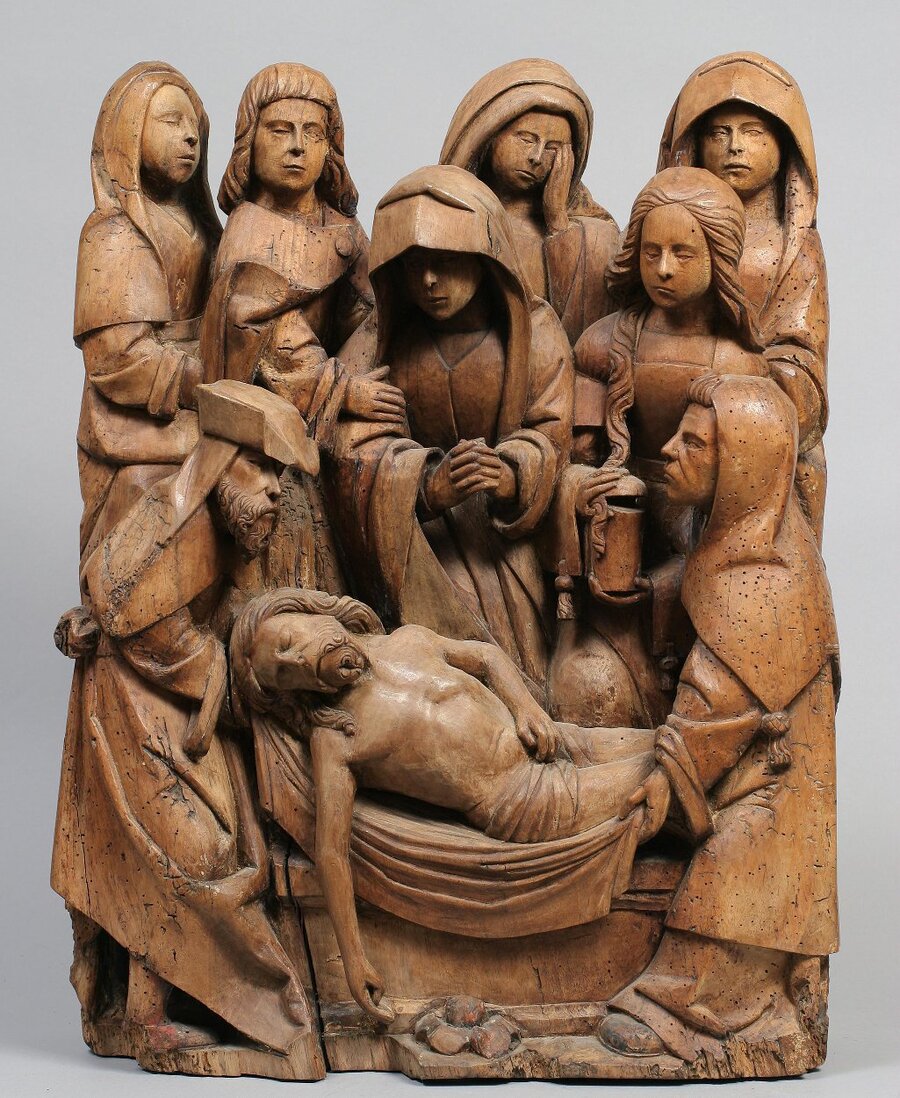
«In the Coffin.» Unknown Dutch Master, second half of the 15th century. State Museum of Fine Arts named after A. S. Pushkin.
Here, it is evident that Christ’s body is no longer merely resting in repose. It becomes the focal point of the action of other characters—it is supported, mourned, and prepared for burial. It seems to me that the very meaning of the reclining posture changes here. When applied to a sleeping person, it is associated with relaxation, but in a burial scene, the body lies still because it can no longer move on its own.
The interaction of the body with other figures takes on special significance. While a sleeping person in ancient imagery is often presented in isolation, here they depend on their surroundings.
I think this can be viewed as a shift in the representation of bodily stillness. The body no longer simply displays its own repose—it becomes an object of care and sorrow. As I wrote previously, the emotional component is also crucial. The gestures of the surrounding characters help the viewer understand what is happening. Thus, the meaning of the immobile body is revealed not only through its pose but also through the reactions of other people.
Thus, unlike the ancient depiction of eternal sleep, death here is presented as an event associated with human loss.
Renaissance. Beauty and the Idealization of the Dead Body