Concept
For many, this may not be immediately obvious, but the act of play preceded the very concept of play. Initially, it functioned as an instinct, a sacred ritual, a way to build culture. It wasn’t until millennia later—when society became complex, pragmatic, and divided life into «serious work» and «frivolous leisure"—that people needed the concept of play to separate it from harsh reality.
In traditional Chinese worldview, the concept of «play» was far broader than mere entertainment or amusement. Games in Ancient China were viewed as models of the universe, tools for comprehending cosmic laws, strategy simulation, and as a vital method for education and self-improvement. For instance, while Wei Qi (Go) models geopolitics and war (where all pieces start equal, luck plays no part, and everything depends on intellect), Mahjong models the economy, trade, and life itself with its inherent randomness. Nevertheless, even in its later, more competitive variations, it contains elements of strategy.
The origin of Mahjong itself has long been shrouded in myth, but we will attempt to uncover the truth behind this game’s genesis, as it did not arise from the warlord Zheng He or the ancient philosopher Confucius, nor did it originate in Noah’s Ark.
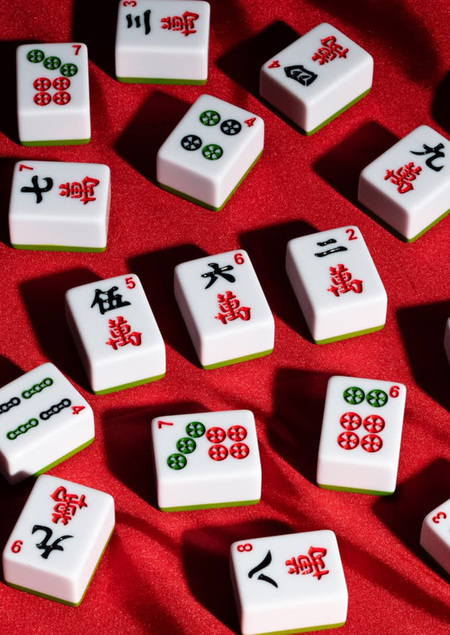
For many of us, the word «Mahjong» conjures an image of a heap of tiles, arranged in a stack where the player must find a match for the second tile. This is solitaire Mahjong, which is essentially not a «real» game in the sense that it lacks the true rules designed for multiple participants. Undeniably, there are countless rules, and in every corner of the world, they differ. They are played differently in China than in America, differently in Japan than in Hong Kong, differently in the United Kingdom than in France, differently in one region than in another, and differently in the Johnson home than in the Steiner home. This game can be compared to playing cards, for which there are hundreds of rule variations. The same is true for Mahjong: the same tiles can be played in countless ways. No matter which version you choose, Mahjong remains a unique and captivating game, regardless of how it is played.
Mahjong was originally created for gambling. The basic suits of the game—dots, bamboo, and symbols—are historical denominations of currency that were adapted for the tiles. For a better understanding, it can be compared to poker, as in Mahjong, just as in poker, one must collect certain combinations that irreversibly influence the outcome of the game. In high-stakes games like this, money often features, which is what creates the thrill. There is also a more grounded way to enjoy the game—a sporting approach. Mahjong is officially recognized as an intellectual sport, alongside chess, checkers, and Go. Within China itself, Mahjong was not an official national heritage for a long time, as it was initially believed to symbolize gambling. However, in the 1990s, the game gained government recognition and became a «social adhesive» for Chinese society. It also gained attention in other cultures, even if it was in the form that was not highly regarded in its homeland—the gambling aspect, in the United States. In Japan, the game evolved into its most complex competitive form—Riichi.
Based on the history and evolution of Mahjong, the following sections were developed:
1. What was known as a game in the Chinese understanding? 2. Origins 3. Authentic Mahjong 4. Risk and Thrill 5. Sport 6. Cultural Heritage and ExportWhat the Chinese called a game?
Emergence
This Mahjong
Risk and Thrill
Sports
Public domain, export