Navigation
1. Concept
2. Before the Avant-garde
3. Period of Flourishing
4. After the Avant-garde
5. Conclusion
6. Bibliography
7. Image Sources
Concept
Topic selection is tied to developing the ability to analyze photography as a tool of visual politics and compare authorship strategies within a single image.
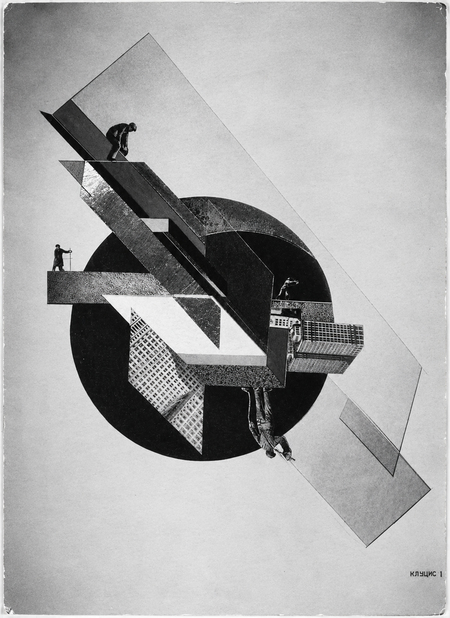
Since the advent of photography, the problem of montage has remained relevant: how to assemble a new statement from existing images. This challenge occupied both mass media and artists who sought a visual language for a new era. Among the authors of Russian photo-montage, El Lissitzky, Alexander Rodchenko, Varvara Stepanova, Gustav Klutsis, and Valentina Kulagina stand out, with their works leaving a significant mark on the history of visual culture.
This research aims to identify patterns and characteristics of photo montage across various stages, exploring its artistic and political significance.
Key question: Where did photomontage originate in Russia—in mass culture or in the artistic laboratory—and what happened to it after the avant-garde?
Hypothesis: Photomontage in Russia did not originate in an artistic laboratory, but in mass culture (postcards, popular prints, tailoring shops with «cut-out» heads). The 1920s avant-garde adopted it and transformed it into a language of agitation, after which the technique reentered official visual culture in the 1930s.
The term «photomontage» refers to the creation of a new image from elements of several photographs through cutting, pasting, and overlaying. Stepanova herself defined it in a 1928 essay as the assembly and combination of expressive elements from individual photographs.
This visual exploration covers the years 1905–1935, with an epilogue in 1938: moving from early-century mass postcards through laboratory experiments and the propaganda boom to state commissions of the 1930s.
It is notable that photomontage in these works serves not only an aesthetic but also a political function. Through the selection of scale, medium, and the ratio of photo to text, the artists compel the viewer to see the image not as a window into reality, but as an argument. The international context is illustrated by Hartfield’s address at a 1931 discussion: when debating who invented photomontage, he responded that the inventor was the social shift, not a person. awdee
The principle of rubrication: tracking the evolution of the phenomenon across different stages. The «Pre-Avant-garde» section showcases mass forms; the «Period of Flourishing» is divided into three comparative blocks (featuring four works from two artists, with the last two compared directly); and the «Post-Avant-garde» section illustrates the re-adoption of the technique for state commissions.
To the Avant-Garde
Before 1919, Russia featured mass imagery that combined pictures and words, though photomontage was not among them.
As early as 1905, the Singer Company released postcards stylized like lubok (Russian popular prints), featuring its trademark among the images. On the postcard from the «Russian Proverbs in Pictures» series, a sewing machine bearing the SINGER inscription stands at the center of the scene, and the proverb beneath the image functions as a moral lesson.
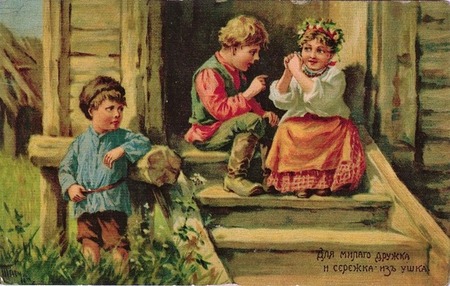
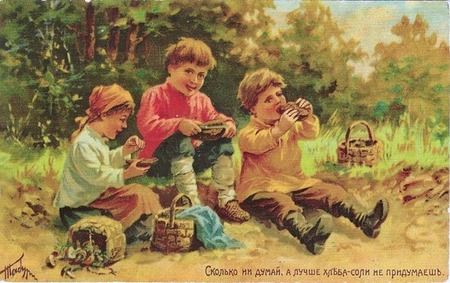
In 1914, the war gave rise to a wave of lithographs, postcards, and brochures, and Malevich and Mayakovsky attempted to revitalize the genre of the lithograph.
On Malevich’s sheet, there are flat, bright colors, a thick black outline, and a couplet at the bottom: a large woman in a red sundress carries on a stretcher a yellow Austrian soldier, and others advance beyond the mountains. While Singer postcards sell products, this sheet sells war and patriotic humor. Yet, the medium is the same: cheap, mass-produced, and designed for the masses.
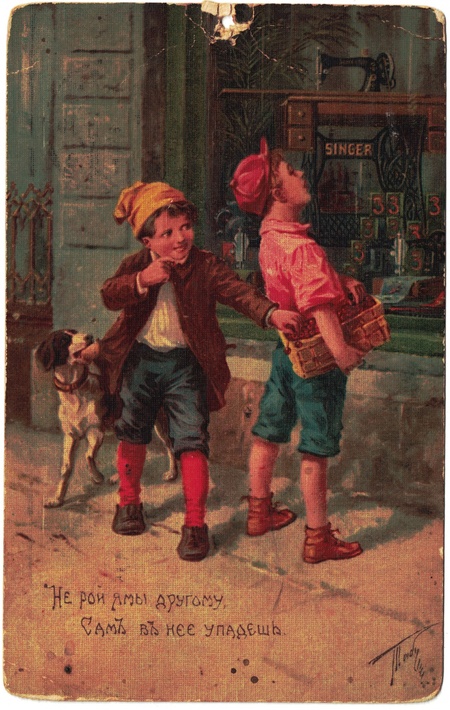
All four sheets are drawn, not photographic: there are no cutouts or photo collages on them. Mass printing in the early 20th century established a visual language based on inexpensive media, high circulation, and the combination of image and text. Nevertheless, all the sheets examined here are executed using graphic means, and the technique of photo collage is not employed.
It emerges in 1919 in the practice of the experimental artist.
Period of Flourishing
Laboratory: Photo-montage as Politics and Advertising
Photomontage emerges where artists seek a language for a new era, and the early works of Klutsis and Rodchenko begin from different points.
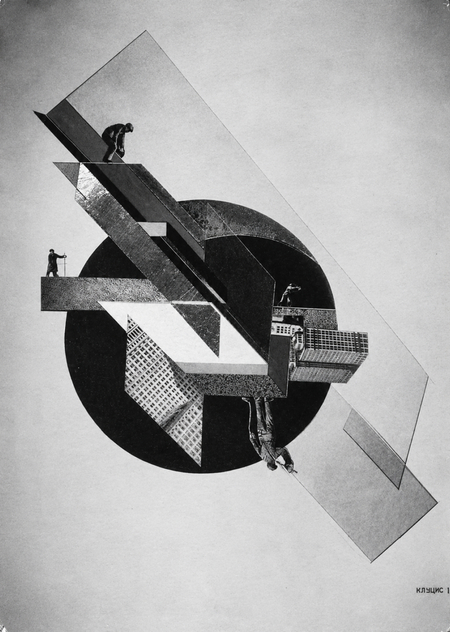
«Dynamic City» cannot yet be called pure photomontage—it is a transitional technique. The foundation here is painterly, continuing the work from 1918. Klucis overlays it with photographic fragments cut from print, adds foil, and refines the sheet with gouache and pencil. For him, photography is one material on par with paint; it functions as a constructive plane, not as a document.
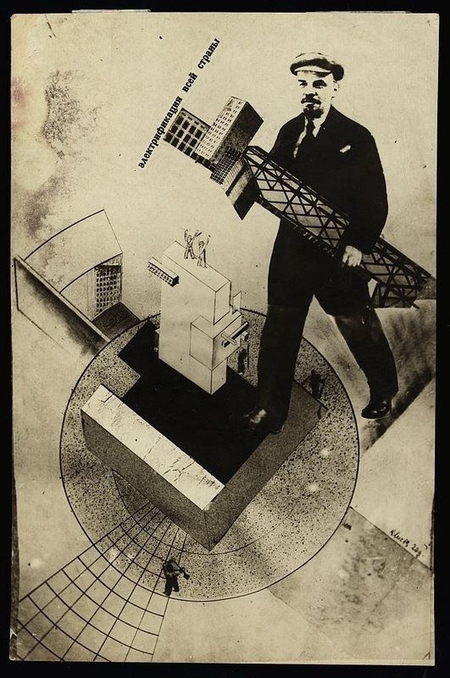
«Electrification of the Entire Country» is composed of glued fingerprints, printed and colored paper, gouache, ink, and pencil. Lenin is depicted as a silhouette against a red triangular banner, accompanied by his words, and the figure remains motionless, like a monument.
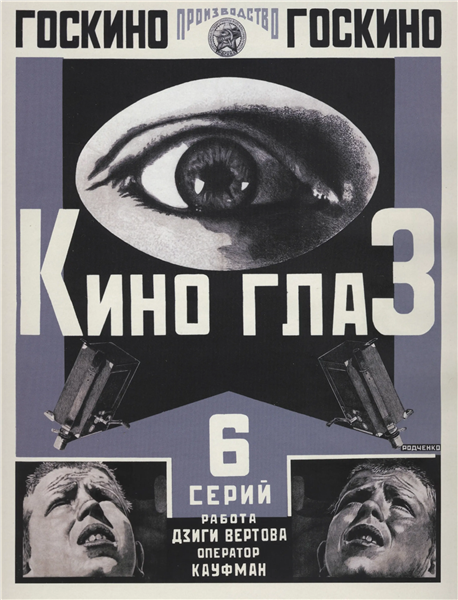
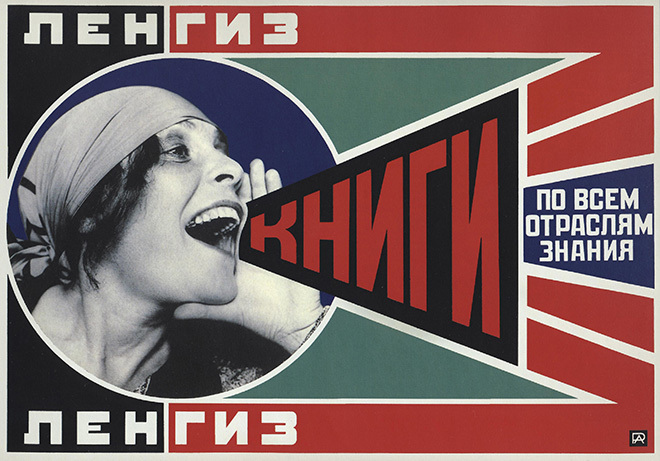
In Rodchenko’s poster, Lengiz’s photograph of a woman in profile is enclosed within a circle, her hand raised toward an open mouth. From the mouth, a black triangular megaphone radiates to the right, bearing the large red word «BOOKS.» The poster is mechanical and linear; there is no trace of the hand. Klutsis uses the triangle to convey the leader’s words, whereas in Rodchenko’s work, it emerges from a living woman and carries a commercial appeal: Klutsis creates a political manifesto, while Rodchenko creates an advertisement.