Navigation
Introduction
William Morris
Magdalena Abakanovich
Faik Ahmed
Alexandra Kehayoglu
Jan Kat
Comparative Analysis
Conclusion
References
Introduction
This visual research delves into contemporary carpet weaving and its connection to artisanal tradition. The starting point was an interest in the diversity of rug objects—their forms, textures, and methods of use. Why do artists and designers choose labor-intensive handmade techniques amidst mass industrial production? Comparing historical and modern examples allows us to examine the reasons behind this choice and understand the significance of manual labor across different artistic objectives.
Research Question
What attracts 21st-century artists to carpet weaving and braiding—manual techniques that require significant effort—when faster methods of working with textiles are available?
Research Objective
To determine what artistic possibilities carpet weaving and braiding offer artists across different eras, and what motivates them to preserve traditional techniques while changing the form and function of their works.
Hypothesis
The complexity of a craft can become its strength.
Handwork demands time and mastery. I hypothesize that these efforts are justified when the artist values the ability to personally select and combine materials. By working with these elements directly, the artist can experiment with different weaves and discover the form and texture that aligns with their concept. Another reason to choose a craft is the desire to create a one-of-a-kind piece or produce a small series.
Using the work of selected artists as an example, I want to investigate whether the complexity of the process always grants the artist an advantage, and what that advantage manifests as.
The Principle of Comparative Analysis
The study compares the works of five artists who engaged with handmade textile techniques under various historical conditions.
For each example, we examine the reasons for technique selection, the specifics of production, the role of craftsmanship, material handling, and the intended purpose of the finished piece.
The main criterion for comparison is what the manual process offers the artist and whether its complexity can be considered an advantage. It is crucial, however, to distinguish between manufacturing complexity and the artistic value of the result.
William Morris
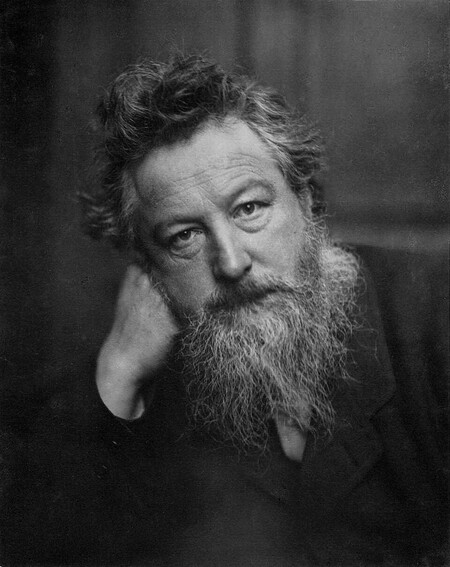
William Morris (1834–1896) was an English artist, designer, and poet, and one of the founders of the Arts and Crafts movement. He advocated for the revival of artisanal production, creating patterns for textiles and wallpapers, and designing rugs and tapestries, with a particular emphasis on material quality, masterful execution, and natural motifs. In his work, a hand-woven rug is viewed not merely as an interior design object, but as the culmination of an artistic vision and skilled craftwork.
In the latter half of the 19th century, the development of industrial production changed not only the methods of making objects but also the attitude toward manual labor.
For William Morris, a turn toward traditional crafts was linked to a critique of mass production, a desire to improve the quality of everyday items, and to enhance the working conditions of artisans.
He placed particular value on the craftsman’s involvement in the creation process and the connection between their work and the final result. At the same time, the Morris & Co. company produced both handmade goods and machine-made products. Morris’s appeal to hand-woven carpets was a deliberate artistic and social stance, not the only available method for manufacturing rugs.
«Do not keep in your homes anything that you do not consider useful or beautiful.»
Bullerswood Rug, c. 1889
Artist William Morris. Rug, Bullerswood, circa 1889. Dimensions—approximately 7,6 × 4 m. Wool, hand-knotted weaving. Metropolitan Museum, New York.
This rug was created for the home of Bullerswood, John Sanderson, a wool merchant from Kent. It was intended for practical use in residential interiors. The composition incorporates the characteristic botanical motifs of William Morris’s work: winding stems, leaves, and flowers. The repetition of ornamental elements established a rhythm, uniting the central field with the decorative border. The hand-woven technique allowed for a complex design and expressive texture on the pile surface.
Holland Park Carpet. Late 19th Century
Artist William Morris, England. Holland Park Carpet. Late 19th century design developed in 1883. Dimensions: 515,6×396.9 cm. Wool, hand-knotted pile rug. Metropolitan Museum, New York.
Hammersmith-style rugs were made by hand using knotting techniques. The design was created directly during the process of working with the colored yarns.
Little Tree Late 19th Century
1890. William Morris, England. «Little Tree.» Late 19th Century (design developed in the 1890s). Size: 287×128 cm. Wool, hand-knotted rug weaving. Metropolitan Museum, New York.
In the «Little Tree» rug, the plastic possibilities of hand-knot weaving allow for the rendition of the smooth curve of the stem and the pointed tip of the leaf. These fine details remain distinguishable even within the dense pattern where adjacent shoots almost touch.
In the latter half of the 20th century, artists' relationship with traditional textile techniques underwent a significant shift. While William Morris engaged with craft as a critique of industrial production, by the 1960s, artists began exploring the new expressive potential of textiles. Experimenting with materials, texture, and volume, they re-examined the boundaries between applied arts and sculpture.
Magdalena Abakanovich
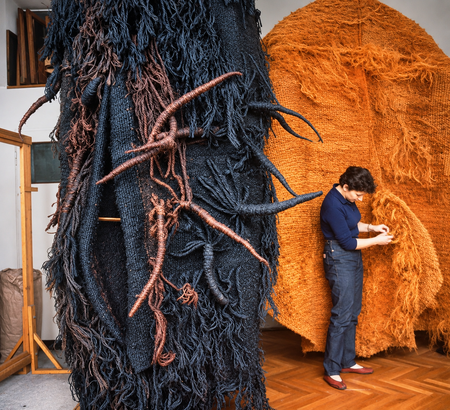
Magdalena Abakanowicz (1930–2017) was a Polish artist and sculptor, one of the key figures in the development of modern textile art. In the 1960s, she began creating large-scale woven objects known as «abakans.» These works transcended the boundaries of traditional wall hangings and assumed an independent, sculptural form. The artist used sisal, ropes, and other fibrous materials. Texture, folds, curves, and internal cavities became crucial means of artistic expression. The term «abakans» derives from the artist’s surname and refers to the three-dimensional textile works she created.
Photo of Magdalena Abakanowicz in her studio. The process of creating the abakans, late 1960s.
Red Abacus
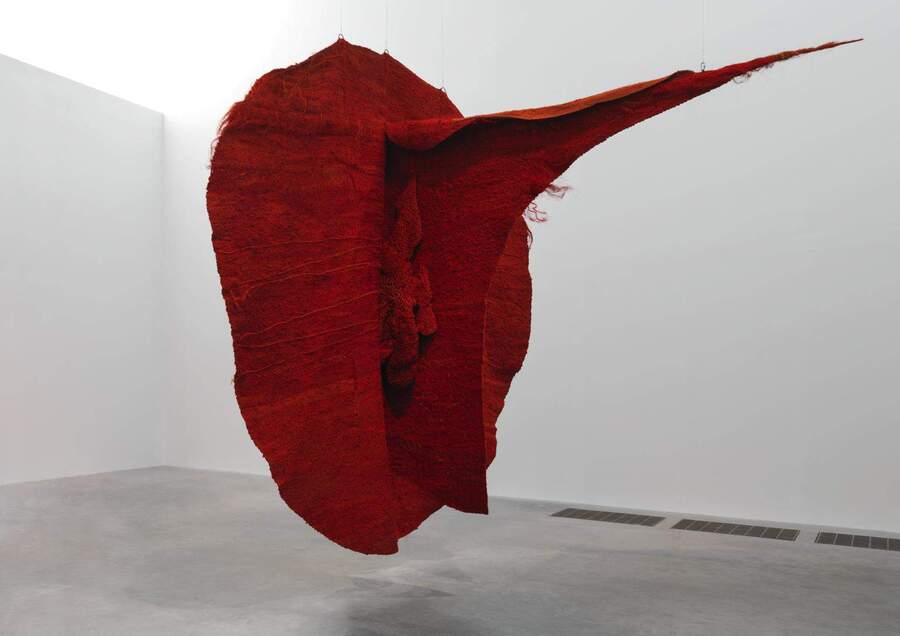
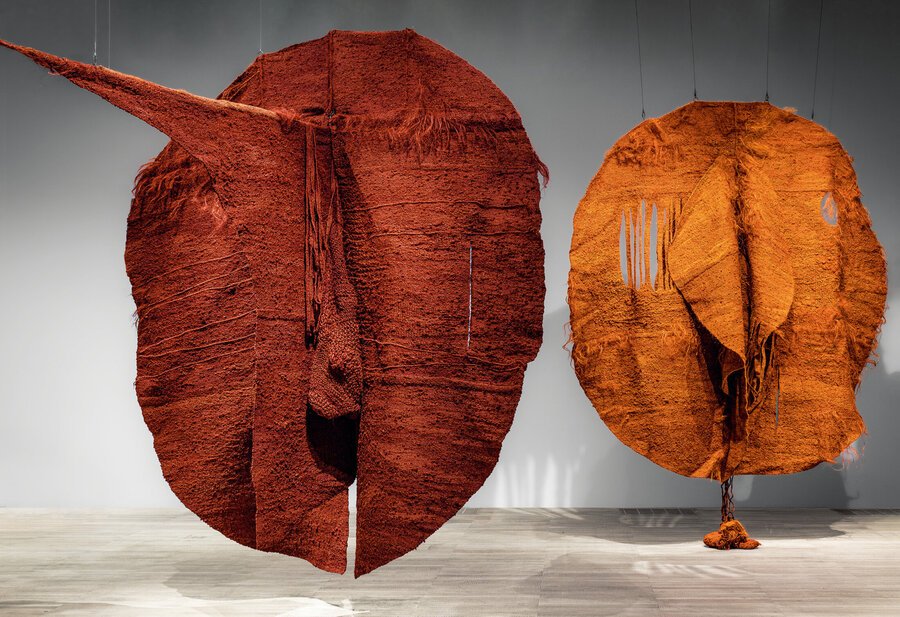
Magdalena Abakanowicz. «Red Abakan» (AbakanRed). Date: 1969. Dimensions: 405 × 382 × 400 cm. Material: sisal — vegetable fiber. Technique: hand weaving, shaping of a spatial textile structure. National Museum of Stockholm
Abakan was created during a period of active experimentation with textile art. In the 1960s, international biennials, such as those held in Lausanne, helped to revise the traditional notion of textile as a flat, decorative canvas. Abakanowicz used hand-weaving to create a large-scale, voluminous form. The fibrous structure of sisal, the uneven surface, and the folds lend the piece an expressive texture. Unlike a traditional rug, decorative ornament is absent here. The primary focus is on the material, the volume, and the interaction of the work with its surrounding space. Thus, hand-weaving becomes not merely a method of textile production, but also a means of creating an independent sculptural form.
Orange Abacus
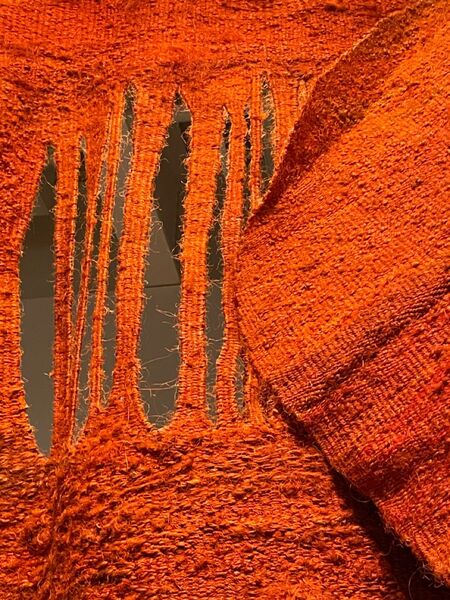
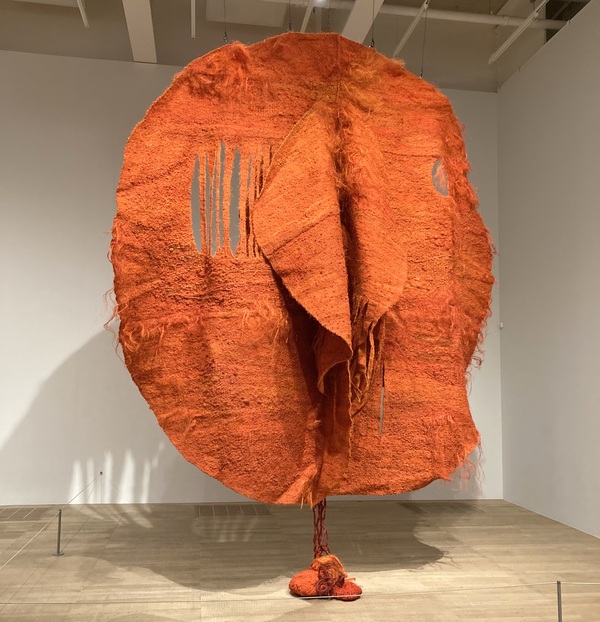
Magdalena Abakanovich. «Orange Abakan» (1971) Dimensions: 405 × 382 × 400 cm, Medium: hand-woven, spatial textile construction.
In this piece, Magdalena Abakanowicz continues to explore the spatial possibilities of textile. The large woven form, with its uneven edges, folds, and internal cavities, is perceived as an independent sculptural object. The varying density of the fiber weave creates a heterogeneous surface, and light and shadow emphasize its relief. Unlike a flat decorative canvas, the work is intended to be viewed from multiple perspectives. Its artistic expression is defined not by ornamentation, but by the relationship between material, form, and surrounding space. The connection to traditional craftsmanship is maintained through the technique of hand-weaving, although its purpose is fundamentally transformed.
Magdalena Abakanovich. Black, 1966. Dimensions: 300×180×60 cm. Technique: hand-woven piece from sisal on a metal support.