GLÄNTA: Furniture as a part of Communication Theory
Сommunication theory in the field of design.
Material, form, and visual language serve as signs that communicate meaning to the user in the context of design. A person interprets these signals when interacting with an object based on their cultural background and personal experiences. Because of this, design cannot be comprehended only in terms of functionality or aesthetics. It is always linked to the process of creating meaning and is part of a larger media landscape that shapes public perceptions of what a living area «should» look like.
Communication in design also develops through interactions between the participants of the process: the project team, the client, and user groups. Internal team communication, role distribution, and the way decisions are negotiated directly influence the final outcome. Collaboration with the client requires clarity, transparency, and sensitivity to expectations. User communities add an additional layer of meaning through reviews, shared experiences, and social interpretation, turning the product into part of a shared understanding rather than an isolated object.
A critical viewpoint emphasizes how design invariably conveys social norms, upholding some values while marginalizing others. Because of this, a brand and its visual identity should serve as channels for establishing dependable and stable relationships with audiences rather than as tools of manipulation.
Communication theory gives designers a conceptual vocabulary for explaining meaning, an awareness of the cultural ramifications of design choices, and an understanding of how messages are conveyed and understood. Therefore, design can be viewed as a method of influencing social values and user experience in addition to being a visual practice.
A general audience.
GLÄNTA — furniture that creates space, not just fills it
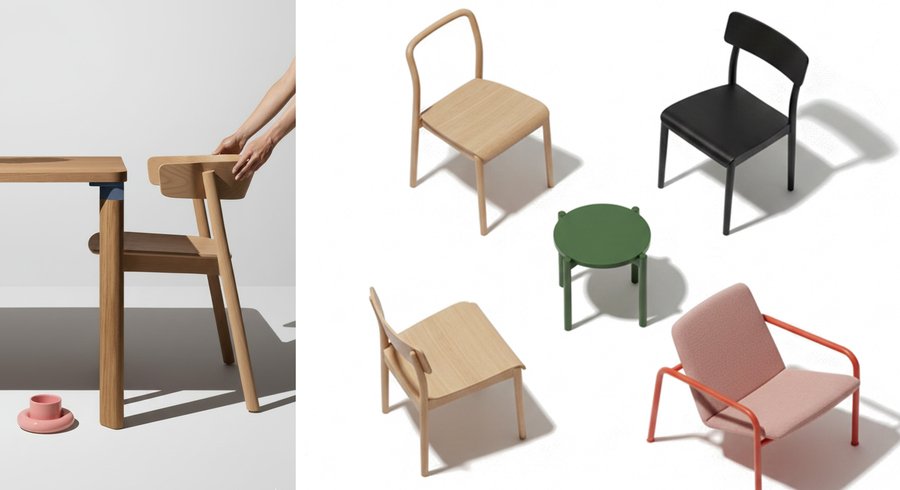
Proposed design for advertising banners
Our approach is simple: a home should not overwhelm you — it should support you.
That is why GLÄNTA creates furniture that brings a sense of ease:
- sofas that look balanced even in small rooms,
- tables that anchor the space without dominating it,
- storage that keeps things organized without visual clutter.
GLÄNTA helps you see your home in a new, clearer way.
Brand products
GLÄNTA is furniture created beyond standard catalog solutions. Each piece is designed specifically for the client’s home and lifestyle, contributing to a more open, comfortable, and balanced living space.
Materials from which the furniture will be made
GLÄNTA is defined by three qualities:
- Clean modern forms
- Calm and natural materials
- Carefully balanced proportions That’s what make the interior feel lighter and more organized.
We avoid unnecessary details because simple forms allow the interior to feel lighter and reduce visual noise.
The rest of the furniture range
Regular furniture is made to fit «the average home». GLÄNTA is designed to fit your exact space and daily routines.
Our sofas, tables, chairs, and storage systems:
- match your layout precisely
- support your everyday habits
- maintain order without looking heavy
- stay modern without demanding attention.
Design concept store of our furniture brand
GLÄNTA is chosen by people who: - prefer modern, calm furniture without excess decoration, - value order and visual clarity, - want functional design that remains aesthetic, - look for furniture that becomes part of their home rather than taking up space, - want to replace old furniture with thoughtful, long-lasting solutions.
Design concept store of our furniture brand
Furniture should support everyday life rather than demand attention. GLÄNTA creates pieces that organize space, maintain order, and contribute to a calm home environment.
The design approach is focused on comfort, spatial coherence, and personal relevance.
A professional audience.
GLÄNTA considers furniture as part of spatial communication within the interior environment. Each piece conveys visual, tactile, and functional signals that structure everyday use, shape perception, and influence the emotional atmosphere of the space.
Our customers can view our product range directly in our showrooms
Design Principles:
1. Semantic Clarity
Forms follow a calm, readable geometry. We avoid visual ambiguity and excess detail to reduce cognitive load and maintain clear interpretation.
2. Material Honesty
Textures and finishes are selected for their symbolic value: warmth, stability, calmness, or neutrality. Each material acts as a recognizable code in contemporary interiors.
3. Structural Efficiency
All constructions are designed to ensure stability, precise ergonomics, and reproducibility at production facilities.
Furniture communicates through: - proportion → creates hierarchy in the room, - volume → defines the boundaries of movement, - texture → sets emotional temperature, - color → affects depth and visual weight, - edge treatment and joints → signal craftsmanship and quality.
Our design language aims to produce low-noise, high legibility, and emotionally stable interiors.
Working with layouts and selecting shades
User-Centered Spatial Scenarios:
The design process begins with an analysis of circulation patterns, lighting conditions, behavioral routines, storage needs, and activities within the space.
Furniture is developed as part of functional scripts that define how a person sits, turns, reaches, rests, and interacts. The aim is to minimize friction in everyday movements and establish a coherent spatial rhythm.
The process of selecting fabrics
The process of manufactoring furniture at the factory
GLÄNTA solutions are developed as adaptable systems:
Adjustable dimensions for diverse layouts,
Modular storage blocks,
Unified geometry principles,
Compatibility across product categories,
Simplified detailing for efficient production.
As a result, GLÄNTA fits small apartments, open-plan interiors, and renovation scenarios.
For architects, designers, and furniture makers GLÄNTA provides:
- clear design logic and reproducible specifications,
- predictable communication with clients,
- ergonomic and aesthetic consistency,
- adaptable designs suitable for customization,
- reduced workload on conceptual and technical phases,
- alignment with contemporary demand for calm, functional interiors.
References to the catalogues
The design package includes detailed drawings with tolerance specifications, exploded diagrams, hardware recommendations, optimized panel layouts, and material lists aligned with local suppliers.
The location of our posters on the streets of the city
Corporate identity references
Advertising poster design
Advertising poster design
GLÄNTA’s visual code reflects the product philosophy through calm, low-contrast palettes, structured layouts, an emphasis on negative space, discreet typography, and rhythm based on modular grids. The identity remains deliberately restrained in order to keep attention on the furniture itself.
GLÄNTA functions as a design method that involves analyzing context, identifying user scenarios, translating them into spatial meaning, engineering reproducible solutions, and maintaining a consistent visual and conceptual identity.
Advertising poster design concept
GLÄNTA integrates several communication principles:
Encoding / Decoding — forms and materials deliver clear, controlled meanings to the user.
Cognitive Load Theory — simplicity of form ensures comfortable perception.
Audience-Centered Communication — furniture responds to real user needs rather than abstract design trends.
Framing — GLÄNTA positions furniture as «space-making».
Semiotic Minimalism — reduction of unnecessary signifiers to maintain consistency and clarity.
Parts of lectures used in the presentation.
- Communication as Meaning-Making
This part of the course shows that communication is not just sending information but also building shared meaning. This idea became the basis for the whole project because GLÄNTA furniture is not seen as a neutral object, but as something that gives meaning to the space. The idea that users actively interpret messages influenced the decision to focus on how furniture is perceived emotionally and symbolically, rather than only functionally.
2. Semiotics and Symbolic Communication
This section explains how signs, symbols, and visual codes operate in communication. It directly informed the development of GLÄNTA’s design language: form, material, texture, proportion, and color were treated as semiotic elements that communicate values such as calmness, clarity, and order. This theoretical block justified describing furniture as a semiotic system and explaining its visual language differently for general and professional audiences.
3. Encoding and Decoding
The concept of encoding and decoding was used to structure the project around different audiences. The same core meaning of the brand is encoded in two different ways: through accessible, everyday language for the general audience and through professional terminology for experts. This helped reduce misinterpretation and ensured that the message remains clear despite differences in background knowledge.
4. Audience-Centered Communication
Effective communication must be tailored to the audience’s experience, expectations, and skill level, according to this section of the course. It served as the theoretical justification for producing two distinct presentations rather than a single, all-encompassing one. While the professional presentation emphasizes structure, method, and reproducibility, the general audience presentation concentrates on lived experience and emotional clarity.
5. Framing Theory
According to framing theory, the way information is presented affects its meaning. Furniture is portrayed as something that creates and organizes space rather than something that fills it. This was used to define the core framework of the GLÄNTA brand. This frame directed the brand’s overall positioning as well as the presentations' narrative structure.
6. Narrative and Storytelling in Communication
The course emphasizes the importance of narrative in helping people comprehend complex information. Instead of framing furniture as separate objects, this idea was used to frame it as a part of everyday life scenarios. Professionals perceive narrative as structured user scenarios and spatial scripts, while the general public perceives it as relatable domestic situations.
7. Interpersonal and Group Communication
This section of the course describes how interactions between people and groups shape meaning. Through communication between the user, client, and designer communities, it shaped our understanding of furniture design. This provided justification for talking about how social interpretation, negotiation, and feedback affect how people ultimately perceive GLÄNTA furniture.
Calhoun C. Communication as Social Science (and More) // International Journal of Communication. 2011. Vol. 5. P. 1479–1496.
Craig R. T. Communication Theory as a Field // Communication Theory. 1999. Vol. 9, No. 2. P. 119–161. DOI: 10.1111/j.1468-2885.1999.tb00166.x.
Dias P. Motivations for Multi-screening: An Exploratory Study on Motivations and Gratifications // European Journal of Communication. 2016. Vol. 31, No. 4. Allison T. H., Davis B. C., Webb J. W., Short J. C. Persuasion in crowdfunding: An elaboration likelihood model of crowdfunding performance // Journal of Business Venturing. 2017. Vol. 32. P. 707–725. DOI: 10.1016/j.jbusvent.2017.09.002.
https://taktcph.com/ (дата обращения 10.12.2025);
https://design-milk.com/ (дата обращения 10.12.2025);
https://www.aesence.com/ (дата обращения 10.12.2025).
Generated by Nano Banana AI
Generated by Nano Banana AI
Generated by Nano Banana AI
Generated by Nano Banana AI
Generated by Nano Banana AI
Generated by Nano Banana AI
Generated by Ideogram
Generated by Ideogram
Generated by Ideogram
Generated by Ideogram
Generated by Ideogram
Generated by Ideogram
Generated by Chat GPT
Generated by Ideogram
Generated by Chat GPT
Generated by Chat GPT
Generated by Chat GPT
Generated by Ideogram