TABLE OF CONTENTS
- Research Concept
- Architecture and the Image of the Future
- The Future of Daily Life — «Star Wars»
- The City of Historical Layers — «Blade Runner»
- The Architecture of Empire — «Dune»
- The Palace as Spectacle — «Flash Gordon»
- The Arena and Society — «Rollerball»
- Comparative Analysis
- Conclusion
- References
CONCEPT
I was particularly drawn to how directors depicted future architecture in science fiction films from the 1970s and 1980s. While one might expect futuristic worlds to feature entirely new buildings and spaces, many films nonetheless showcase forms reminiscent of architecture from past eras. This similarity sometimes manifests in discrete details, and other times in the building’s overall shape, scale, or spatial organization. I chose this period because the majority of the science fiction films familiar to me fall within it. Upon closer examination, I noticed that past architectural styles appear in these films under vastly different circumstances—ranging from small residential settlements to enormous palaces and technological metropolises.
I became interested in understanding why filmmakers draw upon existing architectural forms when visualizing the future.
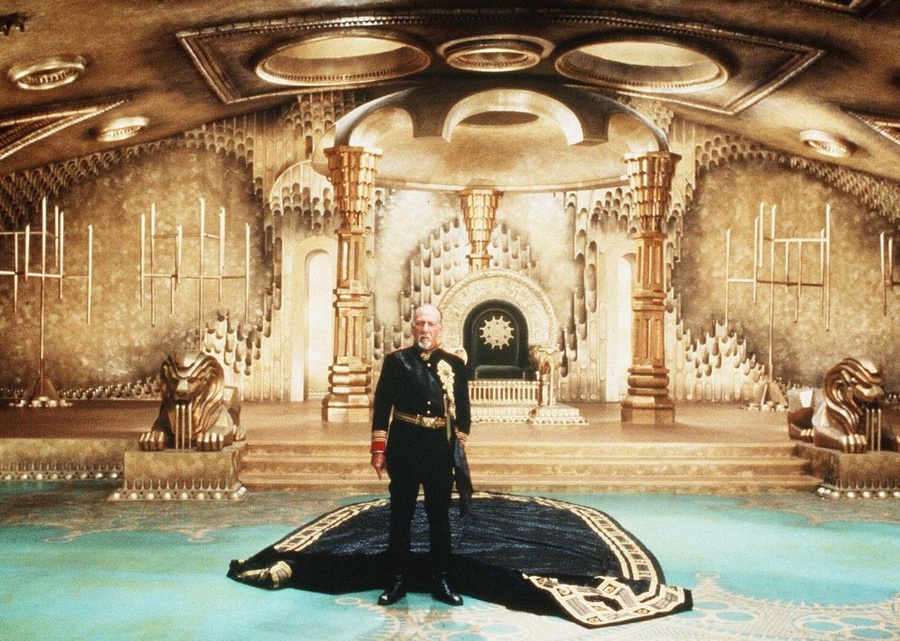
Interior of an imperial palace. A frame from the film Dune, directed by David Lynch, 1984.
My research focused on the architectural imagery in five science fiction films from the 1970s and 1980s connected to Hollywood cinema: «Star Wars: A New Hope» (1977), «Rollerball» (1975), «Flash Gordon» (1980), «Blade Runner» (1982), and «Dune» (1984). I am less interested in the science fiction architecture itself than in its resemblance to actual historical structures, architectural styles, and building construction principles. The central question of my research is why science fiction films utilize architectural forms from the past to depict the future and how those forms transform when transplanted into a fantastic world. I hypothesize that directors create fantastic architecture not solely through novel or unusual forms, but also through the transformation of existing architectural typologies. For example, the films feature stepped pyramids, symmetrical palace spaces, massive walls, and enclosed arenas.
Their fundamental forms and principles of spatial organization remain recognizable, but the scale, materials, and context change.
However, it seems to me that the architecture of the past retains not only the outward resemblance to historical structures but also some of their original meaning. Pyramids and palaces can underscore the power and status of rulers, arenas become venues for mass spectacles, and traditional dwellings continue to fulfill their customary function even in a fantastic world.
I want to check how consistently this pattern appears in the selected films and if there are any differences among them.
I structured the analytical part of my research around five films. In Star Wars, I examine the traditional architecture of desert settlements; in Blade Runner, I look at pyramidal structures and historic buildings; in Dune, monumental palaces; in Flash Gordon, the architecture of imperial residences; and in Rollerball, the resemblance between sports arenas and ancient structures. In each section, I compare frames from the films with real-world architectural landmarks, paying close attention to form, proportion, scale, and spatial organization. This will help determine which features of past architecture persist in fictional worlds and which have been altered. For my research, I also selected works on architecture in cinema and American science fiction: Film Architecture edited by Dietrich Neuman, Vivian Sobchack’s Screening Space, and J. P. Telott’s Science Fiction Film. These sources help explore architectural imagery within the context of film and American culture. Ultimately, I aim to understand why architecture from the past continues to appear in visions of the distant future and how significantly it influences the appearance of these fantastic worlds.
ARCHITECTURE AND THE IMAGE OF THE FUTURE
The architecture of Mos Eisley on the planet Tatooine. A scene from the film «Star Wars: Episode IV — A New Hope,» directed by George Lucas, 1977.
In science fiction films from the 1970s and 1980s, futuristic architecture often blends new technologies with forms reminiscent of past eras. Even in imagined worlds, one can see structures resembling ancient temples, palaces, pyramids, and traditional settlements.
However, these historical motifs are employed in varying ways. Some structures maintain nearly their original appearance, while others are noticeably altered by changes in scale, materials, and fantastic environments.
Using five films as examples, I will explore which architectural forms directors translate into the future and why those specific forms prove so appealing.
THE FUTURE OF DAILY LIFE — «STAR WARS»
The Lars family dwelling on the planet Tatooine. A scene from the film Star Wars: A New Hope, directed by George Lucas, 1977.
In «Star Wars,» the architecture of the planet Tatooine significantly diverges from conventional notions of the future. Instead of towering glass structures and complex constructions, the landscape features low-lying buildings with domed roofs, massive walls, and small openings. This architectural style is reminiscent of traditional settlements in the hot regions of North Africa. What is particularly fascinating is that in creating this fantastical world, the designers utilized not only sets but also actual architectural sites from Tunisia.
Traditional subterranean dwelling, now the Sidi Driss Hotel. Matmata, Tunisia. A historic architectural site used for filming «Star Wars.»
In Matmata, located in southern Tunisia, traditional underground dwellings are common. They are constructed around an open, sunken courtyard. From this courtyard, one can access living quarters carved directly into the surrounding earth. This layout helps protect the interior spaces from intense heat and sharp temperature fluctuations. One such complex, the Sidi Driss Hotel, was used during the filming of the Lars family home. It illustrates how architecture, which originated as a response to real climatic conditions, becomes part of a fantastical world almost unchanged.
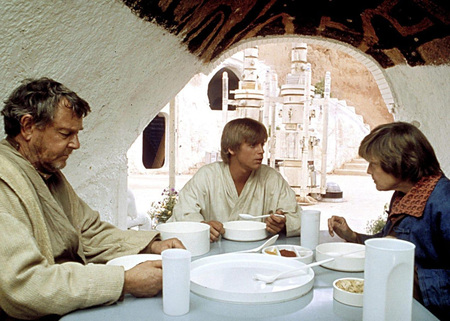
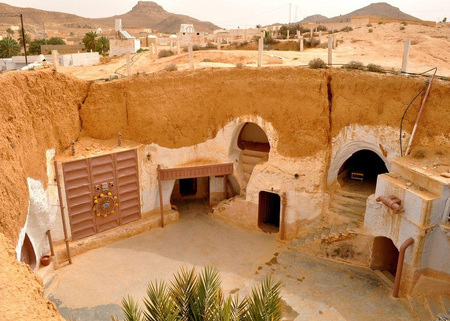
Lars Family Residence, 1977 — Underground courtyard of the Sidi Driss Hotel, Tunis
Architecture designed for desert life becomes architecture for life on another planet.
Upon comparison, one can notice that the film retains the core principle of traditional housing: rooms are arranged around an sunken, open courtyard. This spatial organization may look unusual for a fantasy world, yet it remains perfectly logical for a desert climate. In this instance, the director is not inventing an entirely new architectural type, but rather transplanting an existing solution into another reality.
CITY OF HISTORICAL LAYERS — «RUNNING ON THE BLADE»
Futuristic Los Angeles. A scene from Ridley Scott’s film «Blade Runner, ” 1982.
In «Blade Runner,» the future is not depicted as an entirely new city, but as a space where buildings from different eras merge. Amidst vast technological structures, one can see old architecture, and some futuristic buildings resemble ancient monuments. What is particularly interesting is that the past does not vanish with technological advancement here. It remains a part of the city, even as its architecture is given a new setting and sometimes an entirely different meaning.
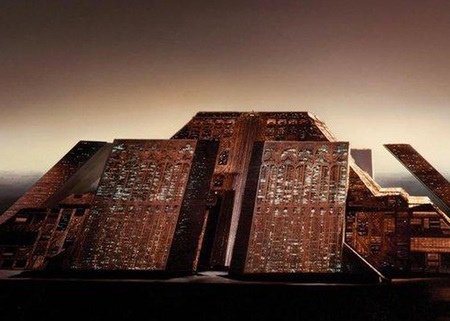
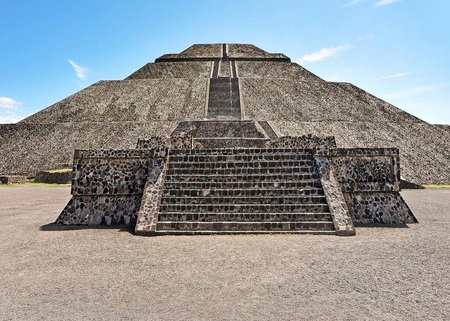
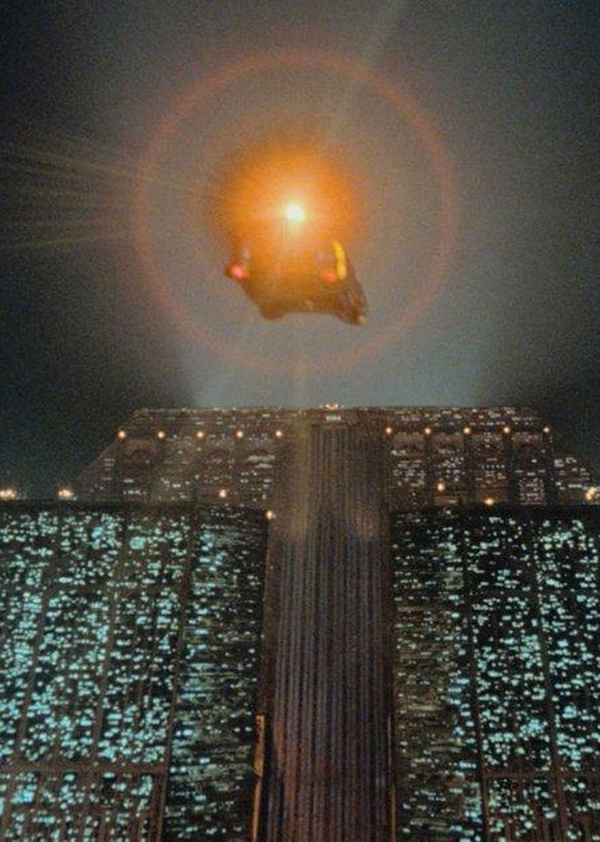
Tyrell Corporation Headquarters. A frame from the film Blade Runner, directed by Ridley Scott, 1982 — Pyramid of the Sun, Teotihuacan, Mexico. 1st–3rd centuries AD. Historical architectural analogue
One of the most striking structures in the film is the headquarters of the Tyrell Corporation. Its massive, stepped volume is reminiscent of ancient pyramids and ziggurats. However, instead of a stone surface, we see a vast technological building punctuated by countless lights. The British Film Institute (BFI) notes this resemblance, connecting the architectural form of the Tyrell headquarters to the monumental structures of ancient civilizations. In the past, such structures were associated with religious and political power. In the film, a similar form is used for the headquarters of the corporation that creates artificial humans. Thus, the architecture of an ancient center of power is transposed into a world of the future, where it becomes a symbol of technological might and the influence of large corporations.
Ancient monumental form transforms into the symbol of a technology corporation’s power.
Comparing the Sun Pyramid at Teotihuacan with the Tyrrell Corporation headquarters reveals common elements: a stepped silhouette, a broad base, and a gradual reduction in volume toward the apex. However, in the film, these principles are significantly magnified in scale and augmented with technological elements. The ancient form becomes part of a modern metropolis, retaining a sense of monumentality and inaccessibility.
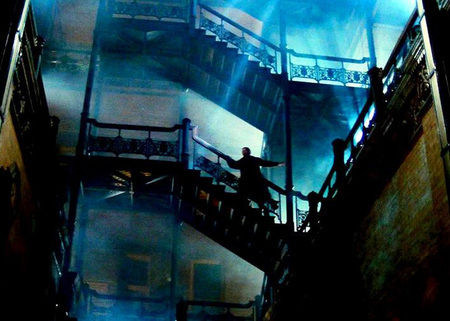
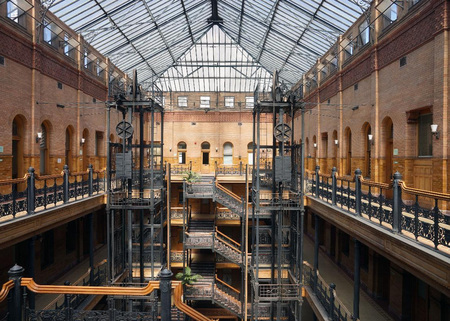
Bradbury Building interior from Ridley Scott’s film Blade Runner, 1982 — Bradbury Building, Los Angeles, USA. Architect George Wyman, 1893. Central atrium interior