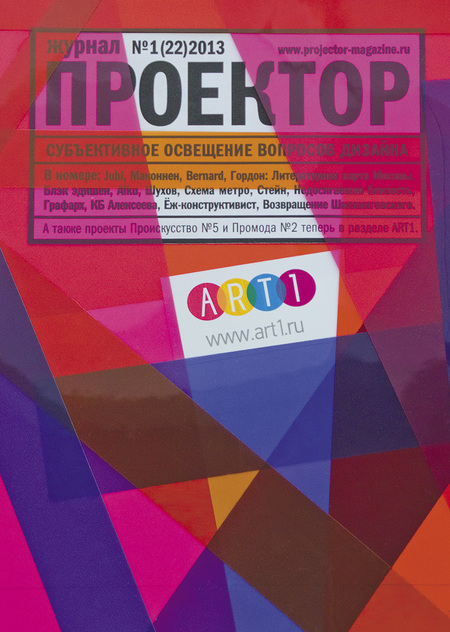
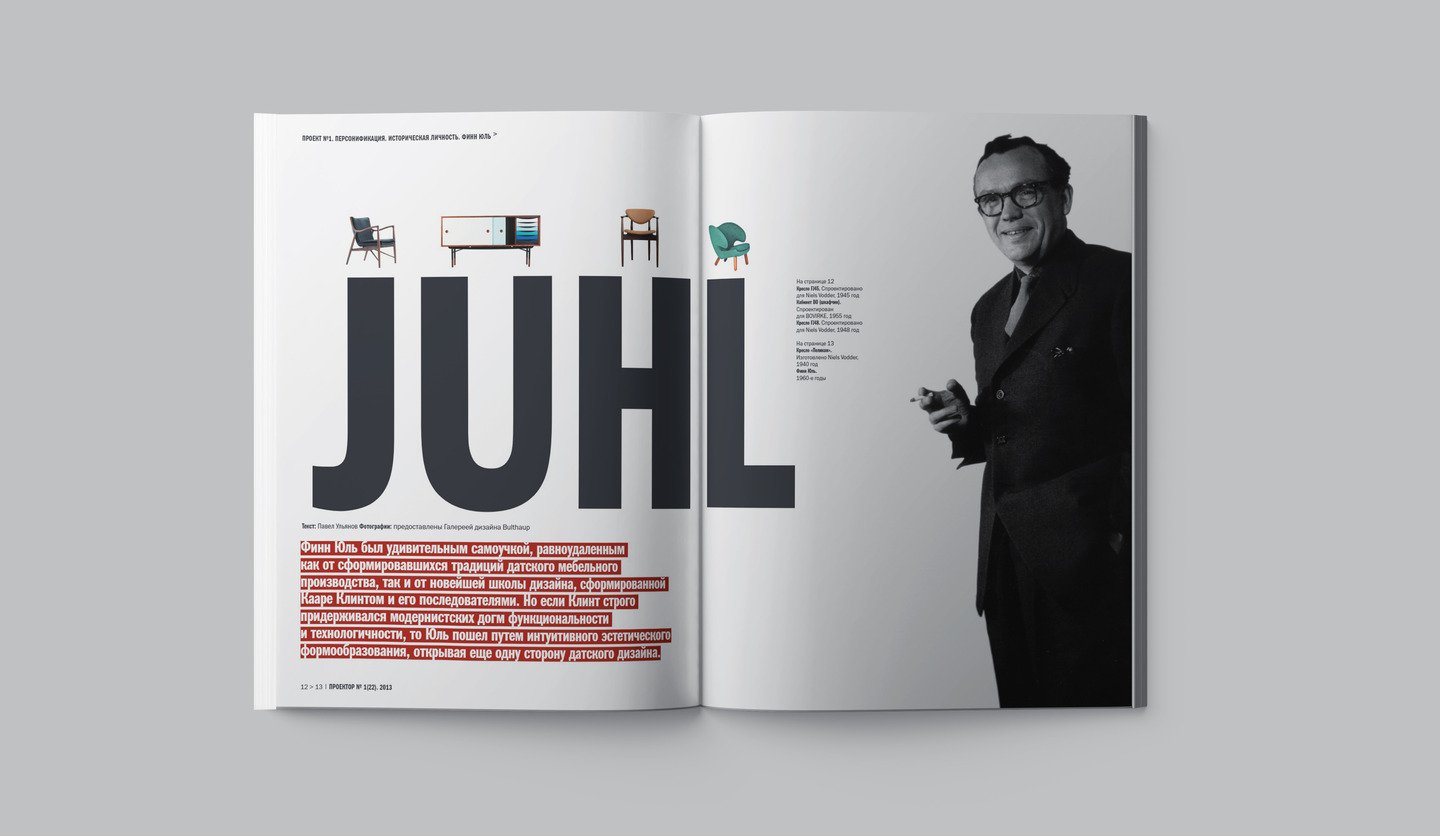
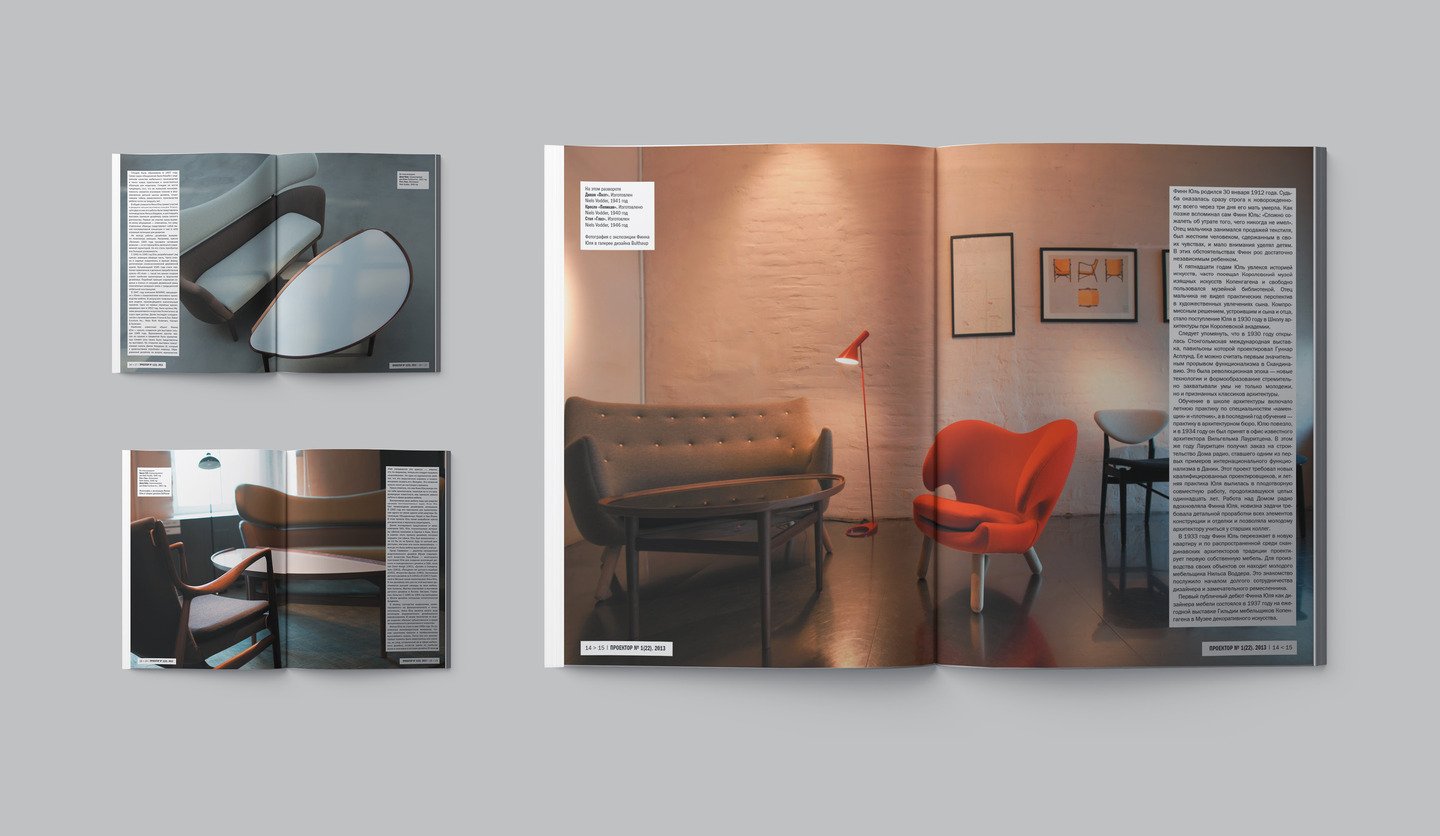
The historical column features Finn Juhl (still a Dane, despite his name). Our expert Pavel Ulyanov talks about his life and work: «Finn Juhl, an extraordinary self-learner, was same far from both contemporary design school made by Kaare Klint’s associates and students, and the craft traditions in Danish furniture making. He chose the path of intuitive aesthetic form making, thus discovering yet another side of Danish design».
Section #1 «Personification» is going on with a great interview given to Projector by the wonderful graphic designer and poster artist Dmitry Makonnen: «I would never stop making posters. Perhaps, I could find more time to sleep I’ve been deprived of for many years. I want to implement the object exhibition and see how it is wanted. And if it turns out not to be, I’ll then forget about art. I still want to publish a lot of things. When I was a singer in different groups, I wrote numerous songs and experimented a lot. I even think that I became well-versed on poetry. I’d like to publish poetry — both new poets and old masters».
Section #3 «Lettering» starts with the interview given by the French wizard Tomas Bernard, the person, who does something miraculous with letters. «I allow myself to think as much time as I need to invent something experimental. On the other hand, I have to be very efficient at applied design job, so as not to lose even a second of the precious time. For example, saving a file on your computer may take a few minutes! Some lose these minutes surfing blogs, websites, Facebook. I prefer to spend them on another project of mine. If I calculate these moments at the end of the week at the agency, it comes out they allow me to push almost two working weeks into one, without any rush job at night».
Section #4 «Object» continues the LightMusic series: «The co-project with Artlight in all respects fits my favourite concept of redesigning objects of a rich life experience. Each item we come across is unique and has its own personality. Old musical instruments, not suitable for sound extraction, become interior design objects and take on a new function, while their original shape is maximally preserved».
Next comes the story of the Finnish desk Alku — the item which seems quite innocent only at first sight: «The Alku desk is distinguished by charisma of its architectural structure, in which the technical design elements are the key factors forming the aesthetics of the object».
Section #5 «Environment» opens with a historical publication about the outstanding engineer and inventor Vladimir Shukhov: «Shukhov’s name is connected with all the major construction works of the first five-year plan: Kuznetskstroy, Magnitogorsk, Chelyabinsk Tractor Plant, the first cross-country pipelines. In 1927-1929, Shukhov participated in the implementation of the electrification plan. Same time he got over next height restrictions, this time for the power lines. According to his project, three pairs of hyperboloid towers over the Oka River in Dzerzhinsk district in the region of Nizhny Novgorod were constructed».
Section #7 «Photography» shares the works by Vadim Stein. Vadim told us how it all started, and what’s going on in his work today: «The story began long ago when I was still at the Restoration School, and took up classes of amateur pantomime. After that, the group developed into a professional theatre, where I worked for seven years — the Plastique Drama Theatre. By the way, this is also where I learned to manage the light. I mean, I started doing this it in the theatre, not in the studio. And now my wife is a dancer. My latest approach to photography was four years long, and she was my only model for a couple of them».
In section #8 «School» I am happy to share the remarkable works by the students of the winter intensive class at British Higher School of Art and Design: «At every final review of the works, I choose the best one. In my subjective opinion, Yana Popovich has won a slight advantage over her colleagues. In a very quick-witted manner, she simulaed the design method used by the authors of the vernacular lettering by taking the two modules — the round one from the bottom of a paper cup and the rectangular — of a duct tape width».
Next, Sergey Helmyanov, the researcher and chronicler of Soviet design school, talks about the Construction bureau of Rostislav Alexeev: «In the 1950s, a special design bureau for hydrofoils was set up in the town of Gorkiy. The revolution in the understanding of what a ship is as a means of transport, took place, as usual, at the „storm front“ between the demands of the society and the brutal, inertial system of the state. SEC was not a boat in the traditional view. In many ways, it was almost a plane. That’s why the newly created Bureau welcomed the graduates from both shipbuilding and aviation faculties».
Next, there’s a story about a remarkable book dedicated to the works by Pavel Shillingovsky, published Ildar Galeev, an educator and gallery owner in Moscow. Andrey Kharshak, the co-author of the book, puts it under a microscope, draws historical parallels between the current issue and the one of 1926 and speaks of Shillingovsky: «There was the portrait of L.D.Trotsky placed on the forty-fifth page of the Kazan edition, for which the author was awarded with the prize at the II All-Russian competition. But the fate of Trotsky influenced his images. I’ve handled five of the five hundred copies of the book, including the first and second ones, and in each of them the page with his portrait had been neatly cut out».
The section has four publications. Alexander Florensky talks about how he illustrated the book by Boris Grebenshchikov Ivan and Danilo: «We gathered a large company in Malaya Konyushennaya street at Borya’s, started drinking, reading and drawing. I drew a lot of pictures, but then got tired, and the process followed past practices: everybody got happily drunk, red wine was spilt onto some images, Borya finished reading, and I (that’s the moment I remember very clearly for some reason!) began to try to play Borya’s new twelve-string guitar and sing a ditty „How at the station Lanskaya I was given a blody nose with a plank“.
The special section «ProFashion» is this time dedicated to an interseasonal event. Between the autumn and spring fashion weeks not only is AFWR preparing for the upcoming big event, but also pleasing fashionistas with more intimate, but not less interesting ideas. February is no exception — the well-known journalist and fashion critic Diane Pernet has visited St.Petersburg. She brought a festival of shorties about fashion ASVOFF (A Shaded View on Fashion Film). We took a brief interview with her.